
An AI agent buying a weather forecast can pay in a dollar stablecoin while the seller receives an ordinary bank payout. Another agent could buy the same service through a card account. A bank's institutional customer might move a tokenized deposit instead. The software's ability to send money tells us surprisingly little about the claim the recipient ends up holding.
That distinction is becoming practical. In March 2026, Stripe and Tempo introduced the Machine Payments Protocol, supporting programmatic payments across stablecoins and conventional payment methods. In June, Mastercard announced Agent Pay for Machines, describing settlement across cards, accounts and stablecoins. AI agent payments are developing across several forms of money at once. Stripe's MPP announcement, Mastercard's launch
The change creates an opportunity for businesses selling small units of useful work: one data lookup, a short computation, a few minutes of access. It also moves decisions about payment costs, currency exposure and recovery into software that may make thousands of purchases while its owner is doing something else.
Our view is that the most consequential competition will concern who sets those decisions. A system can optimize for its owner's completed task, or for the payment provider's preferred currency and network. Both might appear to the user as a simple instruction: "Pay for it."
This is the second article in our series on money and AI agents. Part one examines agent purchasing and the card networks. Here we follow the money itself, including what happens when someone needs it back.
Different claims can share the same dollar label
Conventional bank balances are already digital. A card is a means of accessing a payment arrangement, potentially including credit; it is not a separate currency. Changing the interface from a checkout page to an agent does not, by itself, change the underlying dollar or euro obligation.
A fiat-backed stablecoin adds an issuer and its redemption terms. Circle describes USDC and EURC as backed by liquid reserves held separately from its operating money, with weekly reserve disclosures and monthly external assurance for USDC. Those arrangements support confidence in redemption. They do not make every wallet balance equivalent to an immediately spendable bank deposit in every country. Circle's reserve disclosures
A tokenized bank deposit remains a claim on a bank, represented on programmable infrastructure. J.P. Morgan describes its USD JPM Coin product on Base as commercial bank money for vetted counterparties, convertible through its Blockchain Deposit Account framework. Access to a public blockchain does not mean any consumer can open the required banking relationship. JPM Coin product description
Volatile cryptoassets introduce a different budgeting problem: their market value can change against the currency in which the business earns revenue or pays expenses. A tokenized fund share introduces investment ownership and redemption conditions. Neither becomes cash simply because the same wallet interface displays it beside a stablecoin.
The practical question for an agent is therefore more specific than "Do you support crypto?" It must identify the asset, issuer, network and acceptable recipient, then establish how the resulting balance can satisfy the next obligation. A company that owes wages in euros has not finished that job by receiving a dollar-denominated token.
Why more payment choices are arriving now
Machine payments reduce the need to interrupt a task for a human to register, select a subscription and enter billing details. Under MPP, a service can request payment as part of a software interaction. Stripe says receipts flow through its existing payment infrastructure, with funds entering the merchant's balance and following its standard payout schedule. The agent's fast purchase and the merchant's bank payout remain distinct events. How MPP works
Coinbase's March 18 expansion of x402 widened support to ERC-20 tokens and introduced gas sponsorship mechanisms. This lets an intermediary handle blockchain transaction fees that users would otherwise need to fund themselves. It broadens the assets developers can accept; a merchant still has to choose which assets and networks it actually supports. "Gasless" describes the payer's experience, while another participant covers the cost. Coinbase's x402 update
Mastercard's June announcement also describes programmable authorization rules and spending limits. Its list of participating companies includes both conventional payments firms and crypto businesses. The announcement establishes a service and a development effort around shared rules; it does not establish universal availability at every merchant or prove the economics of high-volume machine commerce. Agent Pay for Machines
These developments support a useful possibility: a business can sell through an agent-friendly interface without requiring every buyer and supplier to adopt the same financial arrangement. The difficult work moves into the connections between those arrangements.
Follow one purchase all the way through
Consider a hypothetical European logistics company whose agent needs fresh weather data from a US supplier. This is an illustrative workflow, not a deployment we tested. The company gives the agent a daily euro budget and permits purchases from approved data providers.
The agent finds a dollar price. Before paying, the business needs an answer to several ordinary purchasing questions: Is this the right forecast? Does the quoted price cover the intended use? Can the supplier deliver within the deadline? A valid payment credential answers none of them.
Suppose the supplier accepts both a card payment and USDC. The company already has a card arrangement, while using USDC would require funding a wallet. The comparison must include that funding step, conversion into dollars, the service provider's charges and the handling of any unused balance. A low blockchain transfer fee can be a small part of the completed purchase.
Now change the circumstances. The company already holds an approved stablecoin balance and regularly buys from the supplier. Funding costs can be spread across many purchases, and immediate transfer may help the supplier release data without extending credit. The same route can become more attractive without any change to the token's technology.
Or the supplier may prefer to receive local currency through a processor. Stripe's stablecoin documentation describes that arrangement, with completed payments settling into its merchant balance in local currency. Its acceptance availability is narrower than worldwide customer reach: the documentation lists US availability and private previews in other regions. A seller's eligibility has to be checked before designing the workflow. Stripe's stablecoin payment documentation
The economic unit worth comparing is the successfully delivered forecast, recorded and paid for in a form both sides can use. This requires measuring the full route against the company's existing billing or bank arrangement, including the time employees spend resolving exceptions.
The exit can matter more than the transfer
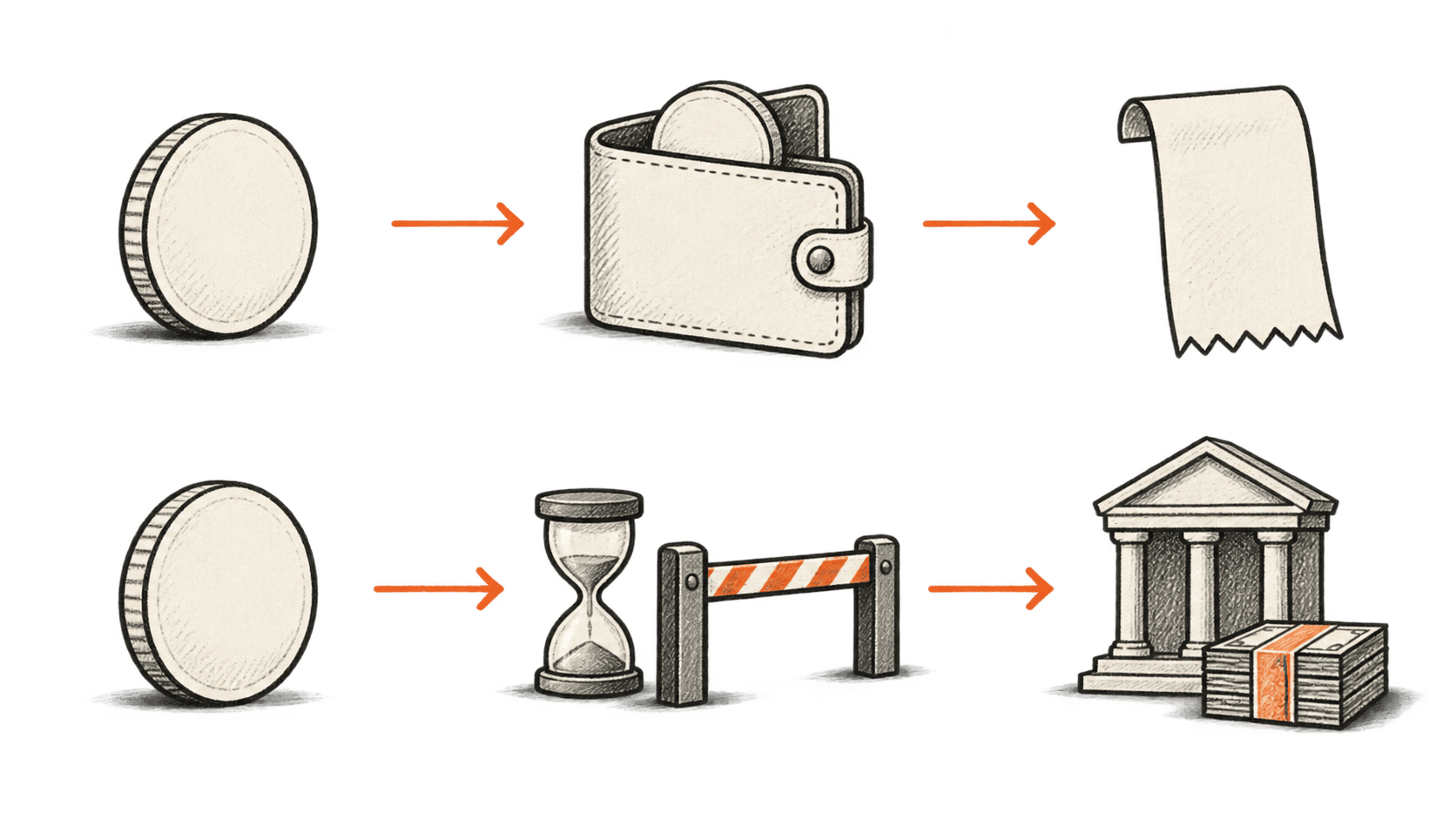
Stablecoin payments are especially promising when the recipient wants to retain or reuse the token. Someone who needs a bank balance instead depends on redemption, exchange liquidity or a payment provider's conversion service.
Circle's EEA redemption policy, updated September 15, makes the distinction concrete. It recognizes redemption at par, subject to its conditions. Retail holders using its direct process must pass identity and transaction checks and provide suitable bank details. The stated process should take no more than five business days unless discrepancies arise; the policy separately provides for delays during defined stress events. This is a particular redemption route, not a claim that every USDC sale takes five days. Circle's EEA redemption policy
Commercial terms differ too. Circle's Mint fee schedule effective March 15 distinguishes processing tiers and includes charges connected to redemption flows. Near-instant processing and a slower basic tier have different economics. "One dollar backing one token" does not describe the complete price and timing of moving into a bank account. Circle Mint redemption structure
PayPal announced a PYUSD expansion to 70 markets in March, including conversion into local currency when withdrawing. Its announcement also specifies local variations and business-only availability in Singapore. The distribution is significant because an existing financial interface can make a token useful to people who would never manage a standalone crypto wallet. Actual fees and eligibility still belong in the route comparison. PayPal's expansion announcement
Ripple's March payments expansion similarly combines collection, custody and conversion across traditional money and stablecoins. That is a provider's account of its offering, not independent proof that every corridor is cheaper. It illustrates why a business may buy a service that hides the settlement asset while still depending on the provider's liquidity and compliance operations. Ripple Payments expansion
For our hypothetical logistics company, a dollar peg also leaves euro-dollar exposure. The token can hold its dollar value perfectly while the euro cost of replenishing the wallet changes. A refund received later can have a different euro value. Treasury policy should specify who accepts that exposure and when conversion happens.
A completed transfer can leave an unfinished dispute
Return to the forecast. The agent pays successfully, but receives stale data. The ledger can prove that value moved; deciding whether the supplier delivered what it promised requires a separate commercial process.
Stripe's stablecoin documentation supplies a useful example: it supports full and partial refunds to the original wallet, while listing no dispute support. A merchant's ability to send money back differs from a buyer's ability to challenge a transaction through a payment scheme. Neither refund handling nor contractual recourse should be inferred from the word "stablecoin." Stripe's refund and dispute terms
An agent owner therefore needs recovery rules before allowing a new route. Who receives the complaint? What evidence identifies the purchased service? Does the original wallet still exist? How long can the buyer wait for a response? For a tiny purchase, pursuing a refund may cost more than the payment. Repeated failures across many agents can nevertheless become a material expense.
Implementation also matters. A July research preprint examining x402 facilitators found authorization and execution weaknesses in the systems it tested and reports that affected parties adopted mitigations. This is evidence of specific studied implementations, not proof that all current x402 transactions are unsafe. It shows why the intermediary translating a payment request into settlement deserves scrutiny. The original x402 security study
Our hypothetical buyer should also handle retries deliberately. If the forecast response times out, paying again before checking the first purchase can create a duplicate charge. The application needs a persistent purchase record, a way to verify delivery and an exception path. Faster settlement makes that bookkeeping more urgent.
Choosing the money is a delegated financial decision
An agent allowed to choose a supplier need not be allowed to change currencies, open a new wallet or move balances between issuers. Those actions create exposures beyond the original purchase.
In the logistics example, a sensible design would separate proposing a payment from releasing funds. The company could permit small purchases from known providers, set an aggregate daily ceiling and require approval for a new asset or unfamiliar recipient. These are design choices, not a description of a universal standard already in place. The payment system must enforce the limits even when the agent forgets an instruction.
A recent product announcement shows how restrained delegation can look. Ripple said on September 10 that its expanded GSmart treasury agents propose actions, cite relevant policy and wait for approval. It separates financial calculation from AI interpretation, with treasury teams retaining authority over financial actions. This describes the vendor's product design; its effectiveness remains something customers must assess. Ripple's GSmart announcement
The optimistic possibility is practical. Software could make approved payment options easier to compare, reduce idle prefunding and help smaller suppliers sell individual services without negotiating a full enterprise contract. Those gains depend on repeatable economics and manageable exceptions. They should appear in cost per completed purchase, usable funds received and time spent on recovery.
The pessimistic possibility is equally concrete. An agent platform could steer customers toward its own balance or issuer, presenting a low transfer fee while leaving conversion and withdrawal costs elsewhere. Fragmented balances could multiply across networks. An owner might discover that a convenient route has weak recovery options only after a supplier fails.
The BIS's August assessment reinforces the interoperability concern. It argues that stablecoins on different networks can remain difficult to exchange, while acknowledging that tokenized bank deposits also lack a mature interoperable ecosystem. Its preference for a system anchored in central bank money is a policy position, not a declaration that bank tokenization has already solved the problem. BIS assessment
For fintech builders, the useful contribution is evidence about the entire obligation: which customers could use the route, what they paid in, what the recipient could spend, and how failed purchases were resolved. A demonstration that ends at a successful transfer leaves readers without the information needed to judge the business.
Part three follows the question into tokenized assets: what changes when software can move an investment or collateral position as easily as it can request a payment, and which ownership rights still depend on institutions outside the ledger.