Repeated visual patterns can make stereo cameras and AI depth models place objects at the wrong distance, a University of Florida-led team reports. In controlled experiments, cameras on a moving ground robot and a car produced false obstacle estimates that persisted long enough to meet a response threshold cited by the researchers for autonomous driving software.
The study, posted on arXiv on September 14, connects those errors to how cameras turn light into pixels and align their two views. It also tests a software defense. For people developing or evaluating autonomous systems, the useful finding is a specific failure mechanism that survives in learned depth models, alongside evidence of how it can be reduced.
The big change
- What changed: The researchers connect ambiguity in repeated visual patterns to measurable camera artifacts, then show depth errors in conventional stereo matching and learned models. Replacing a matching algorithm with AI did not remove the weakness in the systems tested.
- Why it matters: Distance estimates feed obstacle detection. In these experiments, a van beside the driving path could produce a perceived obstacle within it. That makes the reliability of the depth estimate relevant to the vehicle's next decision.
- What to watch: The proposed defense checks the matching process for repetition. Its promising results cover limited image sets; reliability across other cameras, models and operating conditions remains the practical question for adoption.
How repetition changes the distance estimate
A stereo camera uses two views of the same scene. Software finds a feature in each image and measures its horizontal displacement, called disparity. The camera's geometry converts that displacement into a distance.
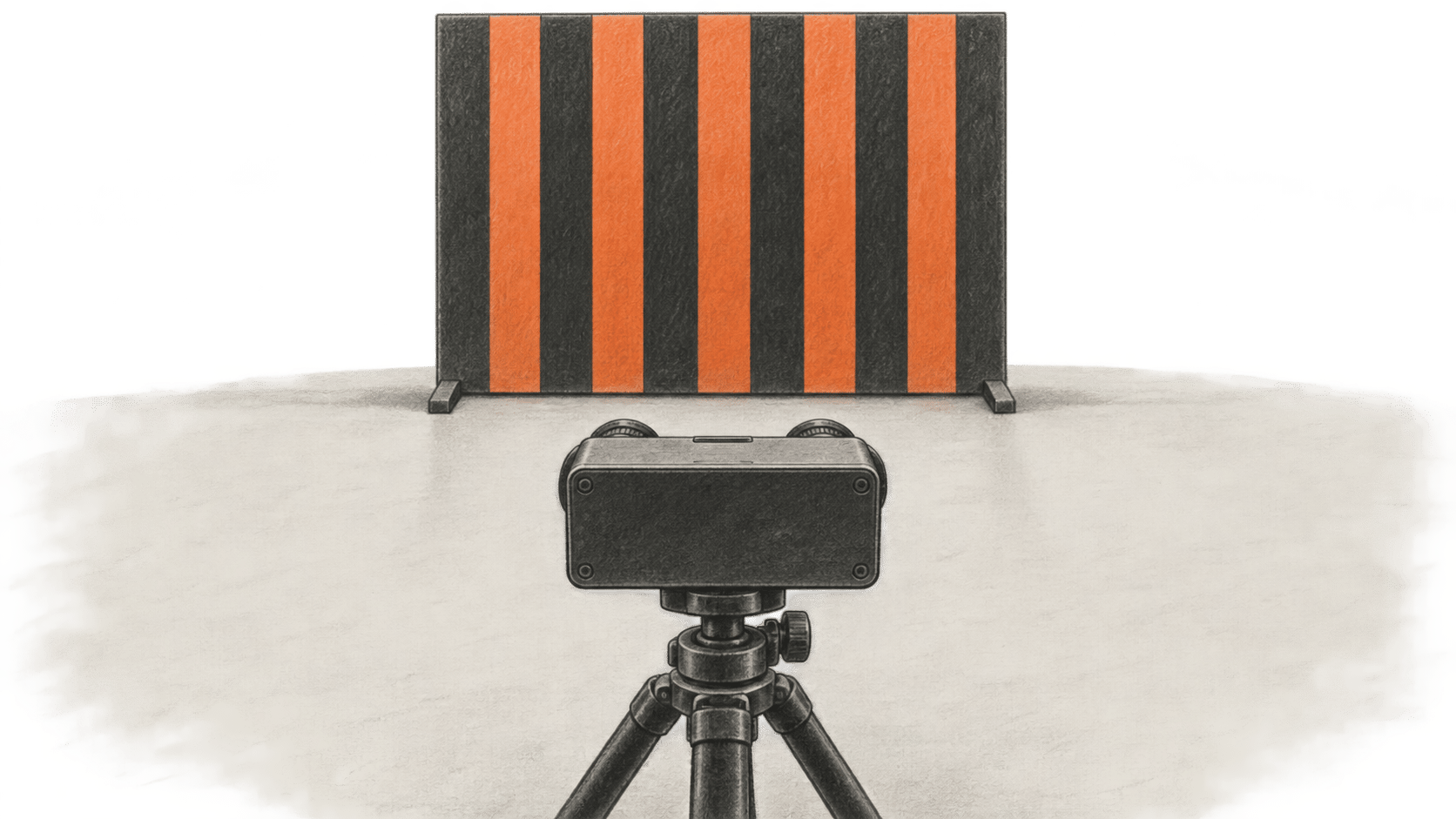
A repeating pattern creates several plausible matches. The paper's analysis identifies two ways the wrong match can win. First, each camera samples the scene onto a pixel grid. The boundary between a dark shape and a bright background can fall differently across the two grids, producing slightly different pixel intensities. Second, residual calibration errors distort the correspondence between the images.
Together, those effects can make a different repetition resemble the reference more closely than the correct one. The resulting displacement puts the surface at the wrong distance. The team also found this sensitivity in learned stereo models, which compare features extracted from the images.
These were deliberately selected patterns. The study's threat model assumes knowledge of the camera and relevant processing settings, or access to a comparable system for evaluation. In UF's account of the research, dated September 22, research lead Sara Rampazzi also identifies naturally occurring repetition as a safety concern. The study does not measure how often ordinary roadside textures cause dangerous errors in deployed vehicles.
The tests covered different parts of the perception system
The researchers combined experiments on recorded images, physical camera measurements and simulations.
Evaluation | Systems and conditions | What it measured |
|---|---|---|
Modified driving images | Patterns overlaid on 7,518 KITTI stereo image pairs; BM and SGBM matching algorithms, plus PSMNet, MoCha-Stereo and UniMatch | Changes in estimated depth across conventional and learned methods |
Stereo and LiDAR fusion | SGM-DDC, with a synthesized LiDAR point cloud representing a flat wall | Whether this fusion method resisted the pattern-induced error |
Physical camera tests | ZED2 and RealSense cameras, indoors and outdoors | Depth errors from displayed or projected patterns |
Physical motion | Cameras on an AgileX Hunter 2.0 ground vehicle at 10 km/h and a car at about 15 km/h | How long false depth estimates persisted during movement |
Higher-speed simulation | CARLA at 10, 20, 30 and 40 km/h, with stereo images processed using BM | Persistence of the depth error in simulated driving |
The paper and its artifact appendix identify the RealSense sensor as D435. The authors' demonstration page labels it D435i; those source descriptions do not resolve the exact variant consistently.
In one indoor test, a surface three meters from the cameras was estimated at 0.8 meters by ZED2 and 0.6 meters by RealSense under the selected pattern conditions.
SGM-DDC uses LiDAR distances to constrain stereo matching and was more resistant to pattern changes than the methods without fusion, but it still produced errors in the tested configuration. The synthesized LiDAR input limits this finding to one fusion method under constructed conditions.
The driving tests established false obstacle perception
In the physical car experiment, the team projected a pattern onto a van positioned beside the car's trajectory. The false depth estimate placed part of that surface within the car's perceived path. The paper's results table reports persistent false estimates lasting roughly 0.7 to 1.2 seconds across the two cameras and lighting conditions.
For the downstream evaluation, the researchers used Autoware's Euclidean clustering, which groups nearby points in a depth map into potential obstacles. They counted a trial as successful when the false points were detected as an obstacle and cited a 0.5-second persistence threshold as sufficient for an automatic response such as emergency braking. The artifact appendix likewise describes evaluating recorded point clouds and the duration of the false-depth cluster.
The reported evaluation does not document a physical emergency-braking maneuver, measured deceleration or a crash. UF describes possible collisions and hazards from sudden braking as risks raised by the research. Those outcomes were not demonstrated in the reported experiments.
The physical tests took place in controlled environments at up to 15 km/h. At 40 km/h, the result came from CARLA: the simulated depth manipulation persisted for 2.1 seconds. The separate simulation extends the conditions studied, but it does not establish a physical test at that speed.
A defense checks for repeated candidate matches
The proposed defense examines the scores used to compare the two images. Repeated structures produce a recurring sequence of plausible matches. The method detects that regularity and matches the affected region as a larger unit, reducing the chance of selecting the wrong repeated element.
On 200 stereo image pairs collected under physical test conditions, the authors report reducing the depth error below half a meter in 96.5% of evaluated cases. They also adapted the approach to intermediate matching information inside PSMNet. On 200 KITTI pairs with the patterns added, that version reduced the error below 0.1 meters in every evaluated case.
The learned-model defense result belongs to PSMNet; it does not establish the same result for MoCha-Stereo or UniMatch. The study also limits its physical experiments to flat or semi-flat projection surfaces and uses a fixed pattern during dynamic trials. Its discussion shows that training data can change which patterns affect a model and by how much.
The experiments give system developers a reason to examine repeated-pattern behavior in both camera processing and learned depth estimation. The defense's performance across a deployed system's full operating conditions remains unestablished.
The authors list the paper as forthcoming at ACM CCS 2026. The conference's official site gives November 15-19 in The Hague and says the final program is being prepared. The work has not yet been presented there.
Sources & further reading
- Illusion of Depth: Revealing Hidden Stereo Vision Vulnerabilities in Depth Estimation, September 14, 2026. The full paper supplies the mechanism, evaluated algorithms and cameras, physical and simulated conditions, defense results and limitations. Its reported vehicle consequence is false obstacle perception with a cited response threshold; the methods do not document an actual braking maneuver or collision.
- University of Florida's research account, September 22, 2026. Provides the research team's explanation and attributed safety implications. Its collision scenarios describe possible consequences rather than observed incidents.
- Author demonstration page and research artifacts, checked September 24, 2026. The artifact appendix describes the image, point-cloud and simulation evaluations. The demonstration captions name D435i while the paper and appendix name D435. BIG CHANGE did not rerun the experiments.
- ACM CCS 2026, checked September 24, 2026. Confirms the conference dates and location. The forthcoming-paper status is stated by the authors; the conference page read for this article did not provide a specific presentation slot.