# Ocean sampling study tests AI forecasts
> Researchers simulate adaptive ocean sampling.
By BIGCHANGE.AI Editorial
Published: 2026-11-05T15:49:38.187Z
Updated: 2026-11-05T15:49:38.187Z
Canonical: https://bigchange.ai/blog/ai-ocean-sampling-simulation
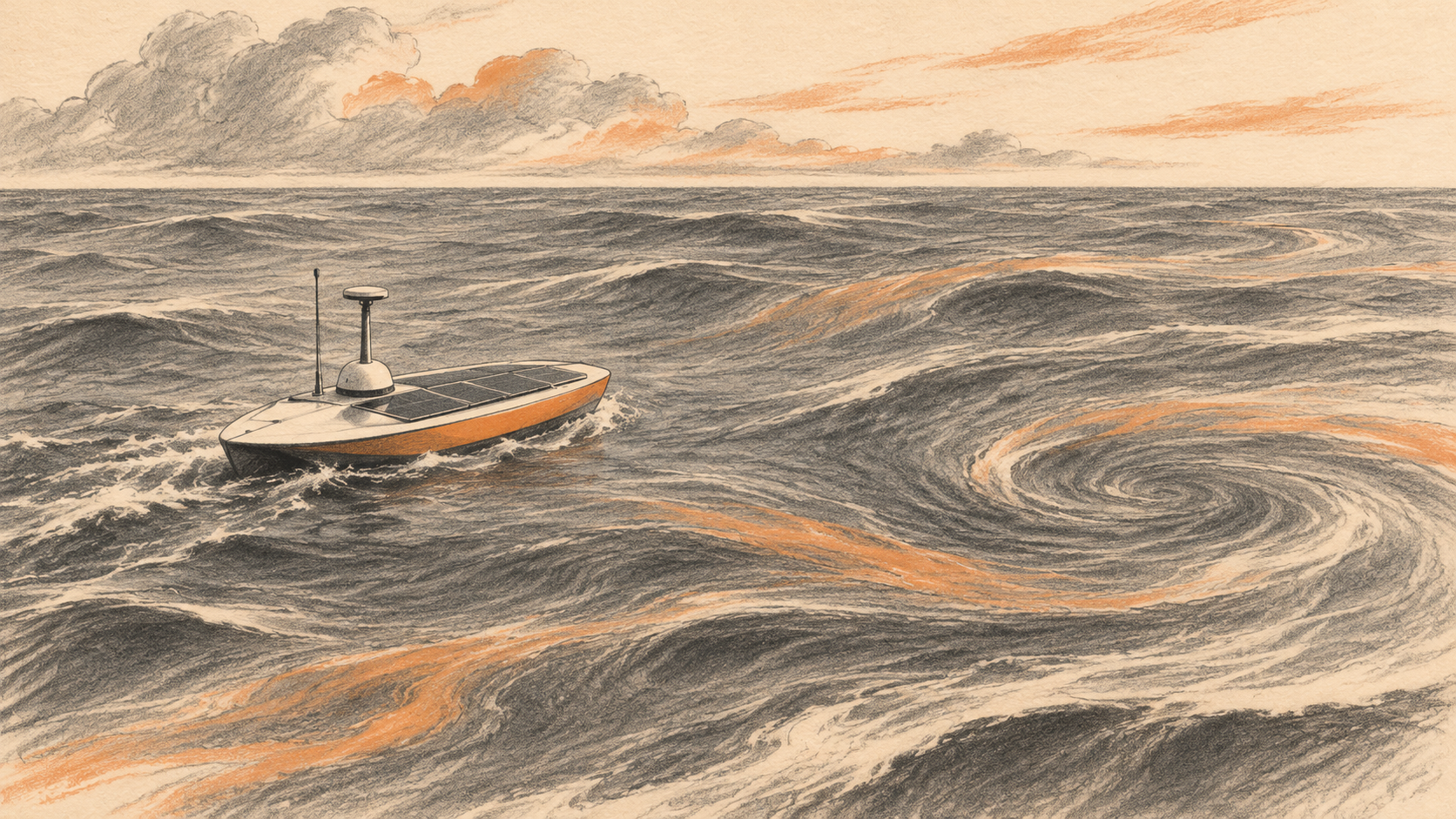
AI-generated conceptual illustration by BIG CHANGE.
A [November 4 preprint](https://arxiv.org/html/2611.05776v1) tests forecast-guided ocean sampling in simulation.
## The big change
- Forecasts estimate where uncertainty is highest.
- Currents constrain the robots’ options.
- Observations reshape the next forecast.
## How the loop works
The model generates ocean states and decodes them into physical variables. Where forecasts disagree, sampling may be informative. The planner ranks locations within reach, accounting for predicted currents. Measurements then guide diffusion sampling to update the ensemble toward states matching observations; its next forecast guides the next choice.
## Why the next observation matters
In a [2022 field study](https://www.frontiersin.org/journals/marine-science/articles/10.3389/fmars.2022.1067174/full), researchers used an ocean glider and operational forecasts to follow a phytoplankton bloom in the western English Channel. They regularly updated waypoints and incorporated glider observations into a numerical model. They reported improvements against observations at a nearby station, with a smaller impact at a more distant one.
[NOAA describes](https://www.aoml.noaa.gov/proj/argo/) Argo’s network of free-drifting floats, which collect temperature and salinity profiles as they move vertically through the water. Those measurements help initialize and test ocean models.
## What the experiment found
The authors used reanalysis from two regions, testing temperature and salinity with 20, 50 or 200 simulated robots. Across 120 cases, five policies and three seeds produced 1,800 ten-day runs. The adaptive methods generally beat fixed, random and predetermined back-and-forth sampling on error over the final eight cycles; coverage sometimes did better.
Forecast spread is not forecast error: a model can agree with itself and still be wrong. Where those diverged, uncertainty-guided sampling could miss important errors. It assumed perfect communication, simplified motion and initialization from the reference state. It was not an at-sea trial.
## Sources
- [Sampling preprint](https://arxiv.org/html/2611.05776v1) — Methods, simulations and limits.
- [NOAA Argo program](https://www.aoml.noaa.gov/proj/argo/) — Independent ocean-observation context.
- [2022 glider study](https://www.frontiersin.org/journals/marine-science/articles/10.3389/fmars.2022.1067174/full) — Earlier field study.
The BIG CHANGE newsletter
The big picture. At your pace.
Recent stories on AI and robotics, the shifts worth watching and practical ideas to use. Choose a daily briefing, weekly digest or monthly perspective.
Next scheduled send (UTC): . Your first edition arrives at the next scheduled send after you confirm.
Your privacy, your choice.
Necessary storage supports site security and remembers your choices. Optional Google Analytics stays off until you allow it. You can read every story with necessary storage only. Privacy details