# Arizona court vacates sentence over AI victim video
> An Arizona appeals court affirmed Gabriel Horcasitas's manslaughter conviction and ordered resentencing over an AI recreation of the deceased victim.
By BIG CHANGE Editorial
Published: 2026-10-05T12:20:25.739Z
Updated: 2026-10-05T12:20:25.739Z
Canonical: https://bigchange.ai/blog/arizona-ai-victim-video-sentence-vacated
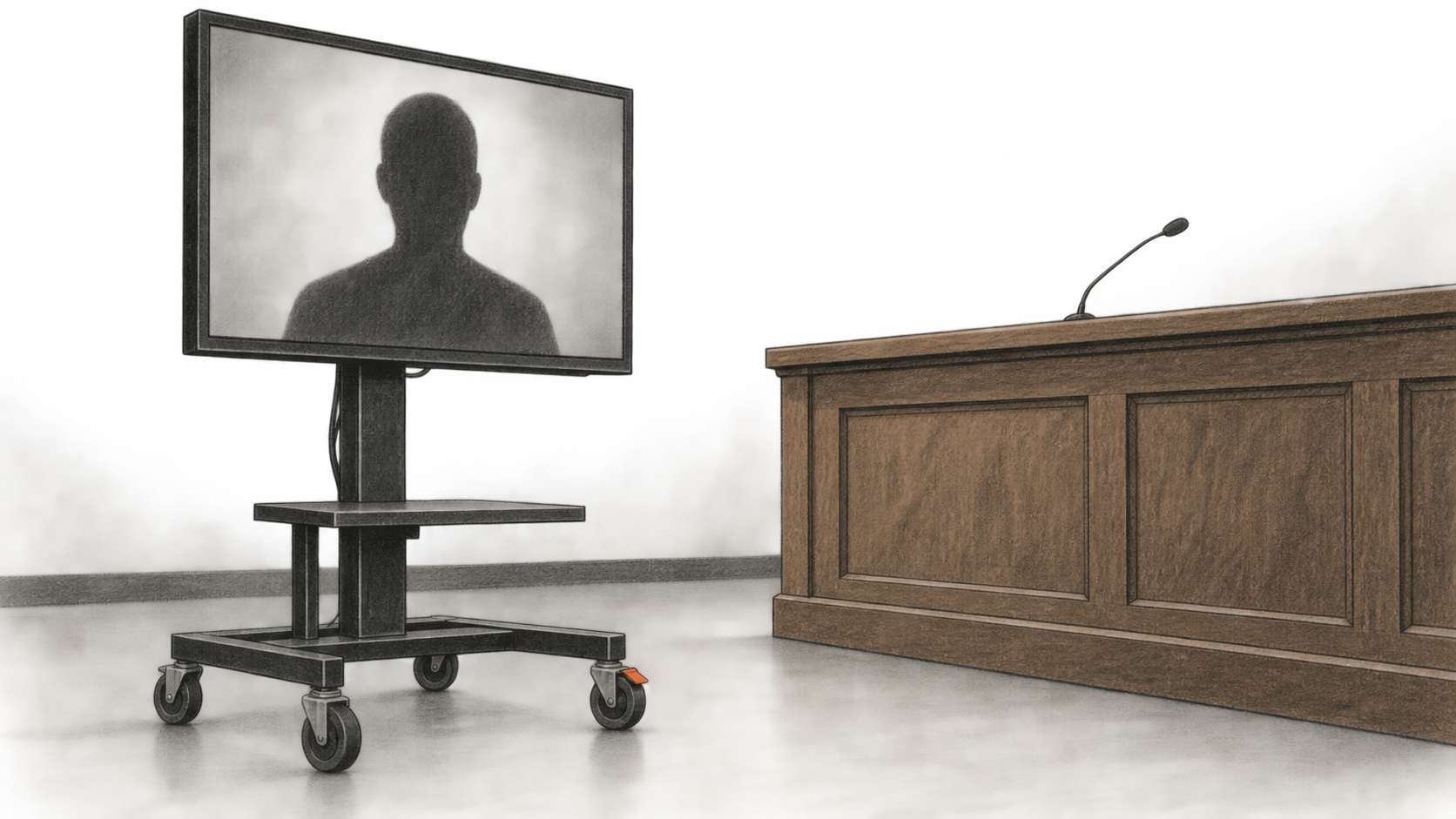
AI-generated conceptual illustration by BIG CHANGE.
An Arizona appeals court has ordered a new sentencing hearing after a judge considered an AI recreation of a dead man delivering a victim impact statement. The September 30, 2026 ruling in *State v. Horcasitas* leaves Gabriel Horcasitas's manslaughter conviction intact while vacating his 10½-year sentence.
The appeal succeeded over information used to decide punishment; the jury's finding of guilt stands. The [Arizona Court of Appeals opinion](https://coa1.azcourts.gov/Portals/1/OpinionFiles/Div1/2026/State%20v.%20Horcasitas%20-%201%20CA-CR%2025-0191%20-%20Opinion.pdf) also separates genuine recordings of the victim from generated speech presented through his likeness.
## The big change
- **What changed:** AI can put a family's interpretation of a deceased person's beliefs into a moving likeness that appears to speak for him. This Arizona ruling identifies a limit when that representation becomes unreliable information used in sentencing.
- **Why it matters:** Families retain the right to describe their loss. For courts, the difficulty is keeping the source of each statement clear: a relative's belief about the victim carries a different basis from words the victim actually said or wrote.
- **What to watch:** The ordered resentencing must address the error found here. The ruling permits the real footage embedded in this video, giving courts and families a concrete distinction between a record of someone's life and a generated account of his thoughts.
## What the judge heard
Christopher Pelkey died in a November 2021 road rage shooting in Chandler, Arizona. His family played the AI video during Horcasitas's May 2025 sentencing, after relatives and friends described their grief, according to [Associated Press reporting](https://apnews.com/article/cd1ca553c7fa80c6698d7f97b51b1edd).
Those presentations had different sources. Pelkey's brother read a statement Pelkey had written about his beliefs and hopes. His sister introduced what she imagined he would say at the hearing. The generated video then depicted Pelkey speaking, using his picture and voice profile. It incorporated real recordings alongside the synthetic representation, as the opinion describes in paragraphs 35 and 36.
The video disclosed its use of AI. That disclosure did not resolve the appellate court's concern. The judges found that the generated portion presented imagined thoughts, including facial expressions, as coming directly from Pelkey. The family's understanding of him had become an apparent statement by him.
## Why the sentence must be reconsidered
Victim impact statements are allowed at sentencing in Arizona, and the opinion affirms victims' right to be heard. Sentencing also permits a wider range of information than a trial. The court explained that this flexibility still requires reliable information and a fair procedure.
Horcasitas had not objected to the video during sentencing, so the appeal was reviewed for fundamental error. The court found that standard met on this record: the AI depiction was unduly prejudicial and made the sentencing procedure fundamentally unfair.
The sentencing judge's response mattered. He praised the video and treated its message of forgiveness as an expression of Pelkey's character. [AZFamily's report](https://www.azfamily.com/2026/10/01/court-appeals-vacates-chandler-road-rage-sentence-due-ai-victim-video/) describes those remarks and confirms the sentence was vacated while the conviction remained. The opinion says the AI video clearly played a role, although the record does not establish precisely how it affected the sentencing calculation.
The appeals court did not calculate how much the video changed the prison term or determine a replacement sentence. It sent the case back for resentencing.
## What the ruling leaves open
The court expressly found the real footage embedded in the video permissible. It also described the surviving family and friends' own accounts of grief and the victim's life. Their ability to address the court was not withdrawn.
The opinion applies Arizona sentencing law and due process principles to this presentation and this judge's consideration of it. It establishes no nationwide prohibition on AI in courts, sets no technical authentication standard for synthetic media, and does not decide every possible use of AI in a victim impact presentation.
For court administrators and legal professionals, the useful distinction is the statement's authorship. A family member can explain her understanding of a loved one. A recording can preserve words he actually spoke. In this case, making imagined speech appear to come from the deceased erased that distinction, and announcing that the video used AI did not cure the problem.
## Sources & further reading
- [*State v. Horcasitas*, Arizona Court of Appeals, Division One](https://coa1.azcourts.gov/Portals/1/OpinionFiles/Div1/2026/State%20v.%20Horcasitas%20-%201%20CA-CR%2025-0191%20-%20Opinion.pdf), filed September 30, 2026. The controlling source for the disposition and reasoning. Paragraphs 33 through 53 address the sentencing video; paragraph 54 affirms the conviction and vacates the manslaughter sentence.
- [Associated Press: Sentence tossed in Arizona case involving an AI victim video](https://apnews.com/article/cd1ca553c7fa80c6698d7f97b51b1edd), October 1, 2026. Reporting supplies the victim's name and the shooting and sentencing dates. Its correction confirms that the defense did not object at sentencing.
- [AZFamily: Court of Appeals vacates Chandler road rage sentence](https://www.azfamily.com/2026/10/01/court-appeals-vacates-chandler-road-rage-sentence-due-ai-victim-video/), displayed publication date September 30, 2026. Local reporting corroborates the sentence length and the judge's response. The opinion controls the legal terminology and outcome.
## Sources
- [State v. Horcasitas, Arizona Court of Appeals, Division One](https://coa1.azcourts.gov/Portals/1/OpinionFiles/Div1/2026/State%20v.%20Horcasitas%20-%201%20CA-CR%2025-0191%20-%20Opinion.pdf) — The controlling source for the disposition and reasoning. Paragraphs 33 through 53 address the sentencing video; paragraph 54 affirms the conviction and vacates the manslaughter sentence. Filed September 30, 2026.
- [Associated Press: Sentence tossed in Arizona case involving an AI victim video](https://apnews.com/article/cd1ca553c7fa80c6698d7f97b51b1edd) — Reporting supplies the victim's name and the shooting and sentencing dates. Its correction confirms that the defense did not object at sentencing. October 1, 2026.
- [AZFamily: Court of Appeals vacates Chandler road rage sentence](https://www.azfamily.com/2026/10/01/court-appeals-vacates-chandler-road-rage-sentence-due-ai-victim-video/) — Local reporting corroborates the sentence length and the judge's response. The opinion controls the legal terminology and outcome. Displayed publication date September 30, 2026.
The BIG CHANGE newsletter
The big picture. At your pace.
Recent stories on AI and robotics, the shifts worth watching and practical ideas to use. Choose a daily briefing, weekly digest or monthly perspective.
Sent at 09:00 Belgrade time: daily, Mondays or the first of the month. Your first edition arrives at the next scheduled send after you confirm.
Your privacy, your choice.
Necessary storage supports site security and remembers your choices. Optional Google Analytics stays off until you allow it. You can read every story with necessary storage only. Privacy details