# Boston Dynamics designs Atlas’s new hand for learned tool use
> Boston Dynamics’ four-finger Atlas hand pairs 13 degrees of freedom, backdrivable actuation and tactile sensing with reinforcement learning in simulation. The company reports initial transfer results but no benchmark or commercial deployment.
By BIG CHANGE Editorial
Published: 2026-10-09T20:36:05.023Z
Updated: 2026-10-09T20:36:05.023Z
Canonical: https://bigchange.ai/blog/boston-dynamics-atlas-hand-learned-tool-use
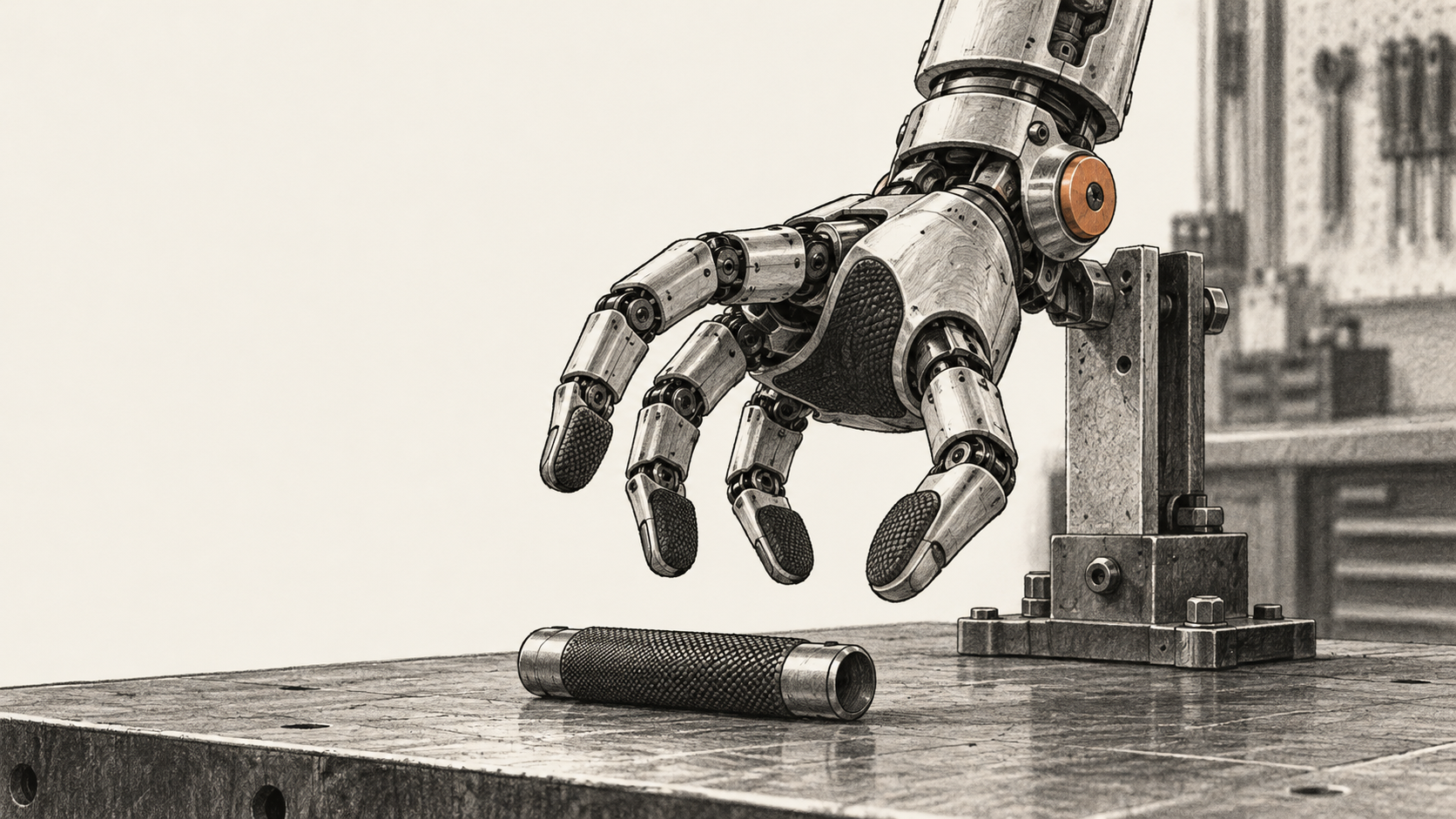
AI-generated conceptual illustration by BIG CHANGE. The generic hand is not Atlas hardware, a Boston Dynamics product rendering, or a test demonstration.
[Boston Dynamics’ new Atlas hand](https://bostondynamics.com/blog/robot-hands-for-modern-ai-and-real-work/) has four fingers, 13 degrees of freedom and pressure sensors across its palm and fingertips. The company says the hardware is designed to make dexterous manipulation easier to train in simulation and transfer to the physical robot. Its public account describes initial sim-to-real results, but does not provide a benchmark, task-level success rates or evidence of commercial deployment.
## The big change
- **What changed:** Boston Dynamics describes a new-generation Atlas hand with more joints than its earlier seven-degree-of-freedom version, direct actuation and dense tactile sensing.
- **How it works:** The company says it models the hand’s geometry, motor behavior and contact with objects, then trains reinforcement-learning policies in simulation with randomized conditions before running them on hardware.
- **Why it matters:** Manipulation depends on how fingers move, feel contact and respond to force. A hand that behaves predictably in simulation could let engineers train more of that control before using the physical robot.
- **What is established:** Boston Dynamics reports initial promising transfer on dynamic tasks. It does not disclose the tasks, sample sizes, success rates, comparison baseline or deployment schedule.
## Four fingers, with a more capable thumb
[Boston Dynamics gives the new hand 13 degrees of freedom](https://bostondynamics.com/blog/robot-hands-for-modern-ai-and-real-work/): four in its opposable thumb and three in each of the other three fingers. It says the thumb can slide along and across the other fingers, enabling pinch and tripod grasps. The company also describes holding a tool while pressing its trigger.
The design leaves out a fifth finger. [Boston Dynamics says](https://bostondynamics.com/blog/robot-hands-for-modern-ai-and-real-work/) the extra finger would add three actuators, along with cost, space, power use and more components that could fail. Its account frames this as a task tradeoff: a four-finger hand may be sufficient for the manipulation behaviors the team is targeting, while reducing mechanical complexity. That is the company’s design rationale, not evidence that the hand performs every task a human hand can.
The hand is close to the scale of a large human hand, according to the company, so it can reach into human-sized spaces and use tools made for people. Boston Dynamics describes sealed actuators, direct drive and backdrivability as ways to make the joints respond to forces from the environment. It says dense pressure sensors cover the palm and fingertips, while actuator feedback provides proprioceptive information about joint movement and force.
Those choices address different control problems. Joint feedback can help a controller estimate how the fingers move and respond when an object pushes back. Tactile sensors can register contact across the hand. The company presents both as part of the design; it does not report a separate evaluation showing how much either sensing system improves task performance.
## Why the hand is designed for simulation
Training a dexterous robot policy requires more than recording a person’s hand motions. Boston Dynamics argues that wearable demonstrations can capture what a person does, but not all of the fast force adjustments needed to control a robot’s fingers. Its approach pairs simulation-based reinforcement learning with a hand whose physical behavior can be modeled.
[The company identifies three parts of that simulation](https://bostondynamics.com/blog/robot-hands-for-modern-ai-and-real-work/): kinematics, or the hand’s geometry and joint positions; dynamics, including friction, torque and backlash; and contact, or how the fingers interact with an object. It says its training randomizes motor torque profiles, surface friction, object geometry and task disturbances. These variations are intended to expose a policy to different conditions before it runs on the real hand.
[Boston Dynamics reports initial sim-to-real transfer on dynamic tasks](https://bostondynamics.com/blog/robot-hands-for-modern-ai-and-real-work/). The company says those behaviors were trained in simulation using domain randomization and then run on the physical hand with high-rate actuator proprioception for feedback. The post does not identify the tasks, the number of trials, the success threshold, the amount of tactile data used in the reported runs or the policy architecture. “Promising” is the company’s characterization; the report is not an independently assessed benchmark.
## A design direction, not a deployment result
The hand’s stated purpose is to make tool use and other precise manipulation easier to train. The announcement is useful for understanding how Boston Dynamics connects mechanical design to reinforcement learning: direct, backdrivable joints and a model of contact are meant to narrow differences between simulated and physical behavior.
The same post calls reliable, low-cost manufacturing a long-term goal. It does not state when the new hand will ship, how many Atlas robots use it, what tasks have been completed outside demonstrations, or whether a customer has deployed it. Those are separate questions from whether simulation can train a policy that transfers to hardware.
## Sources & further reading
- [Boston Dynamics, “Robot Hands for Modern AI and Real Work”](https://bostondynamics.com/blog/robot-hands-for-modern-ai-and-real-work/). Company technical explanation of the hand’s design, sensing and simulation approach, including the company’s initial sim-to-real claim. The page does not display a publication date; checked October 9, 2026. No independent benchmark or commercial deployment evidence is provided.
- [The Robot Report, “Boston Dynamics gives more insight into its redesigned humanoid hand”](https://www.therobotreport.com/boston-dynamics-gives-more-insight-into-its-redesigned-humanoid-hand). Interview context about the redesign. It is not independent performance testing; this article relies on Boston Dynamics for the hand specifications and reported learning results.
## Sources
- [Boston Dynamics, Robot Hands for Modern AI and Real Work](https://bostondynamics.com/blog/robot-hands-for-modern-ai-and-real-work/) — Primary source for design, sensing, simulation and initial company-reported sim-to-real transfer.
- [The Robot Report, Boston Dynamics gives more insight into its redesigned humanoid hand](https://www.therobotreport.com/boston-dynamics-gives-more-insight-into-its-redesigned-humanoid-hand) — Interview context; no unique factual claim from the article relies on it, and it is not a performance test.
The BIG CHANGE newsletter
The big picture. At your pace.
Recent stories on AI and robotics, the shifts worth watching and practical ideas to use. Choose a daily briefing, weekly digest or monthly perspective.
Next scheduled send (UTC): . Your first edition arrives at the next scheduled send after you confirm.
Your privacy, your choice.
Necessary storage supports site security and remembers your choices. Optional Google Analytics stays off until you allow it. You can read every story with necessary storage only. Privacy details