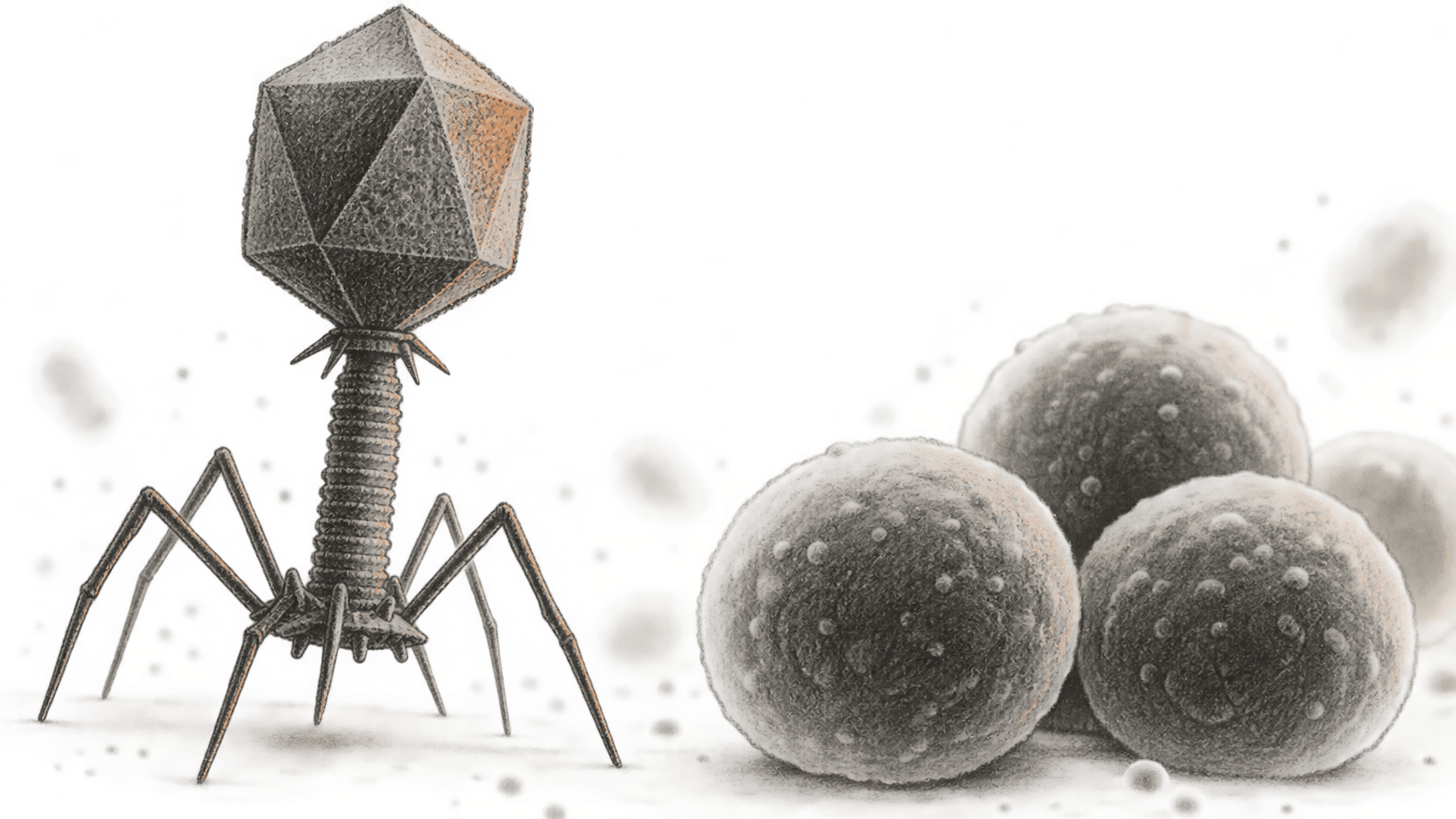
Anthropic says Claude identified an overlooked arrangement in bacteriophage DNA: a reverse transcriptase gene beside a partner gene and a long array of repeats. Bacteriophages are viruses that infect bacteria; reverse transcriptases are enzymes that copy RNA into DNA. The company calls the proposed family array-associated reverse transcriptases, or ART. Its September 23 announcement compares the repeat pattern with CRISPR, the bacterial system behind widely used gene-editing tools.
The comparison describes the shape of the genetic sequence. Anthropic's research preprint reports evidence that the array produces short RNAs, but says the team has not yet shown that the ART reverse transcriptase is active, that it uses those RNAs, or what the system does for the phage. There is no reported demonstration of programmable editing.
The big change
- What changed: In this company-led study, AI agents working through a large sequence search noticed a DNA pattern outside the protein features they had been asked to examine. Human researchers then investigated the candidate and measured its RNA output.
- Why it matters: Researchers searching vast genome databases could use agents to surface unusual arrangements for laboratory follow-up. Here, that contribution is a research lead with some experimental support, while the enzyme's activity and biological role remain open questions.
- What to watch: The decisive next results concern whether the protein acts as a reverse transcriptase, whether the short RNAs are its substrates, and how its partner protein participates. Those tests determine what ART does before any claim about an editing application can be assessed.
What Claude found in the sequence
The preprint by Peter Yoon and colleagues at Anthropic describes a search of roughly 1.9 billion protein clusters. Agents running Claude Mythos 5 recovered about 200,000 reverse transcriptase clusters and investigated candidate genes found nearby. The campaign ran for 21.5 hours across 949 agent sessions, according to the authors. Human scientists set the research brief; the agents pursued the computational search and filed reports for review.
One agent followed an unexpected lead in the DNA beside a phage reverse transcriptase. It noticed a run of repeated sequences separated by distinct segments, examined their spacing and compared the arrangement with known systems. The reverse transcriptase itself had appeared in earlier work. The claimed discovery is the combination of that protein with the repeat array and a nearby partner gene, whose function is also unknown.
The researchers found 95 related reverse transcriptase clusters, with detectable arrays beside 28 of them. The repeats resemble one visible feature of CRISPR arrays, yet the paper reports no nearby cas genes and describes differences in the spacing and conservation of the intervening sequences. Sequence resemblance is therefore a clue to investigate, rather than evidence that ART has CRISPR's mechanism.
What the experiments establish
The researchers reanalyzed RNA data from a 2022 study of phage SA1 infection. In their analysis, the ART array was transcribed during infection and yielded shorter RNA species. They also report short array-derived RNAs in a separate laboratory expression experiment. Those observations support the existence of distinct RNAs from the array.
They do not establish the next steps in the proposed mechanism. In the preprint's discussion, the authors explicitly say they have not shown reverse transcriptase activity or that the array RNAs are its substrates. They also leave the interaction with the partner protein and the system's role in the phage unresolved. The paper's retron-like model is a hypothesis. It cannot yet support a claim that ART cuts or edits a chosen DNA target.
Anthropic published a comment from CRISPR researcher Feng Zhang, who reviewed the preprint and called the RNA-repeat arrays associated with reverse transcriptases intriguing. His stated conclusion was that they merit further investigation. It was neither a report of independent replication nor a finding that ART is a gene-editing tool.
A discovery lead with a repeatability limit
The paper also tests the AI search itself. In ten reruns of the broad campaign reported by the authors, the agents missed the array. In narrower tests that placed the relevant DNA directly in a model's context, the stronger models identified it much more often. When the sequence sat in files behind tools, some attempts never read enough DNA to expose the pattern. This distinction matters: the model could recognize the feature when it encountered it, but the full search did not reliably bring the right sequence to its attention.
The company-led preprint gives other researchers a specific sequence arrangement and RNA observations to challenge and extend. The sources reviewed for this article reported no independent replication as of September 23. ART remains a candidate system whose function is undetermined.