A November 4 preprint tests roadside coordination system CoSafe in simulation.
The big change
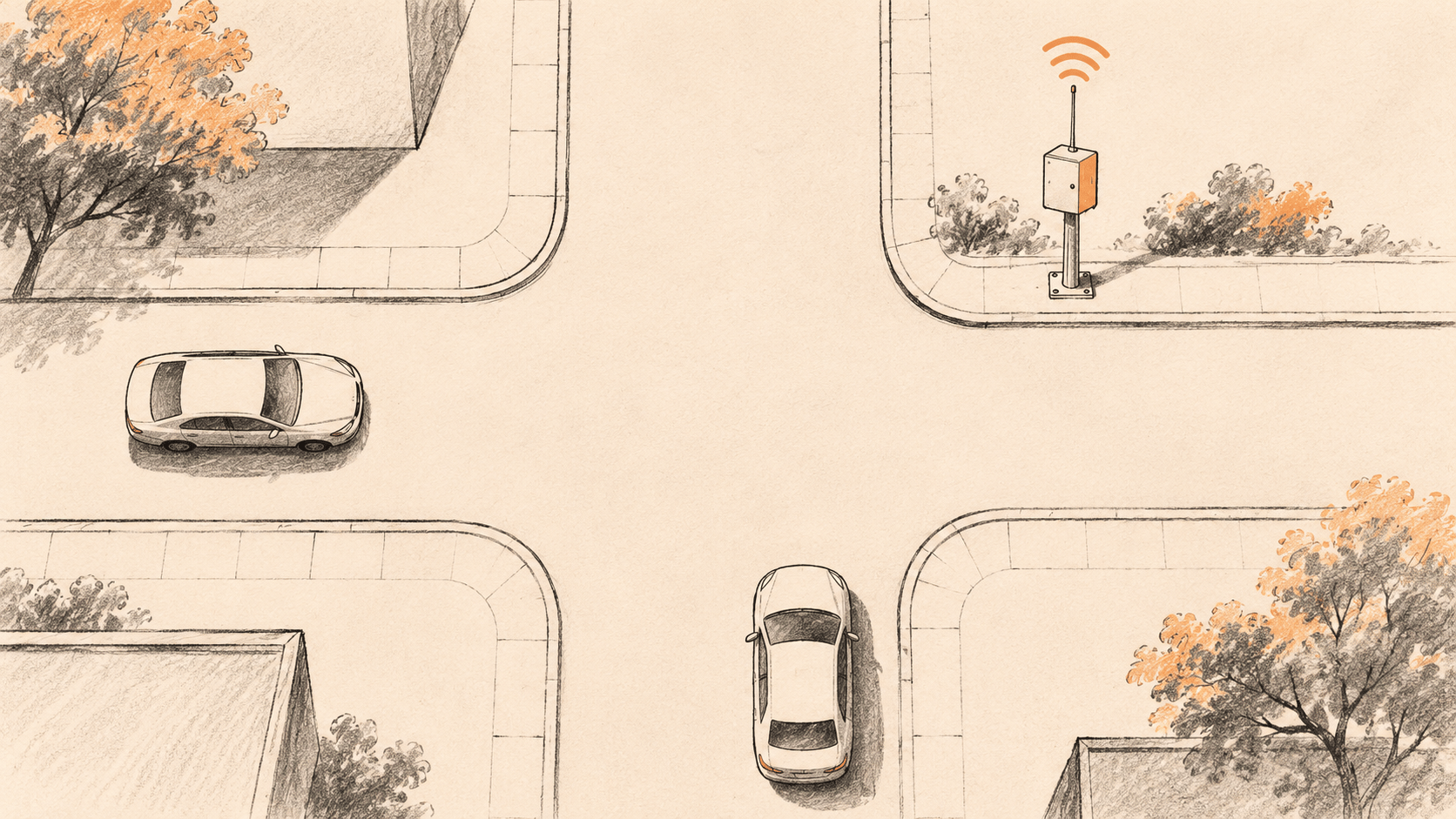
- A roadside unit detects conflicts using observations and vehicle data.
- It selects coordinated paths for affected vehicles; their switches execute them while others retain their plans.
- Participating vehicles must share information and follow those paths; humans remain outside its control.
Why coordination matters
At an unsignalized intersection, two conflicting cars may both wait; coordination lets one proceed while the other yields in the paper’s example.
The US Department of Transportation describes vehicle-to-everything communication as an ecosystem spanning vehicles, roadside equipment and supporting systems. Its V2X briefing identifies interoperability across manufacturers and jurisdictions as a challenge. Connected equipment must be able to communicate across those boundaries for information to be useful beyond a single setup.
The experiment and its limits
Across seven driving systems and 46 routes, averaging five runs, the authors report 87.80% fewer violations across four categories versus unprotected baselines. Deadlocks and stalls remained.
For one system, delayed or lost messages weakened benefits; without a trajectory, vehicles used their own plans. The study excludes sensor and actuator faults and does not establish public-road performance.
The evaluation used InterDrive with background traffic. Its earlier creators introduced the CARLA benchmark; they did not independently validate CoSafe.