# DexSeed studies robot learning from grasps
> Human recordings become simulated robot practice.
By BIGCHANGE.AI Editorial
Published: 2026-11-12T13:45:39.289Z
Updated: 2026-11-12T13:45:39.289Z
Canonical: https://bigchange.ai/blog/dexseed-human-grasps-robot-training
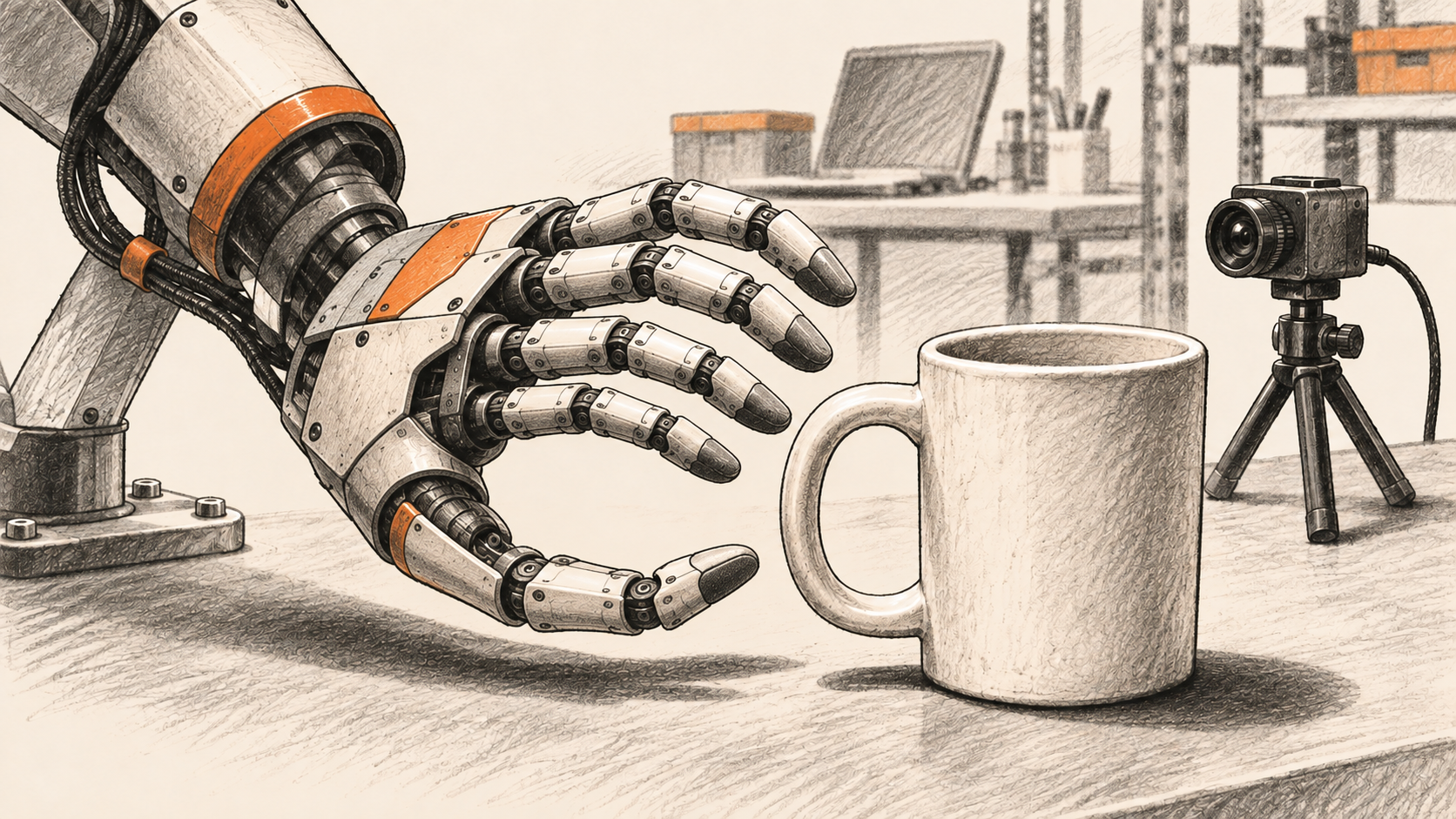
AI-generated illustration for BIG CHANGE.
The November 10 DexSeed preprint describes training a robot hand using simulated demonstrations derived from human grasps.
## The big change
- DexSeed adapts human hand–object relationships to a robot, varying shapes and locations. A simulated finger controller corrects grasps while the arm moves.
- Physical success ranged from 20% to 80% across eight grasp modes, with ten trials and one object per mode. These are narrow tests.
- Generating more practice examples can reduce repeated collection work. But the useful question is which situations the examples cover, and whether a trained robot succeeds under the conditions that matter.
## What a human recording contains
DexSeed uses [GRAB](https://grab.is.tue.mpg.de/), an earlier human-interaction dataset. GRAB’s creators recorded ten people interacting with 51 everyday objects. They fitted three-dimensional body, hand and object motion to motion-capture markers, then calculated contact between the body and object. The records therefore describe how a person and an object move together, rather than only showing an isolated hand pose.
The original dataset covers whole-body interactions, not just a hand lifting something. Its creators also demonstrated GrabNet, a separate model for predicting hand grasps for unfamiliar object shapes. That example concerns human grasp modeling; it is not a test of a robot’s ability to carry an object. Access requires registration and accepting the dataset’s license, including subject-specific restrictions.
## Turning motion into training
The [paper](https://arxiv.org/html/2611.14092) keeps successful simulated runs and pairs rendered views, actions and grasp descriptions to fine-tune a pretrained model. This addresses contact failures that simple motion replay can miss. It learns actions from images and instructions; rendering also uses a captured workspace. Fine-tuning used generated examples, not real-robot action demonstrations.
The physical Franka arm/Wuji hand tests required lifting and placing objects in a target region. The [repository](https://github.com/robbyant-research/DexSeed) says implementation is coming soon. BIG CHANGE did not reproduce the experiments.
## Why researchers generate demonstrations
The separate 2023 [MimicGen study](https://proceedings.mlr.press/v229/mandlekar23a.html) explains the collection problem: gathering human demonstrations can be costly and time-consuming. Its researchers adapted a small starting set to new scene configurations, object instances and robot arms. They reported generating more than 50,000 demonstrations for 18 tasks from 200 human demonstrations.
In that study, robots learned by imitating the generated examples, including tasks involving multipart assembly and coffee preparation. The point of adapting a demonstration is to supply practice under changed conditions without having a person demonstrate every variation. Those findings belong to MimicGen; they are not a direct comparison with this new system.
For a team evaluating robot training, a useful test plan should separate familiar objects from unfamiliar shapes, vary starting positions and record failed placements as well as successful lifts. It should also distinguish a simulator result from a physical trial. These are evaluation questions, not claims that any particular demonstration generator has solved them.
## Sources
- [DexSeed preprint](https://arxiv.org/html/2611.14092) — Method and experiments.
- [DexSeed repository](https://github.com/robbyant-research/DexSeed) — Implementation status.
- [GRAB dataset](https://grab.is.tue.mpg.de/) — Original human-interaction dataset.
- [MimicGen research](https://proceedings.mlr.press/v229/mandlekar23a.html) — Earlier data-generation work.
The BIG CHANGE newsletter
The big picture. At your pace.
Recent stories on AI and robotics, the shifts worth watching and practical ideas to use. Choose a daily briefing, weekly digest or monthly perspective.
Next scheduled send (UTC): . Your first edition arrives at the next scheduled send after you confirm.
Your privacy, your choice.
Necessary storage supports site security and remembers your choices. Optional Google Analytics stays off until you allow it. You can read every story with necessary storage only. Privacy details