# DobotTrack studies how robots follow a described person
> A research model combines target identification and visual history.
By BIGCHANGE.AI Editorial
Published: 2026-11-10T08:23:38.403Z
Updated: 2026-11-10T08:23:38.403Z
Canonical: https://bigchange.ai/blog/dobottrack-robot-person-tracking-study
AI-generated illustration for BIG CHANGE
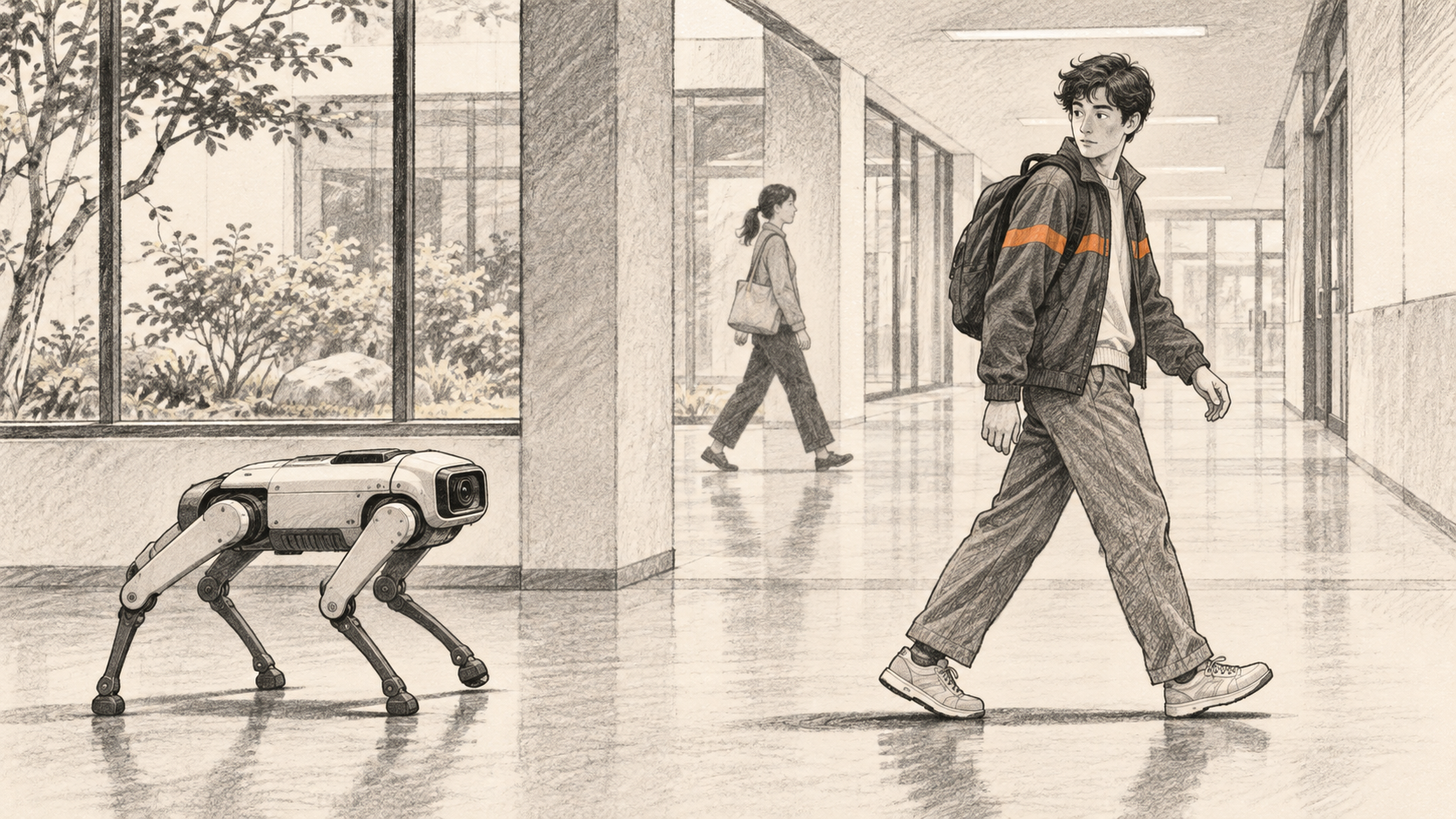
A November 6 [preprint](https://arxiv.org/html/2611.09041v1) describes DobotTrack, a 0.8-billion-parameter model for following a described person.
## The big change
- **What changed:** A target-focused memory informs movement.
- **Why it matters:** A following robot must distinguish its intended person from other people while moving.
- **What to watch:** Real-world reliability and data practices.
## Remembering the target
The model predicts a target outline, bounding box and future waypoints from a description and camera images. Q-identity compresses earlier frames using target and scene features to inform later decisions.
This builds on earlier work in the field. [ReferTrack](https://arxiv.org/html/2607.20061v1), for example, selects a target using detected boxes and retains a history of their positions to guide movement. It illustrates that language-guided tracking and visual memory predate the new paper.
## What was measured
In simulated distractor tests, the authors report 72.5% success, compared with 41.5% for OmTrackVLA and 73.3% for ReferTrack in their table. Success means ending an episode facing the target one to three metres away. The methods differ in components and training.
Training included 126 physical-robot episodes. A quadruped evaluation shows two qualitative comparisons with a trajectory-only baseline, but no measured real-world success or collision rate.
The earlier [TrackVLA benchmark paper](https://arxiv.org/html/2505.23189v1) describes the simulated test environment: 100 avatars and 804 indoor scenes split so test avatars and scenes do not overlap with training. Each of its three tasks has 1,405 test episodes.
In the distractor task, instructions describe a person’s appearance; in the ambiguity task, lookalike distractors make that description less decisive. This design probes different identification problems, but the benchmark’s synthetic people and settings do not represent every real interaction. Simulation allows repeatable comparisons, while physical deployments face changing lighting, people and obstacles.
For anyone considering a following robot, the important questions extend beyond a successful demonstration: how often it loses or switches targets, how it behaves near bystanders, and what happens to recorded images. The preprint does not specify a participant-consent process.
## Sources
- [DobotTrack preprint](https://arxiv.org/html/2611.09041v1) — Method, dataset and evaluation.
- [ReferTrack preprint](https://arxiv.org/html/2607.20061v1) — Earlier target selection and history.
- [TrackVLA benchmark paper](https://arxiv.org/html/2505.23189v1) — Earlier benchmark context.
The BIG CHANGE newsletter
The big picture. At your pace.
Recent stories on AI and robotics, the shifts worth watching and practical ideas to use. Choose a daily briefing, weekly digest or monthly perspective.
Next scheduled send (UTC): . Your first edition arrives at the next scheduled send after you confirm.
Your privacy, your choice.
Necessary storage supports site security and remembers your choices. Optional Google Analytics stays off until you allow it. You can read every story with necessary storage only. Privacy details