# NVIDIA reports Microsoft AI’s Dynamo use for training rollouts
> Generating model-training experience can consume time before the next weight update begins.
By BIGCHANGE.AI Editorial
Published: 2026-11-22T04:31:38.088Z
Updated: 2026-11-22T04:31:38.088Z
Canonical: https://bigchange.ai/blog/dynamo-post-training-rollouts
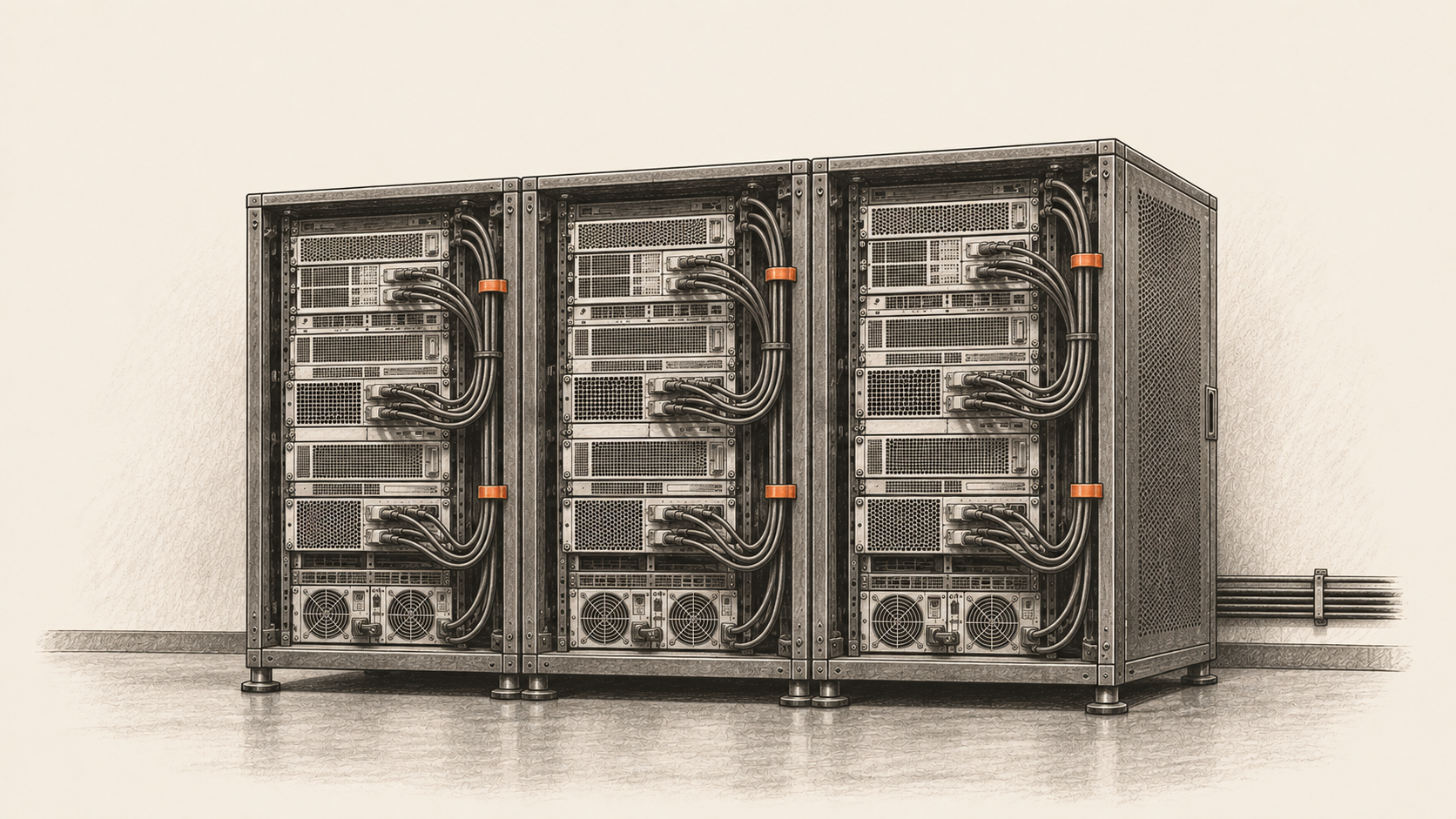
AI-generated conceptual illustration for BIG CHANGE; fictional computing equipment and setting, with no actual Microsoft deployment, routing diagram or measured result shown.
On November 19, NVIDIA reported Microsoft AI’s use of Dynamo inference software for reinforcement-learning rollouts during post-training.
## The big change
- Generating training attempts can hold up the next model update. Dynamo distributes inference work, while the training framework still scores responses, updates the model and decides which samples are usable.
- A training loop generates candidate answers, scores them and changes the model from that feedback. Producing those answers is inference, even though the outputs are being created to support training rather than answer a customer.
- Reusing a prompt’s cached computation can save processing, but it does not remove the work of generating new output. A cache advantage therefore depends on how much repeated context the workload contains.
## What Microsoft’s use establishes
NVIDIA gives no Microsoft deployment date or measured gain.
Dynamo’s router balances cached-context reuse against worker load. Sending every repeated prompt to one cached worker can build a queue, delaying the next training step. Healthy workers can keep generating while a replacement loads the required model version. The training framework must check model versions and cached data before accepting new samples or admitting a replacement worker. ModelExpress, for distributing weights, has experimental live-update paths; one worker finishing does not establish that the whole fleet switched.
## Why generation belongs inside the training cycle
The original DeepSeekMath paper gives a concrete mathematical example. Its Group Relative Policy Optimization method samples several answers to the same question, assigns rewards and uses their relative scores to guide an update to the policy—the model that generates the answers.
That sequence explains why training can require substantial inference. Before the update can use those outcomes, the candidate solutions must be generated and scored. Producing several long solutions is different from computing one answer and immediately treating it as learned knowledge.
In this example, the generated text and the learned weights serve different purposes. The answers supply experience for the update; the update changes how the model will generate later answers. Merely collecting more responses does not itself change the model. This explains a general training mechanism, not Microsoft’s undisclosed choice of algorithm.
## Cache reuse saves one part of the work
The original vLLM documentation describes automatic prefix caching as reuse of the saved computation for a shared beginning of a request. A new request with the same prefix can skip processing that shared portion.
For an illustrative mathematics workload, many attempts might begin with identical instructions and the same problem statement. Reusing that prefix would avoid repeating its initial processing; the different candidate solutions would still need to be generated.
The distinction is between prefill, which processes the input, and decoding, which produces new tokens. vLLM explicitly says prefix caching does not reduce decoding time. If most time is spent producing long answers, or the new prompts share no useful prefix, this optimization has much less to save. Cache reuse is not equivalent to eliminating the rollout.
## A faster weight load is a specific measurement
CoreWeave’s separate original case describes in-place weight loading while retaining an inference engine rather than restarting it. Its control plane tracks the saved model version served by each replica. For strictly on-policy training, its account says a trainer can clear the prompt cache and wait for every replica to finish updating before the next batch.
In its Nemotron 3.5 Lightning benchmark, four replicas ran on GB300 NVL72 systems. The fastest delta-based update was roughly 15 times faster than the average cold-start redeployment. That compares the quickest measured delta update with an averaged restart baseline, not two average training-job completion times.
CoreWeave reports compressed deltas of about 0.14%–0.95% of the full 16-bit (BF16) checkpoint size in its tests. Those small transfers help explain the loading result; they do not show that the same fraction of an entire training job disappears.
## Looking at a complete step
H Company’s distinct original results give another denominator. Its recorded timing covers steps 2–100. The trainer still used 32 H100 GPUs, while average inference capacity increased from eight GPUs to 14.8. Step time went from 147 to 119 seconds with its controller and ModelExpress configuration.
The reported GPU-hours for the comparison fell from 164 to 155, including the trainer’s idle time. More inference capacity could finish useful work sooner while reducing the time the trainer spent waiting; this was not a comparison at identical total GPU count.
Neither benchmark quantifies Microsoft’s gain. For a training team, the relevant comparison includes elapsed step time and total GPU-hours, including time spent waiting.
## Sources
- [NVIDIA’s November 19 author report](https://developer.nvidia.com/blog/reducing-rollout-bottlenecks-in-reinforcement-learning-with-nvidia-dynamo/) — Use disclosure and serving roles.
- [Dynamo’s current refresh contract](https://docs.nvidia.com/dynamo/reinforcement-learning/rollout-weight-updates) — Version, cache and recovery limits.
- [Original DeepSeekMath paper, version 3](https://arxiv.org/html/2402.03300v3) — A mathematical sampling, scoring and update example.
- [Original vLLM prefix-caching documentation](https://docs.vllm.ai/en/latest/features/automatic_prefix_caching/) — Shared input work and decoding limits.
- [CoreWeave’s original post-training case](https://www.coreweave.com/blog/post-training-at-the-frontier) — Specific weight-loading comparison and baseline.
- [H Company’s original session results](https://ai-dynamo.org/gtc-berlin-rl) — Measured step and GPU-hours comparison; simulations separate.
The BIG CHANGE newsletter
The big picture. At your pace.
Recent stories on AI and robotics, the shifts worth watching and practical ideas to use. Choose a daily briefing, weekly digest or monthly perspective.
Next scheduled send (UTC): . Your first edition arrives at the next scheduled send after you confirm.
Your privacy, your choice.
Necessary storage supports site security and remembers your choices. Optional Google Analytics stays off until you allow it. You can read every story with necessary storage only. Privacy details