# GOLD designs RNA sequences with side-chain geometry in the loop
> A new computational method couples RNA sequence and base orientation during inverse folding. Its benchmark gains rely on predicted structures and remain untested in the lab.
By BIG CHANGE Editorial
Published: 2026-10-19T12:21:34.835Z
Updated: 2026-10-19T12:21:34.835Z
Canonical: https://bigchange.ai/blog/gold-rna-inverse-folding-side-chain-geometry
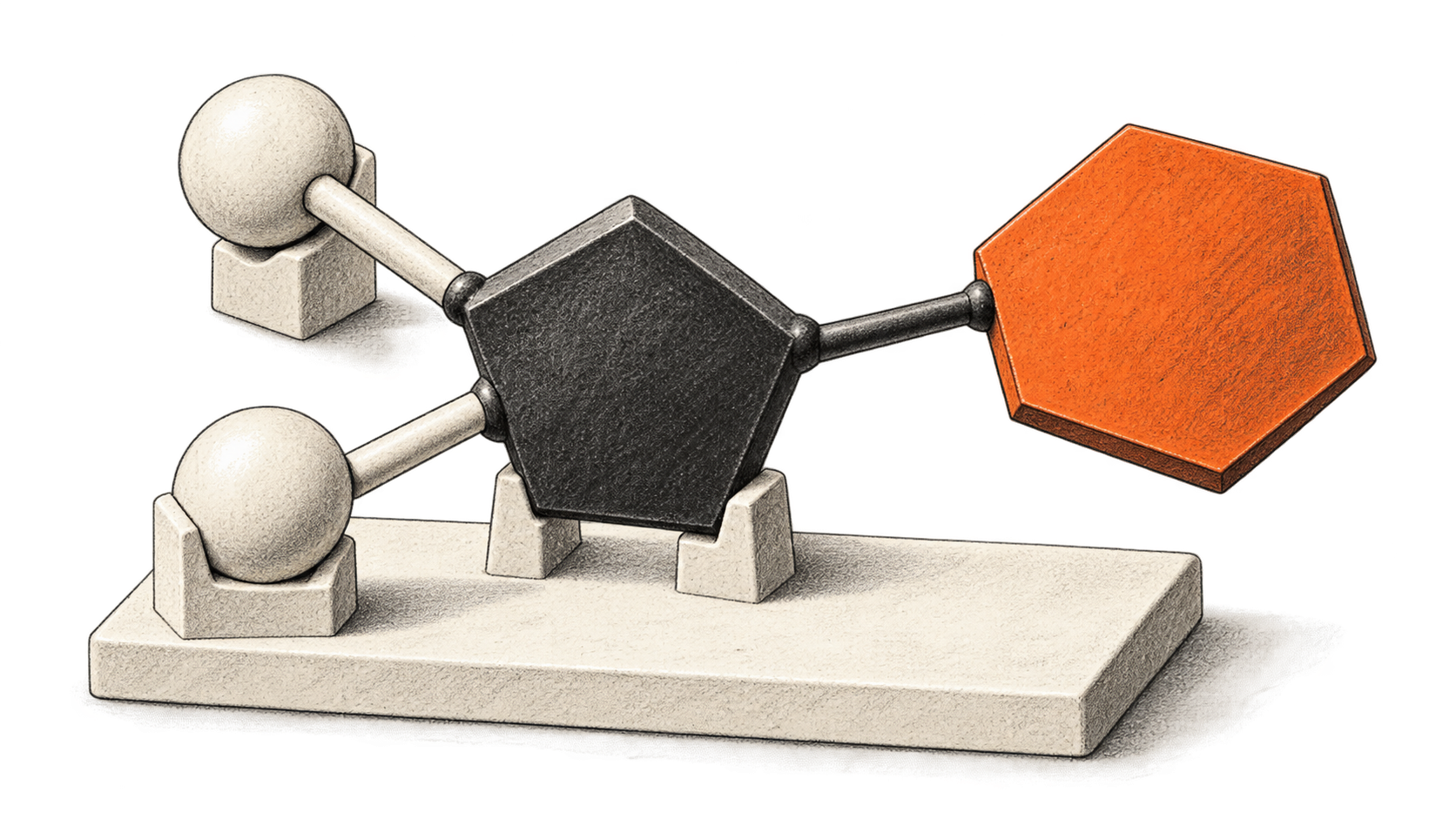
AI-generated conceptual illustration by BIG CHANGE; a simplified teaching model, not an exact molecule, GOLD output or biological result.
A [research paper released on October 16](https://arxiv.org/html/2610.22992v1) describes GOLD, a computational method for designing an RNA sequence around a specified three-dimensional backbone. Its authors model the orientation of each nucleotide base as well as the choice of A, U, C or G. On their tests, the generated sequences scored better than the compared methods on sequence recovery, secondary-structure recovery and predicted 3D structure. These are computational results; the paper does not report synthesis or biological testing of the designs.
RNA inverse folding starts with a target shape and asks which sequence might adopt it. A backbone alone leaves out how the bases turn into space. Those orientations affect whether intended base pairs can form and whether atoms crowd one another. GOLD's contribution is to make the base's glycosidic torsion angle, χ, part of generation instead of assessing geometry only after a sequence is proposed.
## A shared space for sequence and angles
The method has three stages, described in the [paper's methods](https://arxiv.org/html/2610.22992v1) and [official implementation](https://github.com/darkflash03/GOLD). First, a geometric variational autoencoder, GeoVAE, learns to encode discrete nucleotide identities and continuous χ angles together. It represents each angle by its sine and cosine, avoiding the discontinuity between 0 and 360 degrees, and uses a rotation-aware layer to couple angle and sequence features. Its decoder returns nucleotide probabilities and angles. A differentiable structure builder combines those outputs with the fixed target backbone to reconstruct base coordinates. Training penalizes errors in sequence, angle and reconstructed coordinates, and aligns the latent representation with RNA-FM embeddings.
Second, a diffusion model learns to remove noise from that shared latent representation while receiving geometric information from the target backbone. A graph-based geometric vector perceptron extracts backbone features, which condition a diffusion transformer. Sampling then decodes the resulting representation into a proposed sequence and side-chain geometry. The target backbone remains an input constraint; GOLD does not design a flexible backbone from scratch.
Third, GOLD can steer each denoising step with two gradients. One favors valid nucleotide combinations at paired positions in the target secondary-structure graph. The other penalizes close, non-adjacent atomic contacts in the reconstructed geometry. These terms change the sampling path without an additional reinforcement-learning training stage. The guidance needs both a target backbone and a pairing graph, and computing gradients adds inference time.
## What the reported scores measure
The authors built a Protein Data Bank-derived benchmark with 7,583 training structures, 1,144 validation structures and 598 test structures, and separately evaluated RNA targets from CASP15. In the [main results table](https://arxiv.org/html/2610.22992v1), the full dual-guided model scored 0.6380 sequence recovery and 0.8186 secondary-structure recovery on the authors' test set, versus 0.5843 and 0.7366 for SOLD, the strongest listed comparator. Lower is better for the 3D measure: the model's generated sequences had a mean 10.65 Å RMSD when folded with RhoFold, versus 12.61 Å for SOLD. The AlphaFold3 comparison was 12.31 Å versus 13.65 Å. The paper reports means and standard deviations over five random seeds; the quoted values are means.
These measures answer different questions. Sequence recovery counts agreement with the reference sequence. Secondary-structure recovery compares RNAfold-predicted dot-bracket strings for the generated and reference sequences. RhoFold and AlphaFold3 predict 3D structures from generated sequences; their RMSD measures how closely those predictions match the target after alignment. The paper also reports two direct checks: secondary-structure validity tests allowed nucleotide pairs on the native target pairing graph, while the clash score counts close contacts in unrelaxed reconstructed coordinates. With dual guidance, validity rose from 0.9040 to 0.9290 and the clash score fell from 4.51 to 2.67 non-bonded contacts per 1,000 atoms, compared with no guidance. These checks are distinct from the external folding predictions.
The ablation adds useful evidence about the proposed mechanism. With guidance off, a sequence-only version sharing the backbone conditioning and training setup scored 0.5897 in sequence recovery; the version that also modeled χ scored 0.6249. This controlled comparison supports a contribution from explicit torsion modeling within the authors' setup. It does not establish that a generated RNA folds as predicted in a physical experiment, performs a biological function or offers a therapeutic benefit.
## What it takes to examine the method
The [repository README](https://github.com/darkflash03/GOLD) documents a PyTorch implementation with PyTorch Geometric extensions, RNA and structure-processing libraries, and a linked resource archive. It says the archive supplies dataset splits, PDB files, precomputed RNA-FM embeddings and geometric templates. Its workflow trains GeoVAE first, computes latent statistics with a notebook, trains the backbone-conditioned diffusion model from a GeoVAE checkpoint, then samples with both checkpoints configured. The README gives 100 sampling steps and guidance weights of 1.0 for secondary structure and 0.1 for clashes; setting both weights to zero selects the unguided base model. It describes checkpoints produced by training, rather than offering a ready-to-run checkpoint in the repository instructions.
The paper reports training each stage for 100 epochs on one NVIDIA A100 80 GB GPU, at roughly 30 minutes per GeoVAE epoch and one hour per diffusion epoch. The resource archive, CUDA-compatible dependencies, checkpoint selection and latent-statistics step are therefore material to a reproduction attempt. BIG CHANGE inspected the paper and repository instructions but did not download the archive, train a model, run sampling or reproduce the scores.
## The big change
GOLD gives RNA inverse folding a way to generate nucleotide choices and base orientations in a common representation, then adjust both during sampling against pairing and collision constraints. For researchers, its reported benchmark gains and ablation results make that design worth examining. Its present evidence is computational and fixed-backbone: experimental folding, function and safety remain open questions for any proposed sequence.
## Sources & further reading
- [Si and colleagues, *GOLD: Geometric Optimized Latent Diffusion for Structure-Aware RNA Inverse Folding*, arXiv:2610.22992v1](https://arxiv.org/html/2610.22992v1), submitted October 16, 2026. Sections 3–5 and Appendices B–D describe the geometry, model, benchmark, metrics and training costs. All performance results above are author-reported; predicted folds and structural metrics do not establish biological function.
- [GOLD official implementation and README](https://github.com/darkflash03/GOLD), accessed October 19, 2026. Documents dependencies, a linked resource archive, the two-stage training and sampling configuration. The repository instructions describe generating checkpoints; BIG CHANGE has not run the code or verified the archive contents independently.
## Sources
- [arXiv abstract and submission history](https://arxiv.org/abs/2610.22992) — Exact v1 submission timestamp and paper identity.
- [Si et al., GOLD full text, v1](https://arxiv.org/html/2610.22992v1) — Sections 3–5 and Appendices B–D support method, reported benchmarks, metric definitions, hardware and training estimates. Author study only.
- [Official GOLD PyTorch implementation and README](https://github.com/darkflash03/GOLD) — Documents dependency list, linked resource archive, checkpoint-generation workflow and sampling settings. No code was run.
The BIG CHANGE newsletter
The big picture. At your pace.
Recent stories on AI and robotics, the shifts worth watching and practical ideas to use. Choose a daily briefing, weekly digest or monthly perspective.
Next scheduled send (UTC): . Your first edition arrives at the next scheduled send after you confirm.
Your privacy, your choice.
Necessary storage supports site security and remembers your choices. Optional Google Analytics stays off until you allow it. You can read every story with necessary storage only. Privacy details