# IBM brings time-series forecasts into Confluent SQL
> Readings can arrive after the events they describe. A streaming forecast depends on how the pipeline handles time, as well as how quickly a model runs.
By BIGCHANGE.AI Editorial
Published: 2026-11-21T08:44:38.689Z
Updated: 2026-11-21T08:44:38.689Z
Canonical: https://bigchange.ai/blog/ibm-confluent-time-series-sql-forecasting
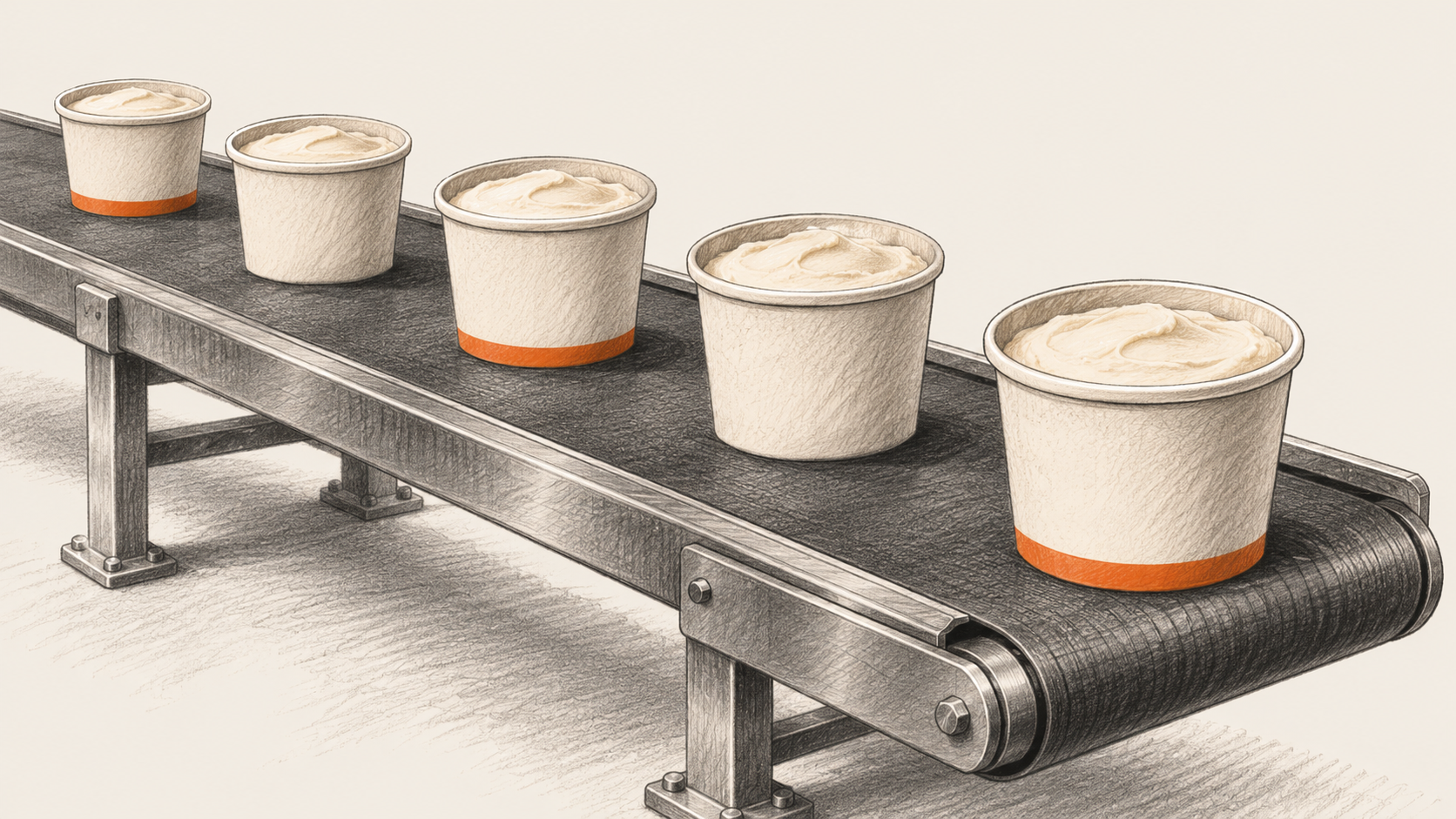
AI-generated conceptual illustration for BIG CHANGE; fictional equipment and production setting.
IBM Research on November 18 described time-series forecasting and anomaly detection through Confluent Flink SQL. The CPU-capable models forecast future values from streams of measurements and flag readings outside an expected range.
## The big change
- Cloud’s AI\_FORECAST is an evaluation-only early-access feature; the on-premises functions are in preview and require an administrator’s model-server setup.
- Event time records when a reading occurred, while processing time records when software handles it. Delays can make those clocks disagree.
- Forecast quality needs testing against later observations that were unavailable when the prediction was made, including the relevant distance into the future.
## What the integration provides
Confluent Cloud’s AI\_FORECAST uses managed models: IBM Granite TinyTimeMixer (TTM) by default, plus TimesFM 2.5, FlowState and PatchTST-FM. It does not accept user-supplied models. Confluent Platform’s preview lists TTM-R3, FlowState and PatchTST-FM, and requires Flink 2.3, registered functions and locally deployed model servers. The Cloud function returns forecast ranges; its documentation recommends evenly spaced timestamps.
IBM’s ice-cream production example illustrates a forecast prompting an operator-reviewed change. It is a scenario, not a reported plant result. Predictions still feed application logic and human decisions; they do not establish that a physical adjustment improved production.
## Why compact models matter
IBM’s TTM-R3 model card describes a family that separates longer-term trends from shorter-term variations. It also describes selecting or blending smaller expert models according to the input, rather than relying on one large model for every forecasting setting. These are numerical forecasting models, with support for adaptation to a particular domain and for using additional explanatory variables. These are model-family capabilities; individual product interfaces may expose a narrower set.
The card reports forecasting benchmarks and CPU throughput, but its own R3 paper and example notebooks are still marked as forthcoming. Those are developer-reported model results, not a test of an entire streaming application’s response time. A model’s reported speed does not by itself specify the time spent preparing inputs or delivering useful outputs. The card provides a reason to investigate compact forecasting models, while leaving the application’s performance to be measured in its own conditions.
## A live stream has more than one clock
Apache Flink’s documentation distinguishes an event’s timestamp from the computer’s clock when it processes the event. Consider an illustrative sensor reading measured at 09:59 but arriving at 10:02. An hourly window based on arrival time and one based on the measurement time can group that reading differently. The distinction is about the meaning of the observations, not merely how quickly a processor can run.
Flink uses watermarks to signal progress in event time, allowing operations such as windows to know when a period can close. Waiting for readings that arrive out of order adds latency, and a finite waiting period leaves a limit on how completely late data can be incorporated. “Streaming” therefore describes a way of handling continuing data; the timing policy still helps determine what information is available for the next calculation.
## A forecast needs a future test
Hyndman and Athanasopoulos explain a separate check in Forecasting: Principles and Practice. A model can fit its recorded history closely and still forecast poorly. Their rolling-origin evaluation repeatedly makes a forecast using only earlier observations, moves the cutoff forward and compares the predictions with later values. This recreates the information boundary faced when predicting, rather than letting future observations help construct the answer.
The forecast horizon is how far ahead an estimate reaches. Testing a next-step prediction does not settle accuracy several steps ahead. Errors are averaged across those successive tests, and forecast intervals can be assessed separately from a single predicted value. For an operator, evaluation at the needed horizon is more useful than a close fit to history that was already available to the model.
## Sources
- [IBM’s November 18 announcement](https://huggingface.co/blog/ibm-research/time-series-powered-streamhouse) — Integration and explicitly illustrative use cases.
- [Confluent Cloud forecasting](https://docs.confluent.io/cloud/current/ai/builtin-functions/forecast.html) — Early-access scope, managed models and input/output conditions.
- [Confluent Platform setup](https://docs.confluent.io/cp-flink/current/jobs/sql-statements/ai/set-up-ai-functions.html) — Preview, model servers and Flink requirements.
- [IBM Granite TTM-R3 model card](https://huggingface.co/ibm-granite/granite-timeseries-ttm-r3) — Architecture, developer-reported benchmarks and publication limits.
- [Apache Flink’s time concepts](https://nightlies.apache.org/flink/flink-docs-stable/docs/concepts/time/) — Event time, processing time, watermarks and lateness.
- [Forecasting: Principles and Practice](https://otexts.com/fpp3/toolbox.html#time-series-cross-validation) — Future-data separation, forecast horizons and evaluation.
The BIG CHANGE newsletter
The big picture. At your pace.
Recent stories on AI and robotics, the shifts worth watching and practical ideas to use. Choose a daily briefing, weekly digest or monthly perspective.
Next scheduled send (UTC): . Your first edition arrives at the next scheduled send after you confirm.
Your privacy, your choice.
Necessary storage supports site security and remembers your choices. Optional Google Analytics stays off until you allow it. You can read every story with necessary storage only. Privacy details