# IBM voice demo exposes a search gap
> Working speech still left the assistant searching the wrong references.
By BIGCHANGE.AI Editorial
Published: 2026-11-25T20:31:37.812Z
Updated: 2026-11-25T20:31:37.812Z
Canonical: https://bigchange.ai/blog/ibm-indic-voice-search-gap
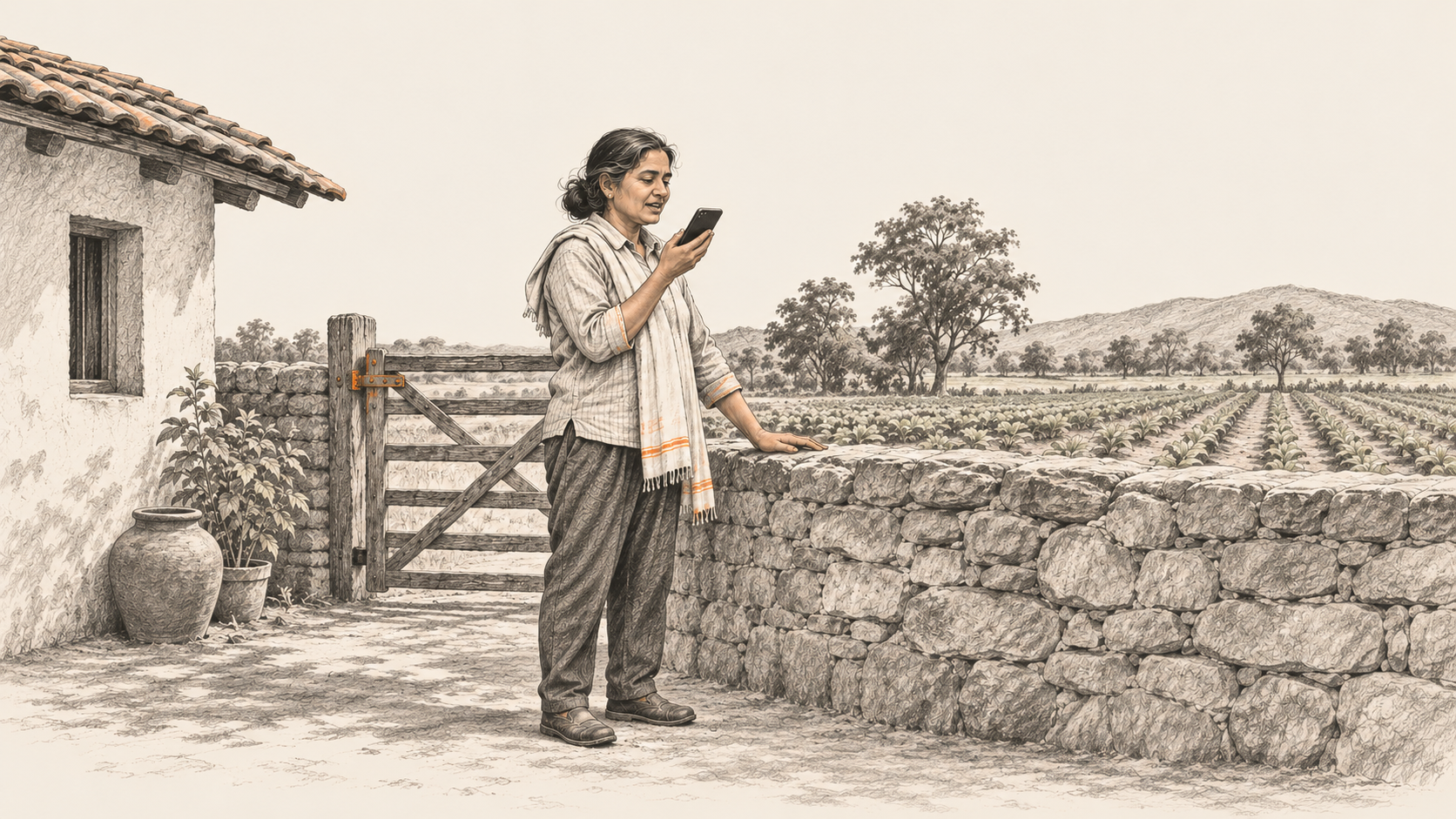
AI-generated conceptual illustration for BIG CHANGE; fictional voice interaction, not an actual IBM demo user or farming result.
On November 25, IBM Research described a CUGA-based Indic voice assistant whose English-only search could fail even when its speech layers worked.
## The big change
- IBM says the assistant’s speech worked, but wrong retrieved passages left it without evidence for an answer.
- Multilingual embeddings connect related meanings across languages, but their language coverage and input limits still require attention.
- FAO’s collection celebrates women’s food knowledge, a purpose distinct from validating an automated farming adviser.
## A quiet failure
IBM says Hindi or Tamil questions retrieved five wrong passages. Told to use only those passages, the model replied that the handbook lacked an answer. There was no software error to flag the mismatch. The team replaced the English-only embeddings with multilingual-e5-large.
## What the reference actually contains
The demo identifies FAO’s 2026 *From land and water: Recipes from women pastoralists, producers, fishers and farmers*. FAO describes it as a cookbook celebrating women’s skills, traditions and innovations across food systems. It is a collection of situated knowledge, not evidence that a chatbot can diagnose an unfamiliar crop problem.
The publisher’s related material includes an account of a Kenyan farmer preserving indigenous seeds and the knowledge inherited from her grandmother. That gives the collection a concrete human purpose: making practices and experiences visible alongside recipes. Reading or retrieving those accounts does not establish that a recommendation fits a different farm, season or local constraint.
## Why changing the search model matters
An embedding represents text as a list of numbers used to compare meanings. The multilingual E5 report describes training on paired texts, first with broad multilingual material and then labeled examples. Related questions and passages can be placed near each other even when their wording differs. This supplies a way to rank candidates for the answering model; it does not translate or verify the handbook itself.
The model card warns that low-resource languages can perform worse and that long inputs are truncated at 512 tokens (small pieces of text). A large document therefore needs useful passages rather than one enormous input. It also says relative ranking matters more than an isolated similarity score. A high-looking score alone is not a probability that an answer is correct.
## A retrieval benchmark is a narrower test
The separate MIRACL project illustrates how relevance can be checked. It provides human judgments of Wikipedia passages across 18 languages, including Hindi and Telugu. Its published task is monolingual: a question and the searched collection are in the same language. Results test whether relevant passages appear in ranked lists; they do not test microphone recognition, pronunciation or usefulness to farmers.
The E5 report gives a 16-language development-set average on MIRACL. That table evaluates same-language text retrieval, not spoken questions or cross-language searches of an English book.
## The hosted speech choices differ
The demo’s public configuration enables Sarvam and an open-source service. Sarvam requires a user key. The hosted alternative uses cloud-hosted SraVaani recognition and the browser’s voice, with text fallback where a device lacks a voice. Svara is a local-run option. IBM describes page citations; BIG CHANGE did not submit a question or audio.
Sarvam’s separate documentation distinguishes transcription in the spoken language from translation into English. Those are different operations: recognizing words does not necessarily remove a language mismatch before search. Its current catalog lists 23 languages for Saaras v4 recognition and 11 for Bulbul v3 speech generation. A recognizer’s language count does not describe the languages a speech synthesizer can speak.
For a service used across several languages, recognizing the question and reading the reply need compatible coverage. Neither language count measures successful conversations. An evaluation also needs to identify its questions, document collection and judgments of relevance. Without those conditions, a broad multilingual claim tells a reader little about which searches actually worked.
## Sources
- [IBM’s original account](https://huggingface.co/blog/ibm-research/an-indic-voice-agent-with-cuga) — November 25 qualitative demonstration.
- [Current CUGA Apps demo](https://huggingface.co/spaces/ibm-research/cuga-apps) — Landing, client and configuration checked.
- [FAO’s original book record](https://doi.org/10.4060/ce1223en) — 2026 collection and related firsthand stories; no agent evaluation.
- [Multilingual E5 original report](https://arxiv.org/html/2402.05672v1) — February 2024 methods; pooled with model card limitations.
- [Multilingual E5 model card](https://huggingface.co/intfloat/multilingual-e5-large) — Language, ranking and 512-token limits; same underlying work.
- [MIRACL’s original methodology](https://project-miracl.github.io/) — Human relevance judgments and monolingual task; not speech testing.
- [Sarvam’s model documentation](https://docs.sarvam.ai/api/getting-started/models) — Current model-specific coverage; pooled with speech API modes.
- [Sarvam’s speech recognition documentation](https://docs.sarvam.ai/api/api-guides-tutorials/speech-to-text/overview) — Transcription and translation are distinct modes.
The BIG CHANGE newsletter
The big picture. At your pace.
Recent stories on AI and robotics, the shifts worth watching and practical ideas to use. Choose a daily briefing, weekly digest or monthly perspective.
Next scheduled send (UTC): . Your first edition arrives at the next scheduled send after you confirm.
Your privacy, your choice.
Necessary storage supports site security and remembers your choices. Optional Google Analytics stays off until you allow it. You can read every story with necessary storage only. Privacy details