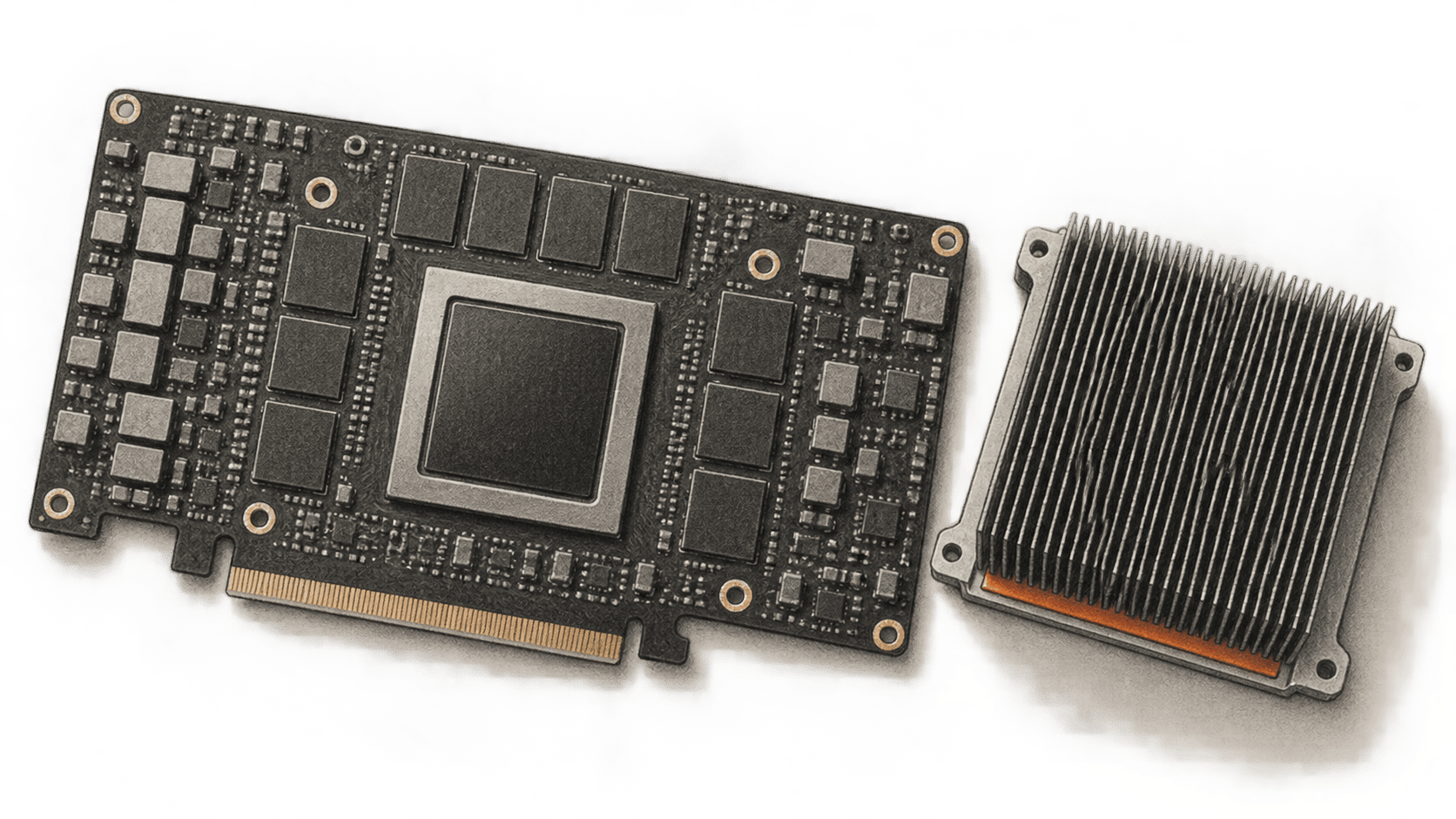
Intel has given buyers more detail about its GPU D-series, formerly called Crescent Island, but the memory figure at the center of its October 12 announcement needs a close read. Intel's own PCIe card has 160 GB of LPDDR5X memory. The design also lets original design manufacturers (ODMs) build their own branded cards with options up to 480 GB. Intel says customer sampling is underway; its announcement and product page do not give a general availability date or price.
That distinction matters to teams sizing an inference server. A 480 GB partner configuration is a possible design within the D-series, not the memory specification of the Intel-branded card a buyer can assume will arrive in every system.
The big change
- What changed: Intel disclosed D-series specifications and said customers are sampling the GPU. Its release distinguishes the 160 GB Intel-branded PCIe card from ODM-branded options that can reach 480 GB.
- Why it matters: Memory capacity affects which models and inference workloads a system architect can evaluate on a card. Buyers need the exact vendor configuration before using Intel's upper-end capacity claim in a deployment plan.
- What to watch: Intel has not supplied a general availability date or price in these sources. Product-level specifications, partner system details and independently measured results would make the sampling announcement more useful for procurement decisions.
One GPU family, different card designs
Intel's October 12 release describes the D-series as an inference accelerator built on its Xe3P architecture. It gives a family-level ceiling of 480 GB LPDDR5X, 1.5 TB/s of memory bandwidth and 1.3 petaflops of FP8 compute within a 350 W power envelope. The release's notes then narrow the memory claim: “Intel branded PCIe card has 160GB LPDDR5x,” while the design enables ODM-branded cards with flexible options up to 480 GB.
The D270 product page twice says “up to 480 GB” in its D270 marketing copy. Read alone, that wording could suggest the Intel card itself has that capacity. The more specific configuration statement in the release's notes assigns 160 GB to Intel's branded card. Intel has not provided, in these two sources, a list of partner SKUs that identifies which ODM will ship a 480 GB configuration or when.
Intel positions the cards for long-context and concurrent inference, where model weights and the growing key-value cache use device memory. It says a single D-series card can support models with up to 300 billion parameters, and an eight-GPU system can support more than one trillion parameters. Those are Intel's stated capability figures, without a public workload configuration in the cited release that would let buyers reproduce them. The numbers also should not be read as an independently tested result for the 160 GB D270 card.
What buyers can evaluate now
The product page describes a standard PCIe 5.0 form factor and passive air cooling. It lists 32 Xe3P cores, 256 XMX matrix engines and a 350 W power figure, and names PyTorch and vLLM among the software environments Intel is targeting. Intel says the shared Xe software foundation is meant to help move applications across its GPU platforms. These are product specifications and vendor plans; BIG CHANGE has not run the hardware or verified framework behavior.
For a sampling conversation, the practical first question is which physical card and memory configuration a vendor is offering. The answer sets the context for power, software and workload measurements. Intel's published figures do not establish a price, an orderable date, or comparative performance under a buyer's own model and latency target. Its product page says performance projections against Nvidia's RTX Pro 6000 rely on Intel internal analysis of publicly available information as of February 2026. It does not present independent D-series benchmark results.
The announcement gives system architects a design to investigate, especially where a PCIe, air-cooled inference card fits an existing rack. A purchase decision still depends on a specified shipping configuration and observed results from the intended serving workload.
Sources & further reading
- Intel press release, October 12, 2026. Primary announcement for D-series architecture, stated performance and model-size claims, customer sampling and ecosystem plans. Its Notes and Disclaimers specify 160 GB on the Intel-branded card and up to 480 GB on ODM-branded designs. All performance claims are Intel's.
- Intel D270 product page, checked October 13, 2026. Intel's product description for form factor, cooling, cores, software positioning and power. Its “up to 480 GB” D270 copy does not separately identify the Intel-branded 160 GB card; the release note supplies that distinction. The page's comparative projections are based on Intel internal analysis, not an independent BIG CHANGE test.