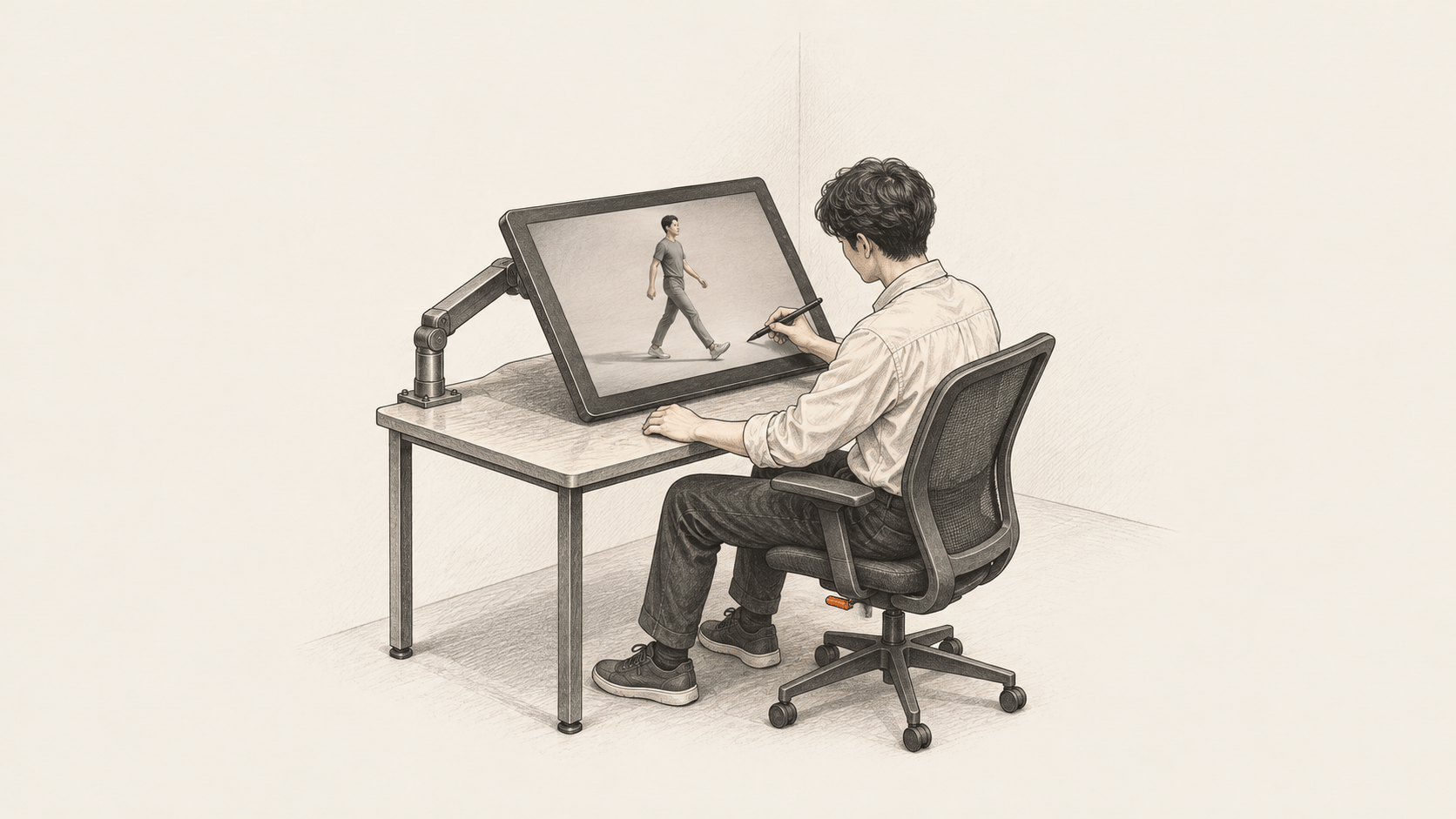
On November 24, NVIDIA detailed Kimodo motion generation inside Unreal Engine 5.9 Preview’s Sequencer timeline.
The big change
- Animators can combine a written action, a drawn route and poses at chosen frames. The preview integration brings those controls into the timeline where a sequence is assembled.
- Kimodo generates a sequence of skeletal poses rather than finished footage. Its research design separates overall movement from body articulation, helping a character follow a route while its limbs move.
- Sequencer provides a place to inspect timing, review individual moments and adjust animation. A generated candidate still needs that editorial work before it becomes a convincing performance.
Directing the movement
Epic’s AnimGenOffline plugin provides the generation framework inside Sequencer; NVIDIA describes Kimodo as its first integrated model. A spline supplies a curved route, while target poses constrain particular frames.
The original March 16 Kimodo paper describes training on 700 hours of optical motion capture: recorded human movement. Its diffusion model progressively refines a noisy pose sequence using text and constraints. A first stage predicts the character’s overall route; a second predicts the body’s movement relative to it. This separates where the character travels from how its joints articulate.
The researchers describe connecting existing motion-capture clips by constraining the beginning and end of an intervening movement. That is a documented authoring example, not evidence that every requested transition will look right. Their released demo also uses cleanup to reduce sliding feet and help outputs meet constraints precisely.
A generated take still has timing
Epic’s Sequencer guide describes a non-linear timeline containing tracks, assets and keyframes. Characters, cameras, audio and effects can occupy separate tracks. Keyframes record values at particular moments. Moving the playhead previews a moment in the sequence; the curve editor provides finer control over animation keyframes and their transitions.
This matters because the same movement can serve a scene differently depending on when it happens. Consider an illustrative shot in which a person pauses before turning toward a sound. Reviewing the pause, turn and accompanying audio together is a sequencing problem. A plausible individual pose does not establish that the reaction lands at the intended moment.
The editor’s playback range and frame markers let a creator review a chosen interval instead of judging only the complete take. These are ordinary timeline tools, not evidence that a generated result has passed an artistic or technical review. They preserve a human decision about which moments work together.
Preview scope and access
Epic’s release notes, updated November 19, already describe the integration. Epic warns that preview builds remain unstable and recommends testing on a project copy.
The cited integration notes do not provide a cross-platform Kimodo compatibility matrix. The standalone research package is primarily Linux-tested and requires approved access to its Llama-based text encoder; those conditions do not certify the Unreal plugin’s requirements.
The research paper explicitly describes offline motion authoring, with generation taking several seconds, rather than a system reacting to a changing environment during play. NVIDIA’s illustrated preview is a demonstration, not a benchmark of artist time saved or production-ready clips.