# LoRN steers frozen robot policies
> A fixed robot policy can produce different movements from different starting noise. Adapting that input requires its own learning process, experience and evaluation.
By BIGCHANGE.AI Editorial
Published: 2026-11-21T03:30:38.208Z
Updated: 2026-11-21T03:30:38.208Z
Canonical: https://bigchange.ai/blog/lorn-robot-noise-steering
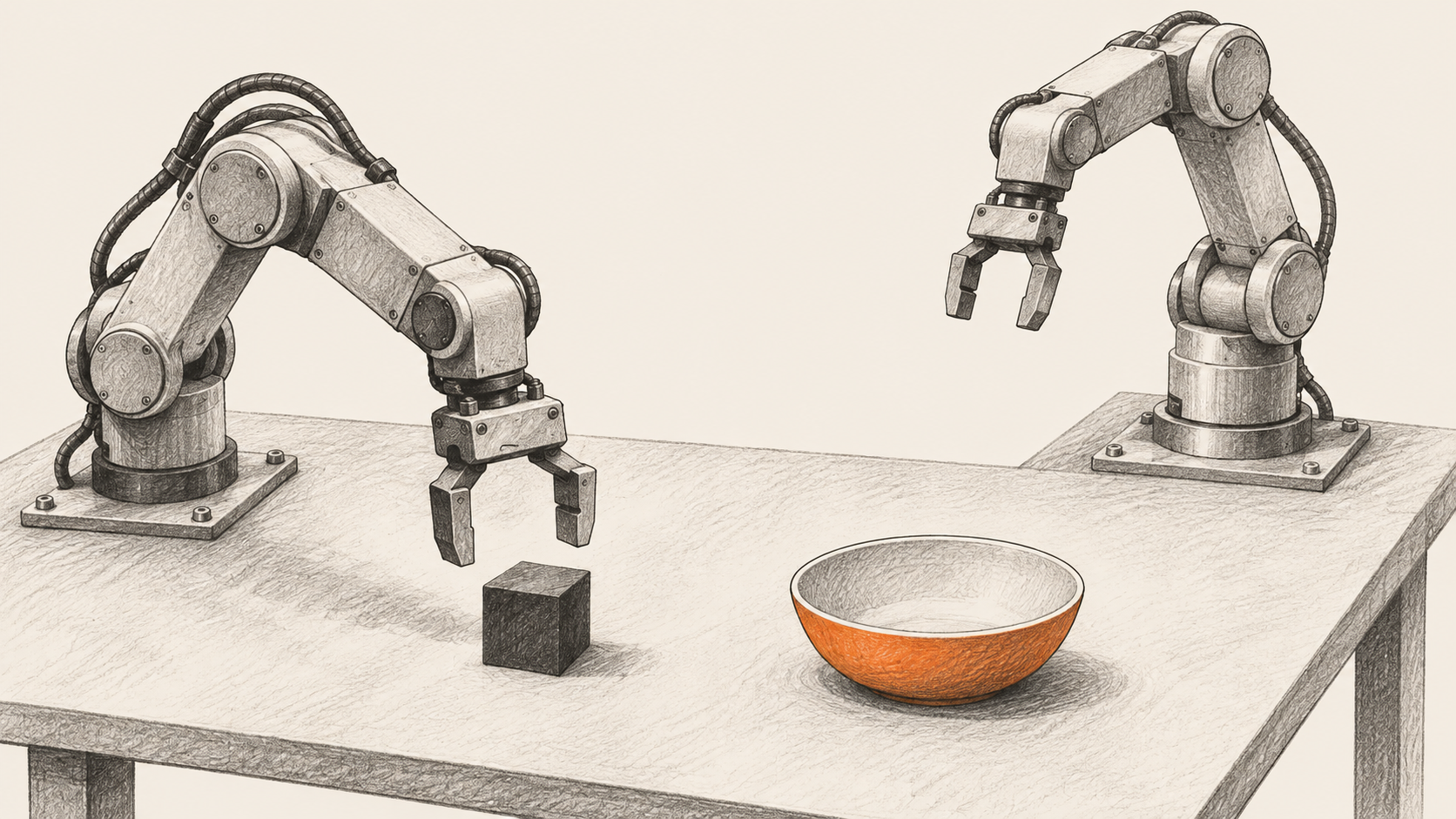
AI-generated conceptual illustration for BIG CHANGE; fictional hardware and setting.
A November 17 [preprint](https://arxiv.org/html/2611.23628v1) introduces LoRN, which adapts generative robot policies through learned changes to their starting noise.
## The big change
- LoRN trains a steering actor with reinforcement learning while leaving the base policy's weights frozen.
- Noise steering still requires learning from experience and a reward signal. Earlier DSRL research explains how that learning can happen outside the original robot policy.
- A world-action model predicts future images alongside motor commands. Those imagined frames help determine an action, but the robot still needs observations of what actually happened.
## Why noise can change a movement
A robot policy translates observations into movements. In the original Diffusion Policy research, the model learns from demonstrations and generates a sequence of actions by repeatedly refining an initially noisy candidate. The noise is a starting point for the calculation, rather than a disturbance deliberately added to a motor. Observations condition that calculation, so the resulting movement should fit the scene. The model can represent several plausible movements instead of averaging them into one potentially unhelpful compromise. [The original paper](https://diffusion-policy.cs.columbia.edu/diffusion_policy_ijrr.pdf) explains this action-generation process.
Its Push-T task provides a concrete example: the robot must push a T-shaped block into a target region, then move its tool to a finishing zone. Completing the sequence matters as well as choosing a useful first motion. The paper's receding-horizon control predicts ahead, executes part of the sequence, and then replans using new observations. That arrangement balances consistency across movements with opportunities to respond when the scene changes. A predicted sequence therefore has a different role from an irrevocable script for the entire task.
## A frozen policy still leaves a learning problem
[June 2025 DSRL research](https://arxiv.org/html/2506.15799v1) moved adaptation into this initial-noise space. A separate learner chooses a noise input, the existing policy converts it into an action, and the environment supplies experience and a reward. An actor learns which inputs to choose; a critic estimates their value. The original policy can be treated as a black box because the learner needs its outputs, rather than gradients through its internal denoising steps. Freezing those weights therefore changes where the optimization happens; it does not eliminate training.
Exploration has limits. DSRL's authors say exploration depends on the underlying policy and provide no guarantee that every policy is steerable. Choosing among its generated behaviors cannot be assumed to supply every missing skill. Developers need to establish whether useful behavior is reachable through the available inputs, and whether experience and rewards can teach the smaller learner to find it.
## Why a video input can affect an action
The [DreamZero primary paper](https://arxiv.org/html/2602.15922v1) describes a world-action model that jointly generates future video and actions. It conditions those predictions on images, language and the robot's own state. Visual futures and motor commands are learned together within one model, rather than producing a movie and asking an unrelated controller to imitate it afterward. This makes the visual prediction part of the action-generating computation. A generated future is still a prediction: after executing an action chunk, DreamZero replaces predicted frames in its stored context with actual observations.
That distinction matters when interpreting an attractive robot video. DreamZero's execution design uses feedback from the physical scene, and its paper treats inference latency as a separate control problem. Merely producing a coherent imagined movement does not establish that a robot executed it or reacted in time. Joint prediction explains how a visual input can influence motor output; execution and feedback determine what happens outside the model.
For Cosmos3-Edge, LoRN expands the actor's 32 chosen numbers through a fixed random mapping into 506,880 video-noise entries; the action input has 256. The mapping reduces search dimension; separate scaling controls noise magnitude.
## What LoRN's tests establish
Across Cosmos3-Edge and DreamZero-14B on four RoboLab tasks each, plus DreamZero-5B on two LIBERO tasks, average success rose 26.2 percentage points over the base policies. That averages ten model–task means with differing protocols, rather than one pooled physical trial. Video steering's Moka-pot mean was 48.4%, below the 56.0% baseline.
On the physical YAM station, LoRN placed a cube in a bowl in 6/10 trials, versus 0/10 for unsteered GR00T N1.7 and 4/10 for DSRL. Actors were selected from three simulation seeds; there was no further hardware training. The separate handover test first fine-tuned π0.5 on 50 simulation demonstrations. These small tests do not establish general reliability.
## Sources
- [LoRN v1](https://arxiv.org/html/2611.23628v1) — Simulation and physical tests.
- [Diffusion Policy original research](https://diffusion-policy.cs.columbia.edu/diffusion_policy_ijrr.pdf) — Action generation, Push-T and receding-horizon control.
- [DSRL v1](https://arxiv.org/html/2506.15799v1) — Separate learner, rewards, model access and steerability limits.
- [DreamZero v1](https://arxiv.org/html/2602.15922v1) — Joint video/action prediction, observation feedback and control latency.
The BIG CHANGE newsletter
The big picture. At your pace.
Recent stories on AI and robotics, the shifts worth watching and practical ideas to use. Choose a daily briefing, weekly digest or monthly perspective.
Next scheduled send (UTC): . Your first edition arrives at the next scheduled send after you confirm.
Your privacy, your choice.
Necessary storage supports site security and remembers your choices. Optional Google Analytics stays off until you allow it. You can read every story with necessary storage only. Privacy details