# NC AI reports welding results for a compact vision model
> NC AI reports results for a compact industrial vision model; field performance remains unverified.
By BIGCHANGE.AI Editorial
Published: 2026-11-03T16:09:38.406Z
Updated: 2026-11-03T16:09:38.406Z
Canonical: https://bigchange.ai/blog/nc-ai-vaetki-vision-welding-model
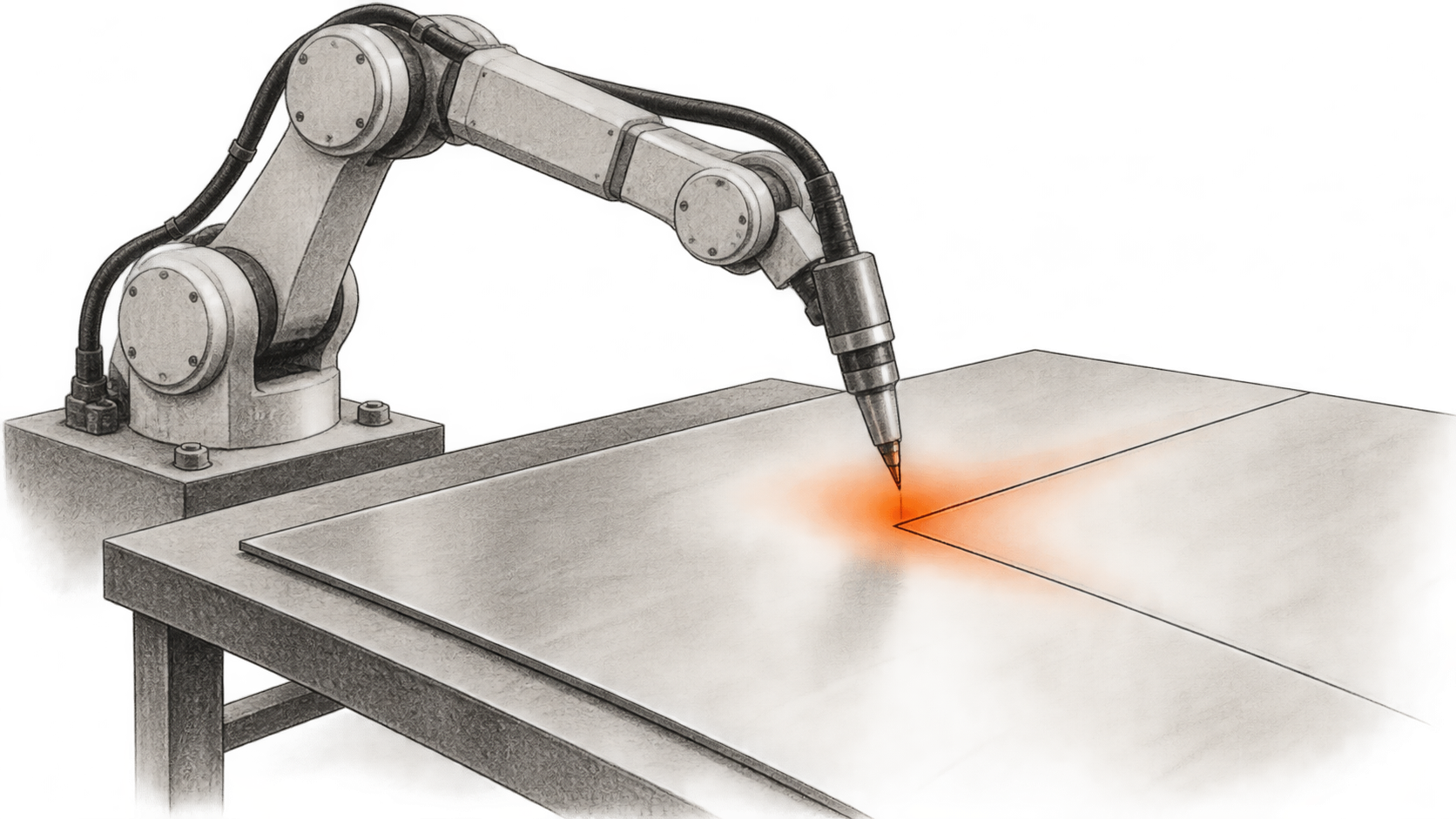
AI-generated conceptual illustration by BIG CHANGE; not a photograph of ISPARK hardware or a measured weld.
NC AI says it has developed VAETKI Vision 3B, a compact vision-language model, and a welding-specific version.
## The big change
- The company designed the model for industrial visual interpretation.
- NC AI reports higher welding classification accuracy than its base model.
- The company plans robotic deployment; field use remains unverified.
A vision-language model interprets images alongside words. [NC AI says](https://www.denews.co.kr/news/articleView.html?idxno=42979) its three-billion-parameter model analyzes eight frames over four seconds to track movement and is designed for limited computing resources.
The company says it fine-tuned the base model on welding data. It reports classification accuracy rising from 41.1 to 80.9.
NC AI names RIAWELC as the classification benchmark. Its radiographic images assess a different task from demonstrating that a robot can weld successfully.
The [dataset authors](https://github.com/stefyste/RIAWELC) describe 24,407 radiographic images in four categories: lack of penetration, porosity, cracks and no defect. A classification result concerns the assigned image labels; it does not by itself measure a physical welding process.
In a [separate 2025 preprint](https://arxiv.org/abs/2503.16537), researchers evaluated other multimodal models on weld acceptability across three contexts. Their prompting technique improved recall in some settings but had inconsistent effects in others. The result illustrates that the effect of prompting can depend on the evaluation context.
The [ISPARK paper](https://arxiv.org/abs/2610.21939) studied simulated welding power control, covered earlier by [BIG CHANGE](https://bigchange.ai/blog/simulated-robotic-welding-control-loop-ispark). Its authors said physical testing remained necessary.
The announcement does not establish hardware speed, on-site validation or safe autonomous welding.
## Sources
- [NC AI model announcement](https://www.denews.co.kr/news/articleView.html?idxno=42979) — Company-reported model and plans.
- [RIAWELC dataset](https://github.com/stefyste/RIAWELC) — Original radiographic welding-defect image dataset.
- [Multimodal models and welding assessment](https://arxiv.org/abs/2503.16537) — Independent preprint on weld-image evaluation.
- [ISPARK robotic welding simulation](https://arxiv.org/abs/2610.21939) — Separate simulation study discussed in earlier coverage.
The BIG CHANGE newsletter
The big picture. At your pace.
Recent stories on AI and robotics, the shifts worth watching and practical ideas to use. Choose a daily briefing, weekly digest or monthly perspective.
Next scheduled send (UTC): . Your first edition arrives at the next scheduled send after you confirm.
Your privacy, your choice.
Necessary storage supports site security and remembers your choices. Optional Google Analytics stays off until you allow it. You can read every story with necessary storage only. Privacy details