# Rover demo pairs chip-run audio with host-run vision
> Recognizing sound, reading changing pixels and commanding wheels are separate processing tasks.
By BIGCHANGE.AI Editorial
Published: 2026-11-25T08:28:38.020Z
Updated: 2026-11-25T08:28:38.020Z
Canonical: https://bigchange.ai/blog/neuromorphic-rover-audio-host-vision
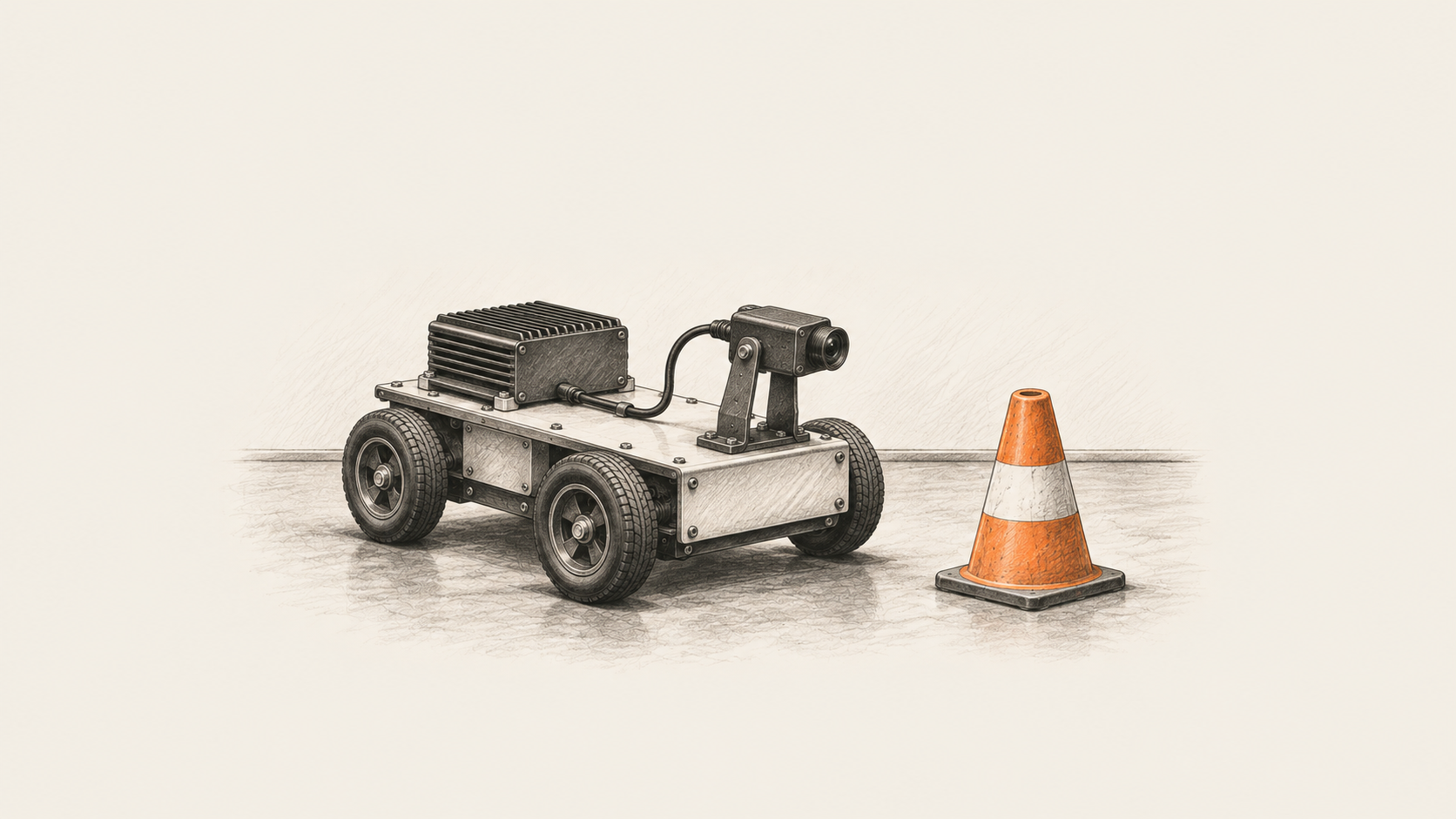
AI-generated conceptual illustration for BIG CHANGE; fictional civilian research equipment and setting, not LISA, a recorded test, autonomous cone avoidance or a measured result.
Spain's Instituto Tecnológico de Informática described LISA, a rover combining conventional audio, chip-based audio and event-camera vision, in a November 20 report.
## The big change
- Xylo Audio 2 combines sound encoding with a spiking neural network on one chip. That moves a particular processing stage out of a general-purpose computer; it does not replace every part of a robot.
- Event cameras report changes in brightness rather than repeatedly capturing complete pictures. Software can collect those events into images, so a frame’s display rate is a separate choice from what the sensor originally reported.
- The rover demonstrations establish integration under controlled conditions. They do not establish comparative system energy, latency or accuracy, and the cone detector does not yet control motion.
## Chip and host
On LISA, Xylo encodes sound and runs the network on-chip. The Jetson AGX Orin host reads output states, selects a pitch class and routes commands through ROS 2. Conventional CNN14 audio also runs on the Jetson GPU.
SpikeYOLO, trained afresh for cones, runs on that GPU using quarter-second event accumulations. Its detections are displayed, not connected to movement.
## From sound to spikes
Rockpool's hardware documentation explains the Xylo Audio 2 division. An analog front-end converts microphone input into spikes across 16 channels before the neural-network core processes them. The microphone signal and the encoded events are different representations: one is an electrical sound signal, while the other is a sequence of discrete signals that the network can consume.
The documentation also separates preparing a model from running it. Software maps a network onto hardware resources and converts its parameters into a hardware configuration. Once configured for live inference, the audio front-end feeds the network directly, while software reads the outputs. A chip can therefore carry out inference without the host having to perform the same calculation on raw audio.
## A change is not a complete picture
Prophesee's sensor documentation describes each event as a pixel location, a time and a polarity indicating an increase or decrease in brightness. Events are emitted when a pixel's change exceeds a threshold. An edge moving across the camera's view can therefore produce a sequence of changes rather than a succession of conventional photographs.
The same documentation shows why an event stream may still be displayed as a picture. Software collects events over an accumulation period and places their positive and negative changes into an image. Changing that period changes which events appear together. A displayed frame rate and the duration of the information inside each frame need not be identical; the sensor stream and its visualization are different things.
## Recognizing a category is another task
PANNs stands for Pretrained Audio Neural Networks, a family of sound classifiers that includes CNN14. In the original author's account, its models learned from AudioSet recordings covering 527 sound classes. Training clips were weakly labelled: a label indicated whether an event occurred somewhere in a ten-second clip, rather than giving its precise start and finish.
That distinction affects what a prediction means. A tag such as speech identifies an event category within an audio segment. It does not itself specify when a robot should start moving, how far it should travel or whether movement is appropriate. Those are additional decisions for the application, not extra meanings contained in the sound label.
## Connecting perception to a response
Robot Operating System 2, or ROS 2, is a modular software platform for robotics. Its architecture paper describes components communicating through messages. A topic is a channel on which one component publishes information and others can subscribe. Device drivers, perception and control can be separate components, each operating on its own timing.
For an illustrative civilian inspection robot, showing a detected marker and issuing a stop command can be separate software functions. The published detection becomes a motion decision only when a controller is designed to act on it. The ROS authors also describe a tradeoff: asynchronous communication helps combine components, but can make deterministic timing harder. A sensor's update rate alone therefore does not describe the timing of the complete response.
LISA's pitch demonstration used a quiet, partly sound-absorbing room: high sounds triggered forward movement, low sounds backward movement, and silence stopped it. The separate cone circuit was teleoperated with room lights off and rover LEDs illuminating the scene.
Their result is a working research integration, not evidence of general field reliability.
## Sources
- [LISA rover technical report](https://arxiv.org/html/2611.27953v1) — Controlled integration, not a benchmark.
- [Xylo Audio documentation](https://rockpool.ai/devices/quick-xylo/xylo-audio-intro.html) — Audio 2 encoding, deployment and readout.
- [Event-camera concepts](https://docs.prophesee.ai/stable/concepts.html) — Events and their accumulated visualization.
- [PANNs author explanation](https://signalprocessingsociety.org/our-story/news-updates/2024/05/panns-large-scale-pretrained-audio-neural-networks-audio-pattern-recognition) — Original training task and weak labels.
- [ROS 2 architecture paper](https://arxiv.org/html/2211.07752v1) — Modular messages, timing and control.
The BIG CHANGE newsletter
The big picture. At your pace.
Recent stories on AI and robotics, the shifts worth watching and practical ideas to use. Choose a daily briefing, weekly digest or monthly perspective.
Next scheduled send (UTC): . Your first edition arrives at the next scheduled send after you confirm.
Your privacy, your choice.
Necessary storage supports site security and remembers your choices. Optional Google Analytics stays off until you allow it. You can read every story with necessary storage only. Privacy details