# OpenAI sets community commitments for future campuses
> OpenAI outlines local commitments and separate policy proposals for compute campuses.
By BIGCHANGE.AI Editorial
Published: 2026-11-05T12:35:39.016Z
Updated: 2026-11-05T12:35:39.016Z
Canonical: https://bigchange.ai/blog/openai-community-compact-compute-campuses
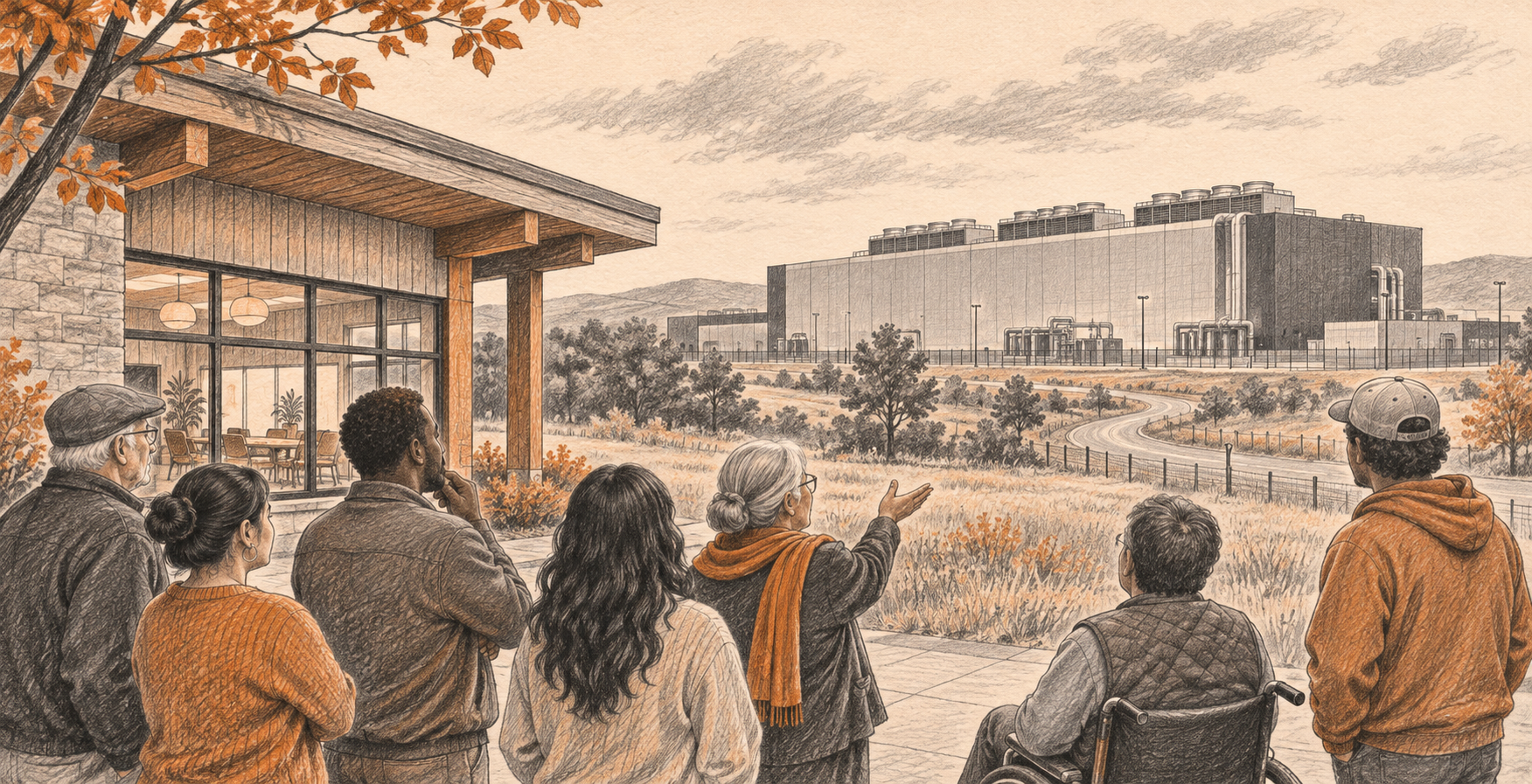
AI-generated conceptual illustration by BIG CHANGE.
On November 5 [OpenAI published](https://openai.com/index/setting-new-standard-responsible-ai-infrastructure/) a community compact for future campuses it owns and operates, alongside separate policy proposals. Each covered campus will have a local compact, OpenAI says.
## The big change
- OpenAI promises to cover power costs and provide financial assurances.
- Covered sites would have water plans, public reports and local input.
- The separate blueprint asks governments to set broader rules for developers; it is a proposal, not enacted law.
## Who pays, and who can see the impact?
The [national compact](https://cdn.openai.com/pdf/community-compact.pdf) promises to cover electricity and incremental infrastructure costs. Financial assurances before major spending aim to protect customers if a project is delayed, reduced or canceled. Local agreements and implementation determine how that protection works.
OpenAI promises site-level water and electricity reporting, independent noise studies, annual progress reports and a local contact. It will prioritize closed-loop or low-water cooling; this is a design preference, not a measured outcome.
Cooling choices involve tradeoffs. The [US Department of Energy](https://www.energy.gov/eere/femp/articles/guideline-water-and-energy-considerations-during-federal-data-center) notes that minimizing on-site water use can increase electricity use, shifting some water demand to power generation. The effect depends on equipment, climate and the electricity supply.
## Existing plans and proposed rules
The national document follows earlier site-specific commitments. For its planned [Effingham County, Georgia project](https://openai.com/index/building-ai-infrastructure-with-the-effingham-county-community/), OpenAI had already promised to pay project power costs and described a closed-loop cooling system and an $80 million community-benefit commitment over the project’s life. Those remain project commitments, not proof of completed benefits.
The separate [policy blueprint](https://cdn.openai.com/pdf/compute-campus-policy-blueprint.pdf) calls on public authorities to protect other utility customers, require impact reporting and make tax-incentive terms public, with ways to recover benefits if commitments are missed. Legislators and regulators would have to adopt such measures; OpenAI cannot create those rules by publishing a proposal.
## Sources
- [OpenAI: announcement](https://openai.com/index/setting-new-standard-responsible-ai-infrastructure/) — November 5.
- [OpenAI: national compact](https://cdn.openai.com/pdf/community-compact.pdf) — Future owned and operated sites.
- [OpenAI: policy blueprint](https://cdn.openai.com/pdf/compute-campus-policy-blueprint.pdf) — Proposed rules for policymakers.
- [OpenAI: Effingham project](https://openai.com/index/building-ai-infrastructure-with-the-effingham-county-community/) — Earlier project commitments.
- [US Department of Energy: cooling](https://www.energy.gov/eere/femp/articles/guideline-water-and-energy-considerations-during-federal-data-center) — General water and energy tradeoffs.
The BIG CHANGE newsletter
The big picture. At your pace.
Recent stories on AI and robotics, the shifts worth watching and practical ideas to use. Choose a daily briefing, weekly digest or monthly perspective.
Next scheduled send (UTC): . Your first edition arrives at the next scheduled send after you confirm.
Your privacy, your choice.
Necessary storage supports site security and remembers your choices. Optional Google Analytics stays off until you allow it. You can read every story with necessary storage only. Privacy details