Orakl Oncology has raised $34 million in a Series A co-led by Norrsken VC and Singular, the investor announced on November 12, to expand its cancer drug research platform.
The big change
- Orakl combines laboratory-grown tumour models, drug tests and patient information with machine learning. Its goal is to help drug developers decide which treatments and patient groups merit further research.
- A laboratory response and a benefit for a patient are different questions. Cultures allow controlled drug testing, but interpretation depends on how responses are measured and compared with clinical evidence.
- Norrsken says the company plans to expand its dataset and AI team and add lung and gastric cancers. Financing supports that work; it is not clinical validation.
A laboratory model, not a whole patient
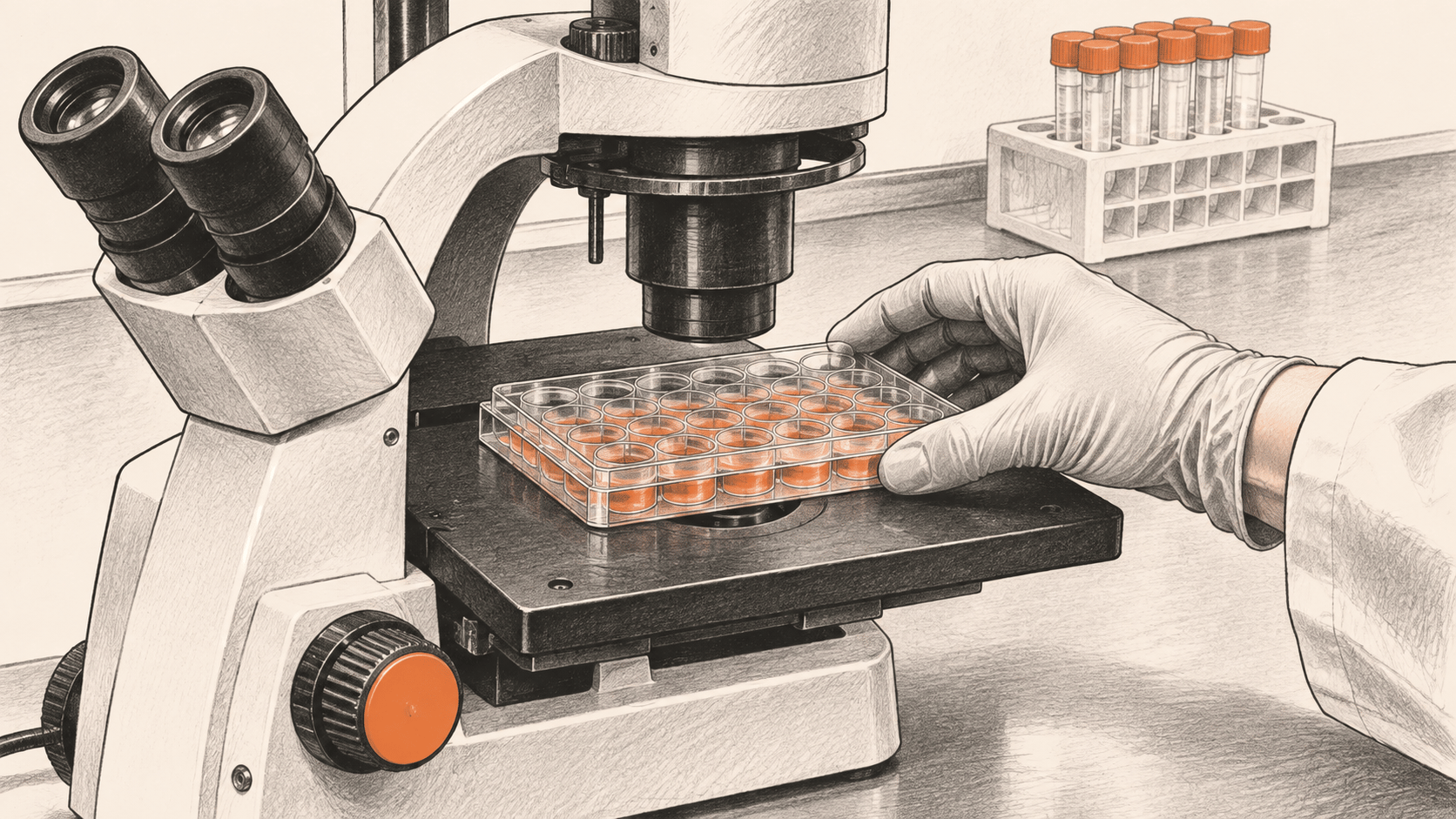
An organoid is a small three-dimensional cell culture grown from tissue. In cancer research, a patient-derived tumour organoid gives researchers a way to observe how cells from that tumour respond to a drug in the laboratory. It is a model of part of the biology, not a complete patient.
In one published colorectal-cancer study, researchers exposed organoids to different drug concentrations and imaged them daily for seven days. Changes in organoid size were used to quantify viability. The team derived treatment-specific thresholds using cultures from previously untreated patients and response rates from first-line clinical trials, then evaluated predictions in other patients.
This example shows why growing cells is only the beginning: an assay needs a defined measurement and a rule for interpreting it. The study did not test Orakl's model. Predicting a response is also a different task from demonstrating that choosing treatment with a test improves survival or quality of life.
What the April study can establish
The company-linked SCOPE preprint combines clinical prognosis with organoid drug sensitivity. Published trial criteria generate patient profiles matched to organoids, producing estimates for treatment groups. Development used 54 treatment lines from 52 patients; evaluation compared 32 arms from 23 published colorectal and pancreatic cancer trials. A trial arm is a group receiving a particular treatment. For 31 evaluable arms, the authors reported average absolute error below one month in predicted median progression-free survival—the time until cancer worsens or death, summarized across a treatment group.
This retrospective evaluation does not establish individual-patient benefit. Employees, founders and a paid consultant are among the authors; independent patient-level and genuinely prospective validation remain necessary. The April v1 text was read through indexed excerpts; it has not been peer reviewed. Its later revision could not be read in full, so these figures should not be assumed to describe the latest version.
What the funding will support
Norrsken says Orakl plans teams in the U.S. and U.K. and predictions across more than ten drug programmes. Those are stated goals rather than completed programmes or evidence that new treatments have been approved.
Before relying on a prediction, a buyer needs to know what decision it supports, which population it was evaluated in, and whether it was tested on information unavailable during development. A funding announcement explains who will finance research; evaluating a clinical tool requires a different kind of evidence.