# Panini studies robot-design rules in simulation
> Robot structures and controllers must be evaluated together. Simulation results also depend on the physical model and its validation against measured behavior.
By BIGCHANGE.AI Editorial
Published: 2026-11-21T02:55:38.128Z
Updated: 2026-11-21T02:55:38.128Z
Canonical: https://bigchange.ai/blog/panini-robot-grammar
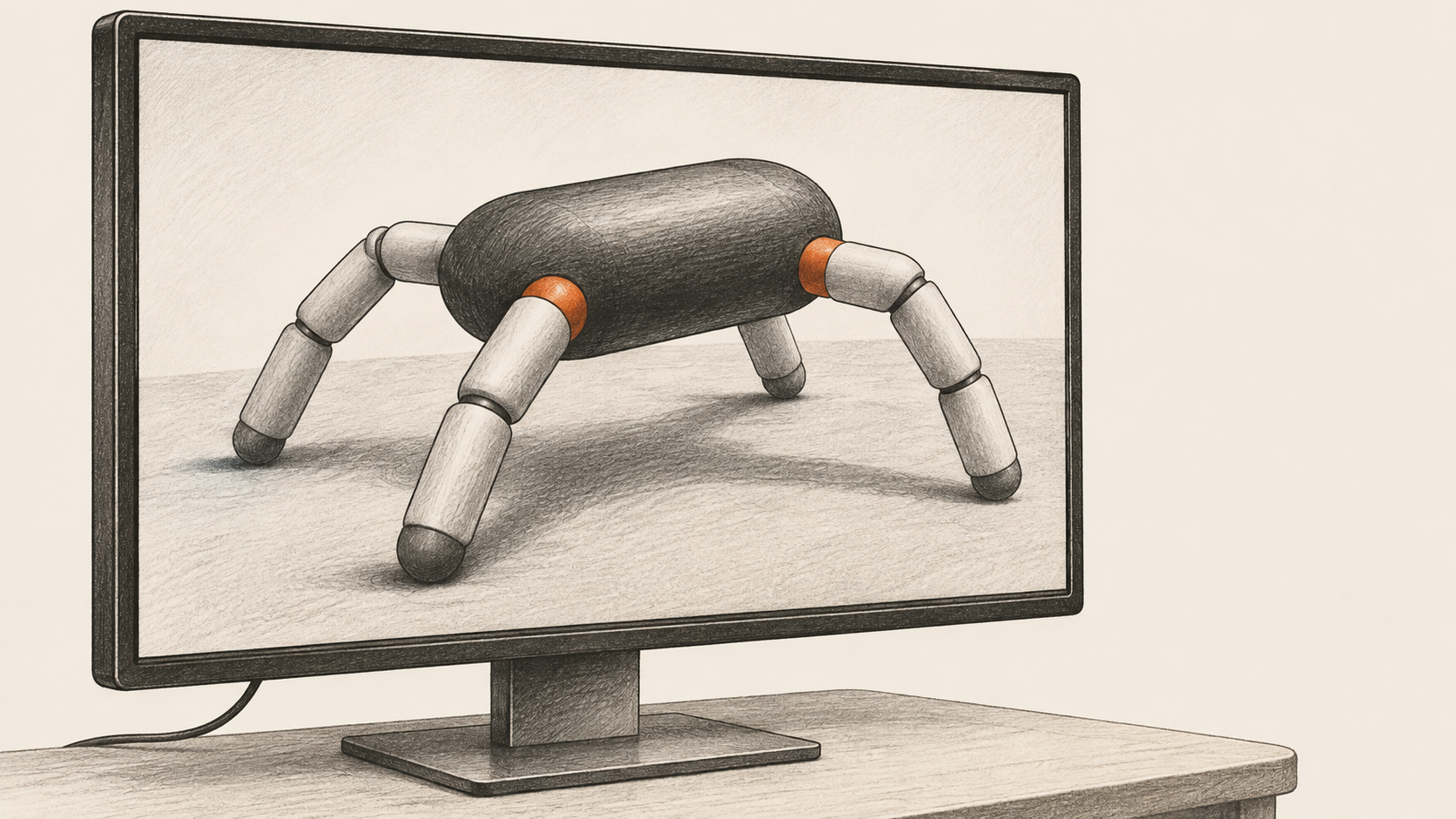
AI-generated conceptual illustration for BIG CHANGE; the displayed robot model is fictional.
A November 17 preprint by Mayukh Debnath and Manan Roy Choudhury tests Panini’s robot-design rules, distinguishing valid structure from better performance.
## The big change
- Panini constrains body-part connections and shared dimensions. Avoiding invalid representations does not establish good movement; task performance is tested separately.
- A robot’s structure and controller work together. Earlier grammar-based design research searches for bodies and their corresponding controls for a terrain, rather than treating a permitted arrangement of parts as a performance result.
- Simulation provides evidence within a physical model. Independent comparisons with real impacts show why contact parameters and modeling choices matter: a stable numerical run is a different claim from matching a real machine’s behavior.
## Rules organize the design space
MIT’s earlier RoboGrammar work gives a concrete account of this approach. Each robot is represented as a graph: components and their connections form a structure that can be generated through a sequence of rules. The available primitives include links, joints and wheels with specified sizes, axes and weights. Choosing the primitives also determines which kinds of candidate designs the system can represent.
RoboGrammar then searches for structures and corresponding controllers for specified terrain. Its search prioritizes promising partial designs, while a controller planning motions using a model helps evaluate movement. This separates two jobs: representing possible assemblies and testing how a complete assembly behaves under control. A rule can make an arrangement available for consideration without making it the best arrangement for a particular surface or objective.
Panini uses shared dimensions and coordinated limb placement around the torso rather than sampling mounting angles independently. A separate gate checks reach, clearance, mass, support area and foot separation.
Scored after three edits from feasible parents, 285/300 grammar trials passed stricter joint constraints, versus 166/300 range-limited trials. Separately, a coordinated hand-coded generator showed no resolved difference; the layout benefit was not unique to grammar syntax.
The main search, using fixed oscillating control, showed no statistically resolved advantage over strong generic optimizers across 30 methods and 24 seeds. A separate 144-body comparison with trained controllers also found no resolved advantage.
Some legal bodies missed a 2 cm displacement test. In another diagnostic across two specifications, all 400 bodies loaded and stepped in MuJoCo, although the geometric gate rejected 207. Its rejection meant failure of a design specification, rather than prediction of a simulator crash.
## What a simulation model actually contains
MuJoCo’s documentation explains why the model needs more than a visible outline. Geometric primitives are attached to rigid bodies and describe appearance and collision geometry. Mass and rotational inertia are specified or computed from shape and density. Inertia describes resistance to changes in rotational motion. Joints, limits and actuation describe how that structure can move and be driven.
The engine also uses a contact model, including friction and soft constraints. A simulated contact is therefore the result of a specified mathematical treatment, not a direct observation of two manufactured surfaces. The chosen representation controls what interactions are available to the solver. A mesh’s outer hull can fill in indentations; an inward-curving object needs several suitable pieces to represent its collision shape.
For a robot designer, this makes the checks traceable. One can ask what geometry, mass and contact assumptions were encoded before interpreting the resulting motion. That is a way to understand a model’s result, not independent proof that the corresponding hardware has been fabricated or validated.
## A measured example of the reality check
Brian Acosta, William Yang and Michael Posa compared simulated impacts with real cube tosses and Cassie biped jumping data. Their study identified contact parameters for specific simulator-and-system combinations, rather than assuming one setting captured every interaction. It used 22 real Cassie jumping experiments and distinguished measured motor torques from commanded torques to account for delays.
The simulators captured much of the bulk motion, including useful agreement in load-bearing joint behavior. Other motion remained sensitive to differences between the modeled contacts and the physical robot. The study also acknowledges uncertainty in the measured state, so even the reference comparison has conditions.
## Sources
- [Panini v1](https://arxiv.org/html/2611.23567v1) — Feasibility and search.
- [RoboGrammar original paper](https://people.csail.mit.edu/jiex/papers/robogrammar/paper.pdf) — Graph-based assemblies and terrain-specific controller search.
- [MuJoCo model documentation](https://mujoco.readthedocs.io/en/stable/overview.html) — Geometry, mass and contact modeling assumptions.
- [Real-impact simulation validation](https://arxiv.org/html/2110.00541v3) — Original physical comparisons, calibration and measurement limits.
The BIG CHANGE newsletter
The big picture. At your pace.
Recent stories on AI and robotics, the shifts worth watching and practical ideas to use. Choose a daily briefing, weekly digest or monthly perspective.
Next scheduled send (UTC): . Your first edition arrives at the next scheduled send after you confirm.
Your privacy, your choice.
Necessary storage supports site security and remembers your choices. Optional Google Analytics stays off until you allow it. You can read every story with necessary storage only. Privacy details