# PhoneBot puts an Android phone in charge of a small walking robot
> A UCLA team's PhoneBot preprint puts sensing and walking control on an Android phone, while 13 servos and a separate onboard computer still move the prototype.
By BIG CHANGE Editorial
Published: 2026-10-10T02:19:01.140Z
Updated: 2026-10-10T02:19:01.140Z
Canonical: https://bigchange.ai/blog/phonebot-smartphone-humanoid-robot-platform
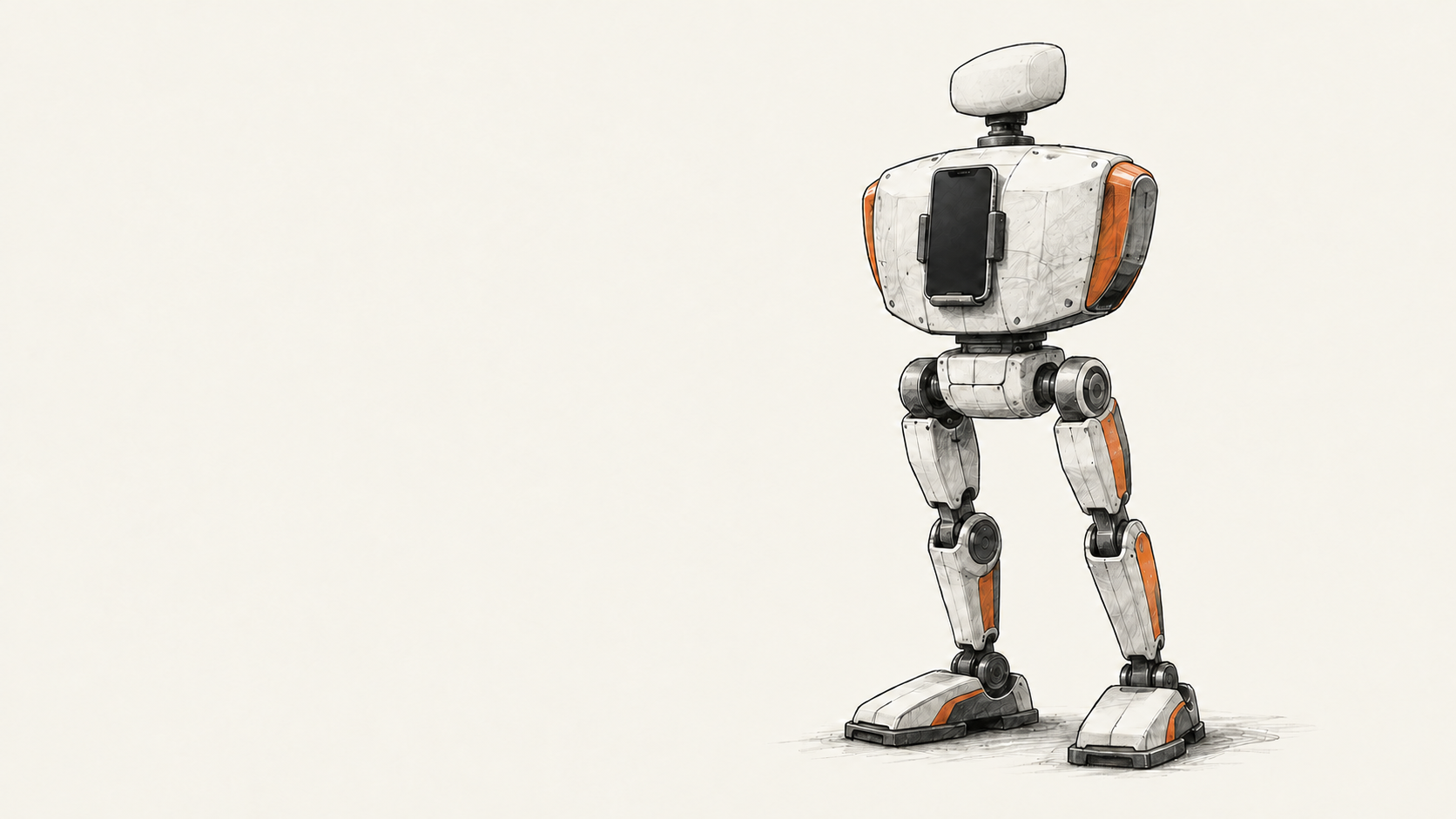
Conceptual illustration of a phone mounted on a robot's chest. The generic body does not depict the authors' prototype or a BIG CHANGE test. AI-generated conceptual illustration by BIG CHANGE.
A [preprint posted October 6](https://arxiv.org/html/2610.08737v1) describes PhoneBot, a 48-centimeter humanoid research prototype whose torso holds a smartphone. The phone supplies the camera, motion sensing, wireless link and computing used for walking control. The UCLA researchers still built a motorized body and a separate electronics path to turn the phone's commands into joint movements.
## The big change
- **What changed:** The researchers used a consumer Android phone as the main computer and sensor package of a walking robot. The paper reports tests on four handsets, including one released in 2017, while the legs and motor controller remain dedicated hardware.
- **Why it matters:** For robotics educators and researchers, reusing a phone could reduce the number of separate boards and sensors to integrate. The team's roughly $400 hardware estimate excludes the phone, and its reported demonstrations have not been independently replicated here.
- **What to watch:** Reproducing the platform depends on accessible build files and repeatable results beyond flat-terrain training. The authors also identify limited motor torque, no arms and an external laptop for dialogue as present constraints.
## What the phone controls
PhoneBot has 13 actuated joints: six in each leg and one that turns the torso-mounted phone. All use DYNAMIXEL XL430-W250-T servos. The paper lists each at $23.90, making the servos the main stated hardware expense. The assembled prototype weighs 1.8 kilograms including its phone, electronics and battery.
The Android app reads the phone's inertial sensor and receives joint feedback. A trained locomotion policy, run through TensorFlow Lite on the phone, computes joint-position targets. Those targets travel over Wi-Fi using UDP to a small onboard computer, which forwards them to the servo bus. The phone has no wired electrical connection to the body. Its camera also supports on-device detection and pose estimation for person-following and look-at behavior; camera and motion data feed ARCore localization. The screen provides status and controls.
Spoken interaction needs another machine in the current setup. According to the paper, the phone records speech, an external laptop runs speech recognition and a language model, and the phone speaks the reply. The authors describe filming and mobile telepresence as capabilities, but the paper's reported experiments focus on locomotion and the phone application.
## What the team tested
The researchers trained walking policies in simulation on flat terrain, accounting for the servos' torque limits. They compared five training runs using mirrored left-right examples with five runs without them. The mirrored training learned faster and produced a more balanced gait in their simulation measurements. Those figures measure the authors' training setup, not walking reliability across real environments.
The paper also reports physical demonstrations of walking, tracking a person and rising from a face-down position. It does not provide an independent field trial or a measured success rate for broad deployment.
For the app, the team tested an Honor 9, moto g 2025, Samsung Galaxy A16 5G and moto g 2024. The authors say all four ran inertial sensing, motor communication, locomotion inference, on-device vision and human interaction. ARCore mapping was unavailable on the Honor 9 because required Google services were unavailable on that device in the US. Four successful app tests do not establish compatibility with every Android phone; the current application is Android, despite the paper's discussion of smartphones generally.
## Cost and availability remain qualified
The paper's comparison table puts the robot hardware at approximately $400 **excluding the smartphone**. It does not provide a complete, independently checked purchase list or a total cost for a builder. Three tested prepaid phones were carrier-locked listings priced around $50 to $90 in September 2026, which are examples from the researchers' tests rather than a universal handset price.
The authors call the hardware and software open source and direct readers to a [project site](https://phonebot.dev/). That site was inaccessible during our source check, so we could not verify the availability or completeness of its build files. PhoneBot has no arms; its walking policies were trained on flat terrain; and the paper says the low-torque servos constrain payload and dynamic movement. It is a research platform described in a preprint, not a retail robot or a tested beginner build. BIG CHANGE did not assemble or operate one.
## Sources & further reading
- [Hou, Wang, Koh and Hong, “PhoneBot: A Low-Cost Open Humanoid Robot Platform Reusing Smartphones”](https://arxiv.org/html/2610.08737v1), arXiv v1, submitted October 6, 2026. The primary source for the hardware, control architecture, phone tests, author-reported demonstrations, cost estimate and stated limitations. The results are the authors' reports in a preprint; BIG CHANGE did not reproduce them.
- [Ingrid Fadelli, “PhoneBot gives old smartphones a new job on two legs”](https://techxplore.com/news/2026-10-phonebot-smartphones-job-legs.html), TechXplore, October 8, 2026. Independent reporting used for publication context. Its description of the system and tests draws on the same research, so it is not an independent replication.
## Sources
- [PhoneBot: A Low-Cost Open Humanoid Robot Platform Reusing Smartphones](https://arxiv.org/html/2610.08737v1) — The authors' full preprint describes the 13-servo body, Android control and communication, four-phone application test, simulation comparison and physical demonstrations. Its roughly $400 hardware estimate excludes the handset. Results are author-reported, not independently replicated by BIG CHANGE.
- [PhoneBot gives old smartphones a new job on two legs](https://techxplore.com/news/2026-10-phonebot-smartphones-job-legs.html) — Ingrid Fadelli's TechXplore report supplies independent publication context and checks the paper's broad system description. It covers the same research and is not an independent experimental replication.
The BIG CHANGE newsletter
The big picture. At your pace.
Recent stories on AI and robotics, the shifts worth watching and practical ideas to use. Choose a daily briefing, weekly digest or monthly perspective.
Next scheduled send (UTC): . Your first edition arrives at the next scheduled send after you confirm.
Your privacy, your choice.
Necessary storage supports site security and remembers your choices. Optional Google Analytics stays off until you allow it. You can read every story with necessary storage only. Privacy details