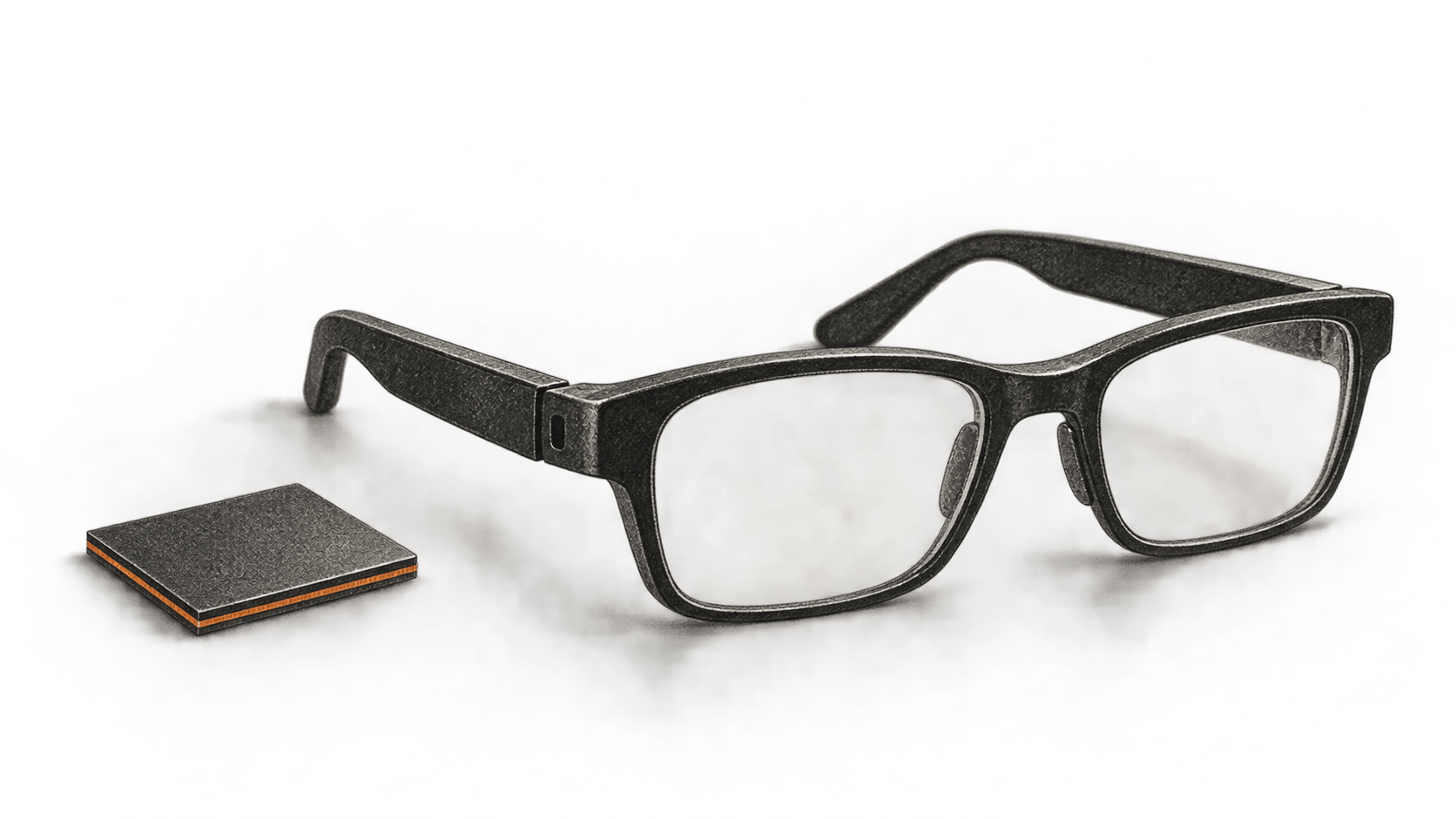
PrismML says it demonstrated a vision-language model running locally on smart glasses powered by Qualcomm's Snapdragon AR1 Gen 1 at Snapdragon Summit on September 23. The work addresses a specific problem for wearable AI: fitting a model and its working data within the memory, power and heat limits of glasses. Its published performance figures come from company and Qualcomm tests under defined conditions, and no glasses using PrismML have been announced for sale. PrismML's announcement; TechCrunch's report.
The roughly 2-billion-parameter system pairs a 1.7-billion-parameter, 1-bit Bonsai language model with a 300-million-parameter vision encoder kept at 4-bit precision. The distinction matters: the whole vision-language model is not 1-bit. PrismML and Qualcomm optimized the system for the Hexagon neural processor in Snapdragon AR1 Gen 1. Qualcomm's tests used an internal QNN software development kit with 1-bit kernel support. Its public AR1 Gen 1 product brief lists INT4 and INT8 support for the Hexagon processor; the special 1-bit compilation path is part of what made this demonstration possible.
The big change
The reported advance is a model and software path that put local vision-language inference on a glasses platform with 4 GB of memory. Reducing the language model's weight footprint leaves more of that constrained memory available for the vision encoder, context and other device tasks. Qualcomm's measurements also found faster text generation for the 1-bit language component in its test configuration. These results establish a controlled demonstration and a possible design route for developers. They do not establish the experience, battery life or privacy properties of a finished pair of glasses.
What the comparisons measured
Qualcomm Technologies International measured 0.43 GB for the 1-bit 1.7B language model's weights, against 1.66 GB for a corresponding 4-bit 1.7B language model. That is a 3.83-fold reduction in language-model weight memory, or about 74% less. It is not a fourfold reduction in the memory used by the complete glasses system. The tested vision encoder remained 4-bit, and the published figure does not include every allocation required to run an application. PrismML's disclosed Qualcomm test conditions.
On the same AR1 Gen 1 platform, Qualcomm reported 15.36 generated text tokens per second for the 1-bit language model and 7.44 for its 4-bit comparator, a 2.06-fold difference. The test used the 2B vision-language configuration, a 1,024-token context, 4 GB of platform memory and the internal QNN build. A token-generation rate describes one part of a response. The announcement gives no end-to-end timing for camera capture, vision processing, speech input and spoken output, so it cannot establish how quickly a wearer would receive an answer.
PrismML assessed model quality separately. Its September benchmarks compared the Bonsai 1.7B 1-bit language model with a corresponding Qwen 3 1.7B model quantized to 4 bits on eight named tests, including instruction following, coding and question answering. The company says the configurations had comparable results under those evaluation conditions. It does not provide per-test scores in the announcement, and these are language-model benchmarks rather than a published independent assessment of visual recognition through glasses. PrismML's benchmark footnote.
The remaining work is in the device
On-device inference can avoid sending some model inputs to a remote service and can remove a network round trip from those requests. Actual data handling depends on the finished product's software, companion phone, connectivity and settings. Qualcomm describes AR1 Gen 1 as a glasses platform with a camera, audio, wireless connectivity and a Hexagon processor, all of which draw on the device's power and thermal budget. Neither the demonstration nor the disclosed tests measure battery runtime, heat during sustained use or the accuracy of answers to real camera scenes. Qualcomm's platform brief.
PrismML's announcement says the model ran locally on glasses hardware; TechCrunch reports that no smart glasses running PrismML have been announced. For product engineers, the demonstrated 1-bit runtime and its precise memory and decode measurements are useful starting points. A shipping decision would still require a named device, accessible software, independent task evaluation and measurements of the complete interaction under wearable power and heat limits.