# QSSR brings AI upscaling to standard PS5, game by game
> Sony is adding QSSR to Wolverine and Ghost of Yōtei on standard PS5. Access is game-specific, and sharper reconstruction does not establish faster frame delivery.
By BIG CHANGE Editorial
Published: 2026-10-02T05:59:25.237Z
Updated: 2026-10-02T05:59:25.237Z
Canonical: https://bigchange.ai/blog/ps5-qssr-ai-upscaling-games-limits
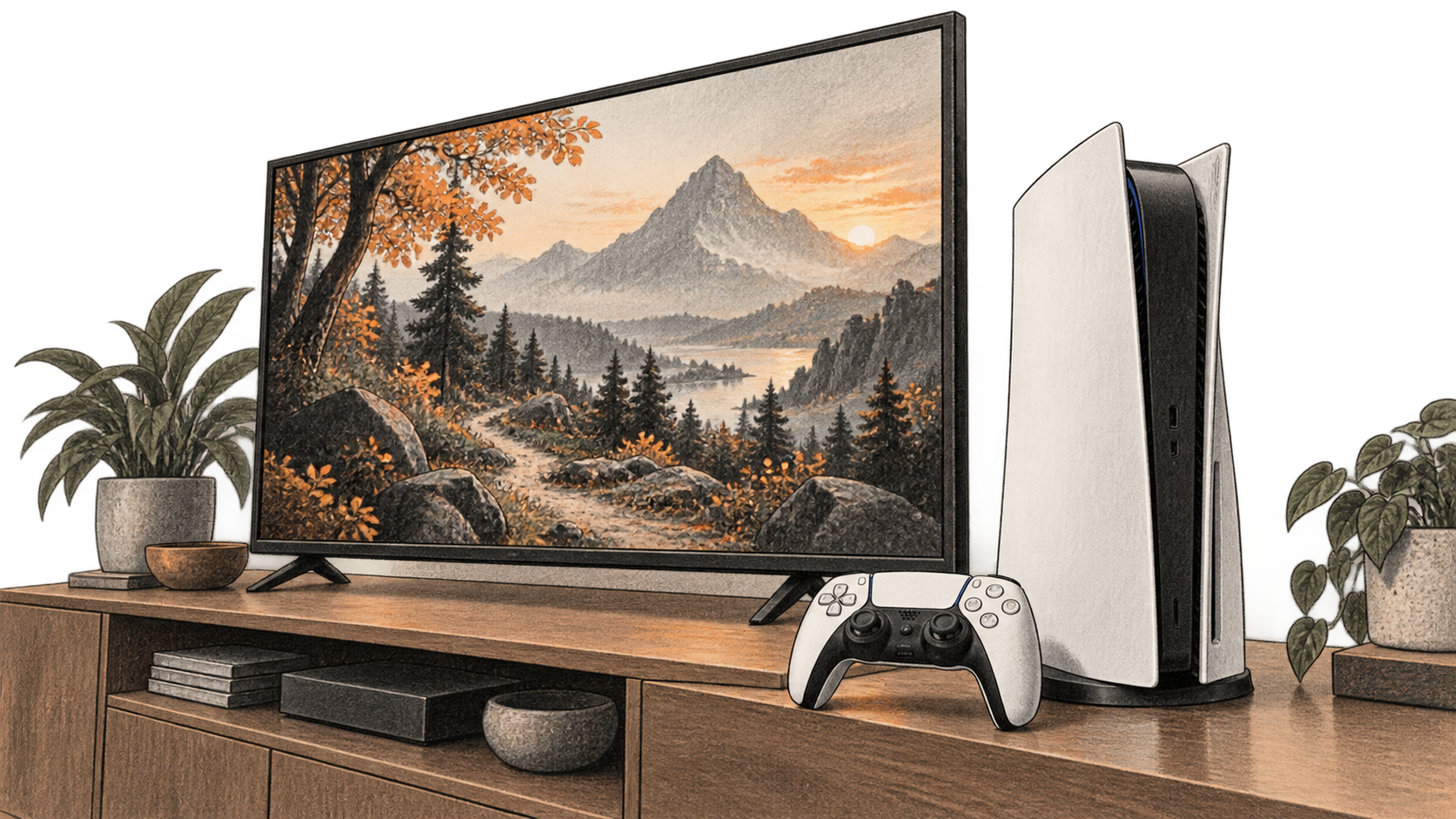
Conceptual illustration generated by BIG CHANGE. The landscape is invented artwork, not footage from Wolverine or Ghost of Yōtei or a demonstration of QSSR output.
Sony announced Quick Spectral Super Resolution, or QSSR, on October 1, with patches for **Marvel’s Wolverine** and **Ghost of Yōtei** adding it as a graphics option on standard PS5. The change gives owners of the existing console a route to AI-assisted image reconstruction. Its usefulness depends on the game's implementation and graphics mode.
## The big change
- **What changed:** AI upscaling is reaching standard PS5 through individual game updates, extending a capability Sony previously associated with PS5 Pro.
- **Why it matters:** Existing-console owners can benefit from new reconstruction software. Developers still have to fit that software into each game's rendering budget.
- **What to watch:** Sony plans broader developer access. Adoption in additional titles, and the image quality and frame times of their particular modes, will determine how widely the benefit spreads.
## A new option for two games
[Sony's launch announcement](https://blog.playstation.com/?p=424016) identifies the two initial titles and says their patches were arriving that day. It describes QSSR as a library developed through Project Amethyst, its graphics collaboration with AMD, using a streamlined neural network and an implementation tuned for PS5. Better detail and stability are the manufacturer's claims.
For a player, access requires the standard console, a supported game and its update. Sony has not published an exact menu path, patch-version requirement or separate QSSR charge in that announcement. It provides no public SDK instructions or detailed input specification. BIG CHANGE reviewed the documentation and has not played either patched game.
The initial list also establishes a compatibility boundary. The announcement supplies no basis for treating every installed PS5 game as QSSR-enabled. A console owner's hardware is only one part of access; the game's developer must implement support.
## Reconstruction and frame generation do different work
An upscaler builds a higher-resolution image from a lower-resolution render. AMD's [FSR upscaler manual](https://gpuopen.com/manuals/fidelityfx_sdk/techniques/super-resolution-upscaler/) describes one established approach, which uses image data, depth and motion vectors, along with information from earlier frames. That documentation explains the category; it does not disclose QSSR's inputs or prove that Sony uses the same pipeline.
Frame generation is a separate operation. AMD's [FSR 3.1 documentation](https://gpuopen.com/learn/amd_fsr_3_1_release/) explicitly separates it from upscaling. Reconstructing a sharper image and inserting an additional frame answer different problems. Sony's QSSR announcement does not establish a new frame-generation feature.
The distinction matters when evaluating the update. A screenshot can show differences in detail, but it cannot establish how steadily frames arrive during play. The processing needed for reconstruction must also fit within the time available to produce each frame. At a 60fps target that interval is about 16.7 milliseconds, calculated as 1,000 divided by 60; this is a timing budget, not a measured QSSR result.
## PS5 Pro retains a different offering
[Sony's PS5 Pro product page](https://www.playstation.com/en-us/ps5/ps5-pro/) continues to describe PSSR alongside additional graphics performance and advanced ray tracing. It qualifies enhanced features by supported title, and says results from enhanced PSSR vary by game. QSSR's arrival does not establish identical visual output or performance between the consoles.
The useful comparison is consequently a game and a mode, with its input resolution, reconstructed output, visible artifacts and frame times. Sony's launch post supplies no measured table covering those conditions. Owners get a newly documented option; a universal image-quality or speed gain remains unsupported.
## Sources & further reading
- [Sony Interactive Entertainment, QSSR announcement](https://blog.playstation.com/?p=424016), October 1, 2026. Primary release record; its quality claims come from the manufacturer and participating studios.
- [PlayStation, PS5 Pro product page](https://www.playstation.com/en-us/ps5/ps5-pro/), checked October 2, 2026; no page update date stated. Documents the separate Pro offering and title-dependent enhancements, not a controlled QSSR comparison.
- [AMD GPUOpen, FSR upscaler manual](https://gpuopen.com/manuals/fidelityfx_sdk/techniques/super-resolution-upscaler/), version 3.1.4, checked October 2, 2026. Technical context for reconstruction inputs; not QSSR implementation documentation.
- [AMD GPUOpen, FSR 3.1 release documentation](https://gpuopen.com/learn/amd_fsr_3_1_release/), July 9, 2024; checked October 2, 2026. Establishes that upscaling and frame generation can be separated; not evidence of a Sony frame-generation release.
## Sources
- [Sony Interactive Entertainment: AI upscaling is coming to PS5](https://blog.playstation.com/?p=424016) — Primary QSSR release record for the two initial games and graphics option. Quality and implementation claims are from Sony and participating studios.
- [PlayStation 5 Pro product documentation](https://www.playstation.com/en-us/ps5/ps5-pro/) — Manufacturer account of the separate Pro offering and supported-title enhancement limits, not a controlled QSSR comparison.
- [AMD GPUOpen FSR 3.1.4 upscaler manual](https://gpuopen.com/manuals/fidelityfx_sdk/techniques/super-resolution-upscaler/) — Technical context for reconstruction inputs and frame history, not QSSR implementation documentation.
- [AMD GPUOpen FSR 3.1 release documentation](https://gpuopen.com/learn/amd_fsr_3_1_release/) — Documents the separation of upscaling and frame generation. Historical technical context, not a Sony frame-generation announcement.
The BIG CHANGE newsletter
The big picture. At your pace.
Recent stories on AI and robotics, the shifts worth watching and practical ideas to use. Choose a daily briefing, weekly digest or monthly perspective.
Sent at 09:00 Belgrade time: daily, Mondays or the first of the month. Your first edition arrives at the next scheduled send after you confirm.
Your privacy, your choice.
Necessary storage supports site security and remembers your choices. Optional Google Analytics stays off until you allow it. You can read every story with necessary storage only. Privacy details