# Runway opens Praxis-1 robot weights
> Developers can now inspect and adapt the policy.
By BIGCHANGE.AI Editorial
Published: 2026-11-12T06:41:38.133Z
Updated: 2026-11-12T06:41:38.133Z
Canonical: https://bigchange.ai/blog/runway-praxis-1-open-weights-robot-control
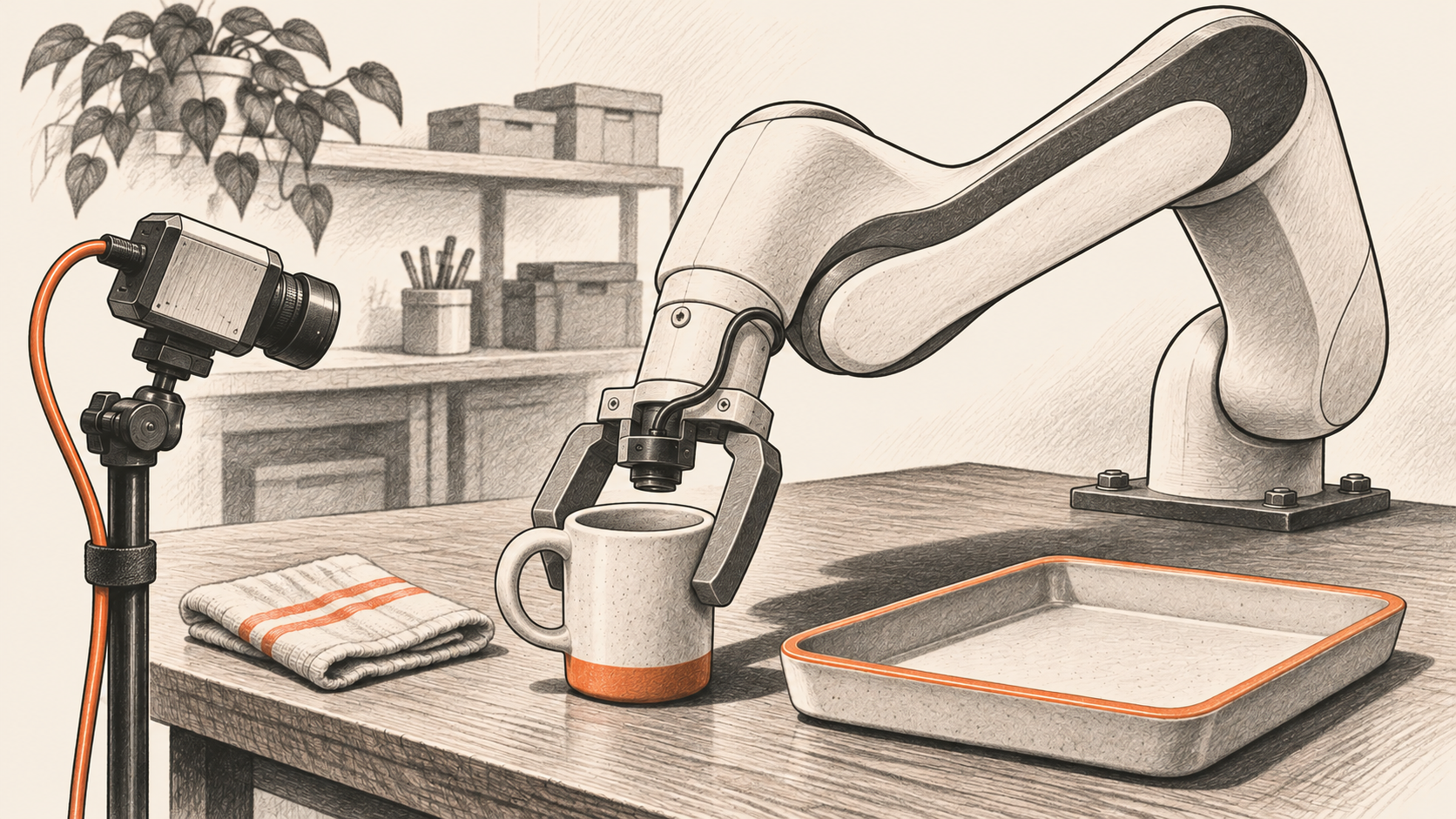
AI-generated conceptual illustration for BIG CHANGE
Runway released Praxis-1 weights and adaptation code on November 11 under Apache 2.0.
## The big change
- Public weights let developers inspect and adapt the policy. Access does not establish dependable operation on their hardware.
- A robot policy turns observations into movement commands. Choosing an object and physically reaching it are different problems; a controller must account for what happens during motion.
- A benchmark measures performance under specified conditions. Before treating a score as useful for an application, check the tasks, hardware and definition of success behind it.
## From video to movement
In its [September introduction](https://runway.com/research/introducing-praxis-1), Runway argued that ordinary video could supply examples of object behavior and hand movements before robot-specific training. That is pretraining: learning patterns from one body of material before adapting them to a narrower task. The earlier announcement offered selected partner access and promised public weights later. This follows [our coverage of that introduction](https://bigchange.ai/blog/runway-praxis-1-video-pretraining-robot-control), when a public implementation was still missing.
The [current research](https://runway.com/research/praxis-1-video-pretraining-to-robot-control) describes instruction, camera and pose inputs, producing predicted video and motion chunks. The robot executes a chunk, then supplies fresh observations. Runway reports difficulties with look-alike objects and multi-step instructions.
Feedback gives a controller another chance to respond when contact moves an object unexpectedly. A fresh observation can expose a mismatch with the plan; updating motion still does not guarantee success.
## Access and conditions
The [repository](https://github.com/runwayml/praxis-1-oss) offers single-arm DROID and two-arm YAM checkpoints; its base requires adaptation. The default simulation quickstart needs an 80GB CUDA GPU, Python 3.12 and CUDA 13.0; optimized configurations differ. We did not download weights or run a robot.
The [Apache license](https://www.apache.org/licenses/LICENSE-2.0) permits use, modification and redistribution subject to its conditions. Redistribution requires a license copy, notices of modified files and preservation of applicable attribution; a supplied NOTICE file creates additional notice obligations. The license does not grant general trademark rights and disclaims warranties, including fitness for a particular purpose.
Those provisions distinguish permission to work with software from assurance that it suits a particular job. A team distributing modifications should review the notices and relevant component licenses. A team operating machinery also needs evidence about the actual control system and intended environment; a software license does not provide that evidence.
## Reading the simulation result
[Runway reports](https://runway.com/news/company-news/praxis-1-is-now-available) 46.2% success across 1,200 RoboLab-120 episodes with its DROID-tuned model, not a deployment success rate.
[NVIDIA describes RoboLab](https://research.nvidia.com/labs/srl/projects/robolab/) as a simulation framework in which developers arrange objects, add a language instruction and specify the robot and observation/action configuration. Its 120-task benchmark covers visual recognition, relationships between objects and procedural skills such as reorientation. The framework can vary lighting, camera position, backgrounds and textures to probe robustness.
One documented task puts an onion in a wooden bowl. The same goal is expressed with a vague vegetable reference or a more specific description of the onion. This illustrates why understanding an instruction is part of evaluation: changing language can change how clearly the target is identified, even when the physical scene stays the same. These are benchmark examples, not a claim that this article tested a particular policy on them.
A simulation comparison is useful for a defined question, but a physical installation introduces its own hardware, contacts and operating conditions. Before relying on a controller, ask for results from the intended task and setup, including failures and the conditions under which testing stopped. A selected demonstration cannot supply that distribution of outcomes.
## Sources
- [Runway release](https://runway.com/news/company-news/praxis-1-is-now-available) — Access.
- [Runway research](https://runway.com/research/praxis-1-video-pretraining-to-robot-control) — Mechanism and limitations.
- [Runway repository](https://github.com/runwayml/praxis-1-oss) — Checkpoints and setup.
- [NVIDIA RoboLab](https://research.nvidia.com/labs/srl/projects/robolab/) — Benchmark methods and examples.
- [Runway September introduction](https://runway.com/research/introducing-praxis-1) — Earlier rationale and access.
- [Apache License 2.0](https://www.apache.org/licenses/LICENSE-2.0) — Permissions and conditions.
The BIG CHANGE newsletter
The big picture. At your pace.
Recent stories on AI and robotics, the shifts worth watching and practical ideas to use. Choose a daily briefing, weekly digest or monthly perspective.
Next scheduled send (UTC): . Your first edition arrives at the next scheduled send after you confirm.
Your privacy, your choice.
Necessary storage supports site security and remembers your choices. Optional Google Analytics stays off until you allow it. You can read every story with necessary storage only. Privacy details