# Runway’s Praxis-1 tests a video-trained route to robot control
> Runway says Praxis-1 applies video pretraining to robot control. Its placement-error comparison offers a limited signal while public weights and fuller evaluation details remain pending.
By BIG CHANGE Editorial
Published: 2026-10-03T10:22:25.737Z
Updated: 2026-10-03T10:22:25.737Z
Canonical: https://bigchange.ai/blog/runway-praxis-1-video-pretraining-robot-control
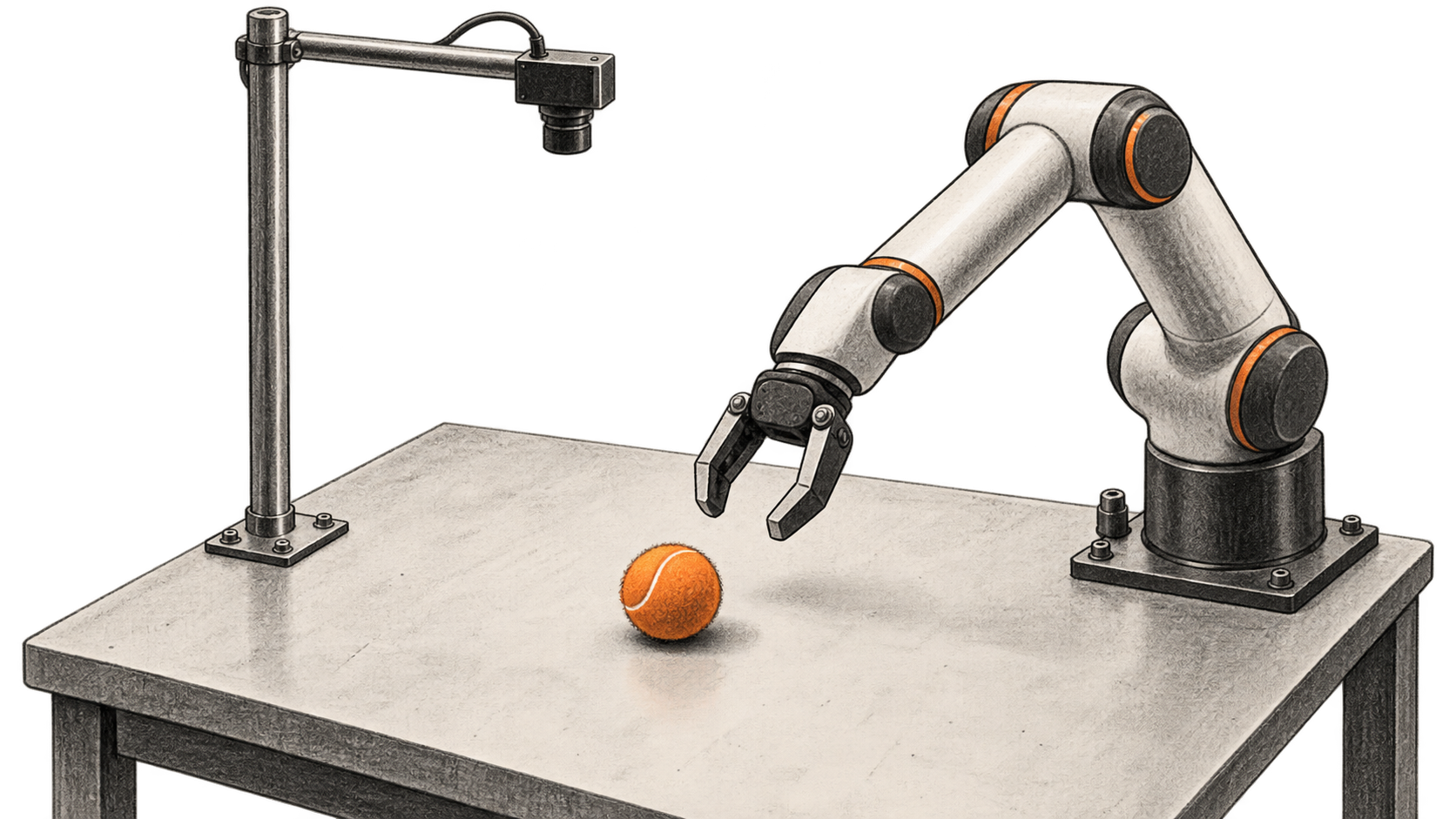
AI-generated conceptual editorial illustration by BIG CHANGE.
Runway has [announced Praxis-1](https://runway.com/research/introducing-praxis-1), a robot policy it says builds on the large-scale video pretraining behind its world models. The company reports testing with selected robotics partners on their own machines. It plans to release model weights publicly in the coming months; they were not available on the announcement page when BIG CHANGE checked on October 3. Runway dates the page September 2026, without specifying a day.
The question behind it is whether everyday video can give a robot policy useful knowledge before it learns from robot demonstrations. Runway offers a placement-error comparison and selected task clips. Details needed to reproduce the result remain unpublished.
## The big change
- **What changed:** Runway is carrying video pretraining into robot action prediction and reporting tests on several kinds of partner hardware. That offers a possible way to use abundant third-person footage in a field where robot demonstration data is costly to collect. Praxis-1 remains in selected access.
- **Why it matters:** Runway’s chart reports final placement error after fine tuning of 16.1 cm for web-video pretraining and 16.0 cm for teleoperated robot-video pretraining. The displayed point estimates are close. Its ±1 SEM bars over 93 evaluation pairs establish neither a significant difference nor equivalence, and the published protocol is too limited to judge performance on another robot.
- **What to watch:** A public weight release, task-level evaluation details and partner results would let researchers assess how much the video pretraining contributes and what adaptation each robot needs. Runway has promised the weights, but gives no firm release date.
## How video enters the policy
Runway’s [Praxis-1 research page](https://runway.com/research/introducing-praxis-1) says its large video models learn patterns of object behavior, hand movement and physical tasks. The company says Praxis-1 brings that pretraining into a generalist robot policy. Its argument is that third-person footage can provide a useful starting point before task-specific robot training. The page says policy performance improves as it scales third-person video.
The page does not describe the Praxis-1 observation format, action output, fine-tuning procedure, inference interface or control frequency. It also gives no weight files or hardware requirements. Those omissions matter to an engineer trying to estimate what adaptation is needed for a particular camera, gripper or mobile base. Runway has a [separate GWM-1 policy-model product page](https://runway.com/product/robotics/policy-model) that describes a custom fine-tuning and cloud SDK arrangement. Its interface and commercial terms should not be assumed to apply to Praxis-1.
Runway’s clips illustrate a tennis-ball placement instruction, a mobile base approaching a shelf and picking up a book, and examples involving repeated objects, clutter, transparent materials and cloth. A further clip is captioned as the same policy moving between a studio and a kitchen without retraining. These are examples chosen by the developer; the page does not report trial counts or success rates for them.
## What the placement-error chart says
The one numerical comparison on Runway’s page is **final placement error after fine tuning**, measured in centimeters, with lower values better. Its chart labels web-video pretraining from scratch at **16.1 cm** and teleoperated robot-video pretraining from scratch at **16.0 cm**. Runway plots hours of pretraining video and says the error bars and band represent **±1 standard error of the mean over 93 evaluation pairs**. Its note says differences smaller than a bar are not significant.
The displayed point estimates differ by 0.1 cm. Runway has not published, on this page, the task mix, number of robots or environments, how the 93 pairs were formed, how much robot data fine tuning used, or a complete statistical test. In the comparison Runway chose to show, the reported final placement-error point estimates are close after fine tuning. The chart does not establish a statistically significant difference or equivalence for that measure. It also cannot show reliable completion of the longer tasks in the clips or a reduction in real deployment data needs.
Runway also cites a **0.95 correlation** between simulated and real-world robot-policy results. That figure comes from its [earlier policy-evaluation research](https://runway.com/research/accelerating-robot-policy-evaluation), which ranked eight policies on tabletop tasks with one Franka Panda arm. It is a separate study of policy evaluation, not a Praxis-1 field performance measure.
## Where access stands
Runway names [Noble Machines, Standard Bots and Ultra](https://runway.com/research/introducing-praxis-1) as early partners using Praxis-1 on their own hardware. The announcement describes bimanual manipulation, a six-degree-of-freedom arm and a mobile base in that section. Runway says it is evaluating efficacy and safety across embodiments and environments before general availability and invites additional selected partners to contact its robotics team.
For a researcher outside that program, the available material is the announcement, chart and clips. There is no public Praxis-1 weight download, published integration procedure or reproducible evaluation package linked on the page. Runway does not state access fees, eventual weight license, compute requirements or a general release date. A team considering early access can use the public record to frame a discussion about its own hardware and evaluation needs, but cannot reproduce the reported comparison from the announcement alone. BIG CHANGE did not request access or test a robot.
Our earlier reports on [GPT-Policy](https://bigchange.ai/blog/gpt-policy-robot-learning-vlm-agents) and [HomeBody](https://bigchange.ai/blog/homebody-humanoid-spatial-memory-robot-skills) examine different research questions. GPT-Policy prompts a fixed vision-language model with demonstrations and robot feedback; HomeBody connects a humanoid’s room memory to reusable skills. Praxis-1 asks whether broad video pretraining can improve the policy itself. Runway has yet to release the implementation or enough evaluation detail to check its performance beyond the reported comparison.
## Sources & further reading
- [Runway Research, “Introducing Praxis-1”](https://runway.com/research/introducing-praxis-1): Primary announcement, dated September 2026. It supplies the pretraining claim, 16.1/16.0 cm placement-error comparison, 93-pair uncertainty note, selected clips, partners and planned weight release. Runway is the developer; these are its own results and descriptions.
- [Runway Research, “Accelerating Robot Policy Evaluation with General World Models”](https://runway.com/research/accelerating-robot-policy-evaluation): Earlier, separate work behind the 0.95 simulation/real-world correlation referenced in the Praxis-1 announcement. It does not measure Praxis-1 deployment performance.
- [Runway Robotics policy-model product page](https://runway.com/product/robotics/policy-model): Documents a separate GWM-1 custom-policy and SDK offering. Included to prevent its interface from being mistaken for a public Praxis-1 integration guide.
- [BIG CHANGE, “GPT-Policy tests context in robot-arm and mobile-exploration tasks”](https://bigchange.ai/blog/gpt-policy-robot-learning-vlm-agents) and [“HomeBody connects a humanoid’s spatial memory to reusable robot skills”](https://bigchange.ai/blog/homebody-humanoid-spatial-memory-robot-skills): Prior coverage of different robot-control approaches. Neither establishes Praxis-1 performance.
## Sources
- [Runway Research, Introducing Praxis-1](https://runway.com/research/introducing-praxis-1) — Developer announcement for video-pretraining claim, final-placement comparison, 93 evaluation-pair uncertainty note, selected clips and partners, limited early access and planned public weights. It does not provide a reproducible protocol, public weights or independent deployment evidence.
- [Runway Research, Accelerating Robot Policy Evaluation with General World Models](https://runway.com/research/accelerating-robot-policy-evaluation) — Developer's separate earlier world-model evaluation behind the 0.95 policy-ranking correlation. It tested eight policies on tabletop tasks using one Franka Panda arm; it is not a Praxis-1 field result.
- [Runway Robotics, Policy Model](https://runway.com/product/robotics/policy-model) — Describes a separate GWM-1 custom fine-tuning, cloud inference and SDK offering. It does not specify Praxis-1's interface, costs or hardware requirements.
- [BIG CHANGE, GPT-Policy tests context in robot-arm and mobile-exploration tasks](https://bigchange.ai/blog/gpt-policy-robot-learning-vlm-agents) — Prior coverage of a fixed vision-language model prompted with context and issuing robot-tool requests; overlap context only.
- [BIG CHANGE, HomeBody connects a humanoid’s spatial memory to reusable robot skills](https://bigchange.ai/blog/homebody-humanoid-spatial-memory-robot-skills) — Prior coverage of spatial memory and reusable skills in a humanoid demonstration; overlap context only.
The BIG CHANGE newsletter
The big picture. At your pace.
Recent stories on AI and robotics, the shifts worth watching and practical ideas to use. Choose a daily briefing, weekly digest or monthly perspective.
Sent at 09:00 Belgrade time: daily, Mondays or the first of the month. Your first edition arrives at the next scheduled send after you confirm.
Your privacy, your choice.
Necessary storage supports site security and remembers your choices. Optional Google Analytics stays off until you allow it. You can read every story with necessary storage only. Privacy details