# Sam Altman on AI discovery, assistants and human control
> Sam Altman discusses AI discovery, assistants and human control.
By BIGCHANGE.AI Editorial
Published: 2026-10-29T02:15:38.951Z
Updated: 2026-10-29T02:15:38.951Z
Canonical: https://bigchange.ai/blog/sam-altman-ai-discovery-assistants-human-control
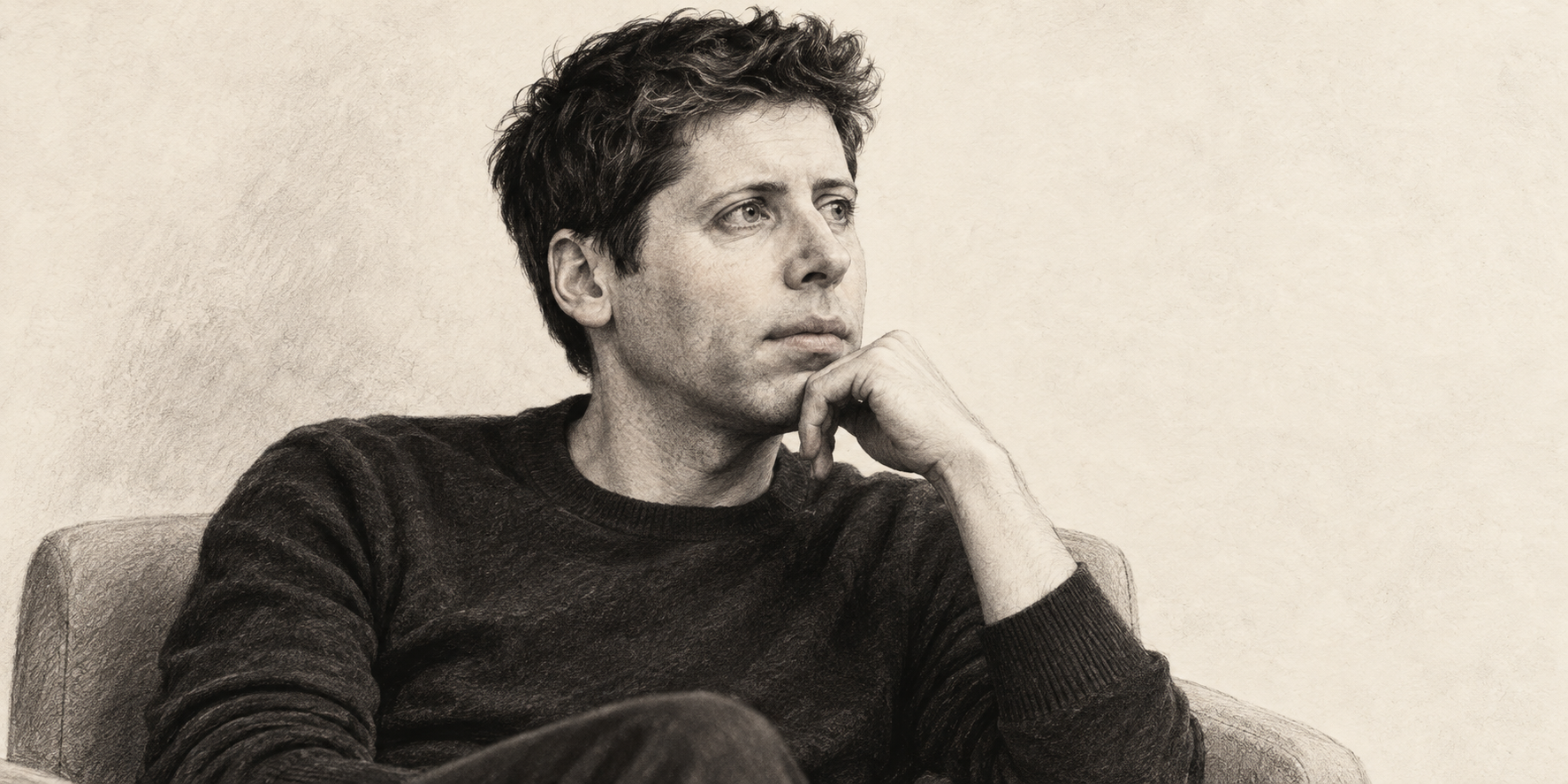
AI-generated editorial illustration of Sam Altman by BIG CHANGE; not a record of the interview.
OpenAI CEO Sam Altman discussed AI discovery and proactive assistants in an [October 21 interview with Matthew Berman](https://www.buzzsprout.com/2640889/episodes/19995455-sam-altman-rsi-ai-consciousness-openai-s-new-hardware-compute-and-more). BIG CHANGE used the creator’s transcript for this account; it contains transcription errors, and we have not independently verified the audio.
## The big change
- AI-generated research can give scientists more material to investigate, but people still need ways to check, understand and use the results. A proof that can be checked is a different kind of evidence from a proposed medicine that must be tested in people.
- A personal assistant that acts with less supervision may reduce interruptions, while putting more weight on the permissions and boundaries set before it acts. A report afterward helps a user inspect an action; it cannot necessarily undo its consequences.
- The interview offers aspirations, not a demonstrated treatment timeline or device specification. The practical questions are what can be verified, what access an assistant needs and where a person can intervene.
## From a mathematical result to a treatment
The transcript records Altman hoping for a candidate to treat or cure a major disease within a couple of years, with testing still required. He identified no disease or candidate.
OpenAI has already published a different kind of research output. In [its October 6 mathematics release](https://openai.com/index/sharing-ai-progress-in-mathematics/), the company said an internal model produced results that it put in a public repository. It also supplied Lean formalizations for many proofs. Lean lets a computer check a proof expressed in its formal language; the release described work still needed to improve exposition and help mathematicians understand and build on the results.
The distinction matters because a mathematical proof and a medicine face different tests. A formalized proof can be checked against its stated assumptions, although understanding its significance remains work for researchers. A promising drug candidate has to survive experiments in the physical world. In the United States, the [FDA describes](https://www.fda.gov/patients/learn-about-drug-and-device-approvals/drug-development-process) laboratory and animal research, clinical studies in people, regulatory review and monitoring after a drug reaches the market. Each stage answers a different question about the product, including safety and effectiveness.
An AI system could therefore help researchers find or assess a candidate without establishing that it is a useful treatment. Faster generation of ideas would leave the evidence needed for patients to weigh benefits and harms. OpenAI’s mathematical release illustrates a way to expose research outputs for scrutiny; it does not establish that the same approach will produce an approved medicine.
## What an assistant can do, and who decides
The transcript records Altman saying better products, computing capacity and possibly future hardware could advance personal assistants. He said his own Dot setup saves time and acts more proactively while reporting afterward. His experience is not an independent measurement, and he announced no device.
The change in supervision has a concrete trade-off. If a person approves every action, they can inspect a decision before it happens, but frequent requests can consume the attention the assistant was meant to save. Letting it act inside a defined scope reduces those interruptions. It also makes the scope itself important: the person needs to know which information the assistant can read, which actions it can take and when it must ask first. A later notification is useful for oversight, but an action already taken may be difficult to reverse.
A separate example comes from a different product and company. [Anthropic’s description of Claude Code sandboxing](https://www.anthropic.com/research/claude-code-sandboxing) explains how filesystem and network restrictions can define where a coding agent may operate, with permission sought for access outside those boundaries. This is an approach to limiting a coding tool, not evidence about Dot’s implementation or a guarantee that every action inside the boundary is correct. It illustrates how the choice of permissions can make room for autonomy while retaining a point at which a user can decide.
For readers weighing more proactive assistants, the question is not simply whether the model seems capable. The meaningful setting is the authority it receives: an assistant may be helpful at finding information while a user still wants to review consequential actions. The appropriate boundary depends on the task, the sensitivity of the information and the cost of a mistake.
## Where the two ambitions meet
Research tools and personal assistants both produce work that someone else must be able to evaluate. In science, that can mean publishing a result in a form other researchers can inspect and test. For an assistant, it can mean giving the user a clear account of what happened and controls over what happens next. The details differ, but both make human judgment depend on access to the relevant evidence.
OpenAI has commercial interests in adoption. Altman’s predictions invite scrutiny against subsequent evidence. The mathematics repository supplies one concrete output to inspect; a successful treatment and the broader assistant experience he described would require their own evidence.
## Sources
- [Forward Future Interviews: Sam Altman interview](https://www.buzzsprout.com/2640889/episodes/19995455-sam-altman-rsi-ai-consciousness-openai-s-new-hardware-compute-and-more) — Creator transcript supports the attributed account; it contains errors and audio was not independently verified.
- [OpenAI: Sharing AI progress in mathematics](https://openai.com/index/sharing-ai-progress-in-mathematics/) — OpenAI describes its repository and Lean formalizations and identifies remaining work in communicating results. Its account does not establish a medical outcome.
- [FDA: The Drug Development Process](https://www.fda.gov/patients/learn-about-drug-and-device-approvals/drug-development-process) — The US regulator outlines preclinical and clinical research, review and post-market monitoring. It is context for the difference between a candidate and a treatment.
- [Anthropic: Making Claude Code safer with sandboxing](https://www.anthropic.com/research/claude-code-sandboxing) — The company describes filesystem and network restrictions for its coding tool. It does not document Dot or prove that every action within a permitted scope is correct.
The BIG CHANGE newsletter
The big picture. At your pace.
Recent stories on AI and robotics, the shifts worth watching and practical ideas to use. Choose a daily briefing, weekly digest or monthly perspective.
Next scheduled send (UTC): . Your first edition arrives at the next scheduled send after you confirm.
Your privacy, your choice.
Necessary storage supports site security and remembers your choices. Optional Google Analytics stays off until you allow it. You can read every story with necessary storage only. Privacy details