# A robotic welding model tests power control before physical trials
> An ISPARK preprint joins a weld-pool model, a fast surrogate and a simulated robot. Its corner test compares modelled widths; physical welding validation remains ahead.
By BIG CHANGE Editorial
Published: 2026-10-17T03:51:13.522Z
Updated: 2026-10-17T03:51:13.522Z
Canonical: https://bigchange.ai/blog/simulated-robotic-welding-control-loop-ispark
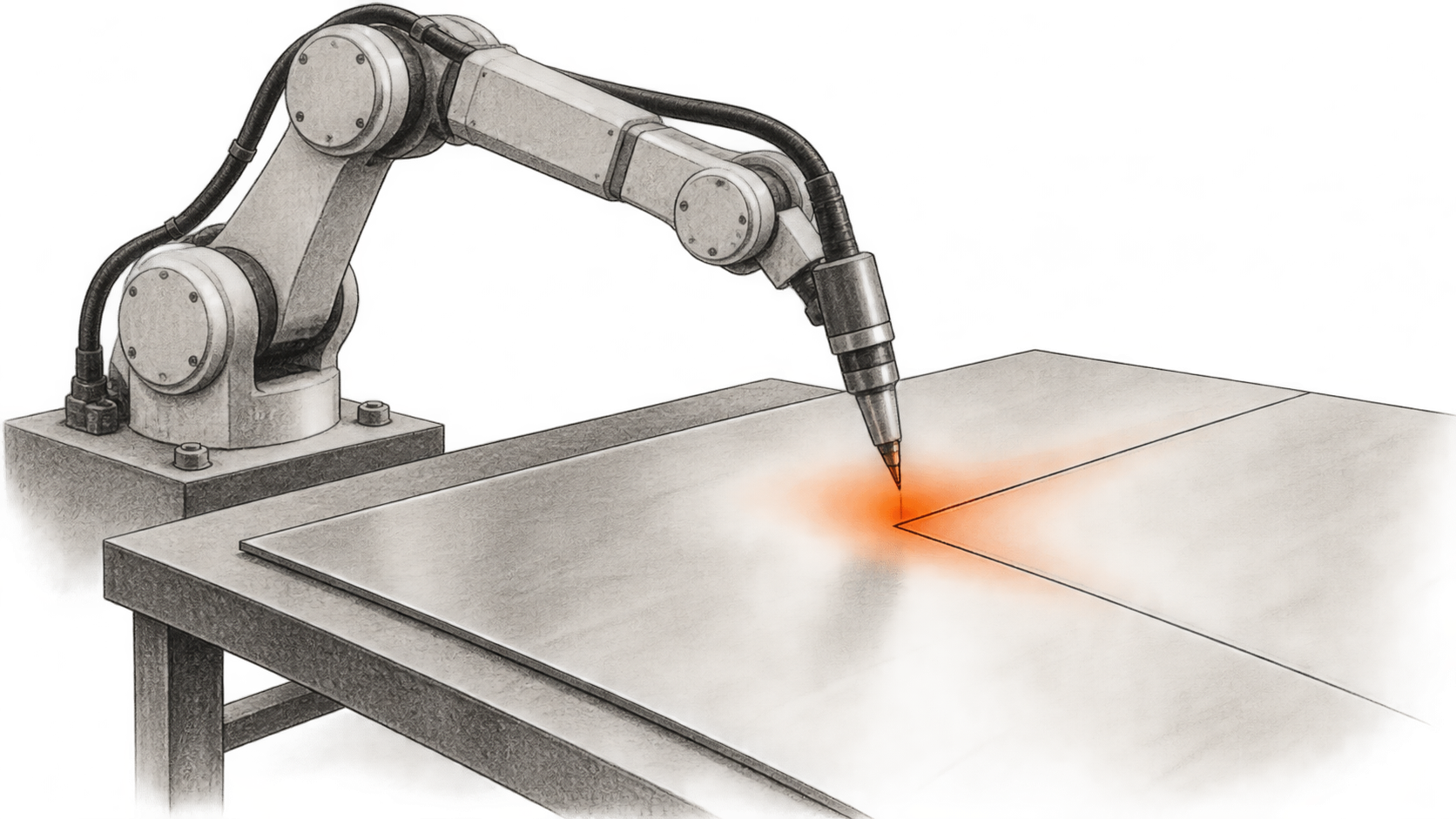
AI-generated conceptual illustration by BIG CHANGE; not a photograph of ISPARK hardware or a measured weld.
The [ISPARK research team's October 15 preprint](https://arxiv.org/abs/2610.21939) describes a way to test robotic welding controls in simulation before trying them on physical equipment. Its model predicts how a weld pool might respond when a robot slows at a corner. A fast statistical approximation then lets a simulated controller adjust the power-source setting during the move.
The study reports a useful screening method, with a firm boundary: no welds were made or measured for this paper. The robot, controller feedback and resulting weld widths were simulated. The authors say experimental validation and tests with robotic hardware are still needed.
## The big change
- **What changed:** The researchers joined a thermal weld-pool model to a fast predictor and a simulated six-axis robot. That lets them compare power adjustments during a changing travel-speed profile, instead of checking only fixed welding settings.
- **Why it matters:** Engineers developing in-space joining methods have few opportunities to test under flight-like conditions. This model can help choose which settings and controller behavior deserve physical tests, while leaving weld strength and reliability unproven.
- **What to watch:** Measurements from weld coupons, thermal-vacuum and reduced-gravity tests would show where the model matches the process. Robotic hardware-in-the-loop trials would separately test motion, sensing and command delays.
## From a slow heat model to a fast prediction
The [full paper](https://arxiv.org/html/2610.21939v1) starts with a finite-volume calculation for a 1 mm sheet of 316L stainless steel. It tracks heat and melting as the torch moves. The model represents some molten-metal transport through an adjusted thermal conductivity, and treats the welding arc as a prescribed heat input. It does not calculate the arc plasma, droplet transfer or the moving surface of the molten pool.
Running that calculation at every robot control step would be too slow. The researchers used 58 accepted model cases to train two types of surrogate, a Gaussian process and a neural network. Each takes welding and environmental settings and predicts eight outputs, including top and root-side pool width, penetration depth and peak temperature. In repeated cross-validation, the Gaussian process had lower normalized mean absolute error than the neural network for all eight outputs. The controller uses its predicted root-side width.
A three-output Gaussian-process query took 249 microseconds in the reported implementation, including input scaling and predictive variance. The simulated closed-loop run executed at 53.6 times real time on the authors' setup. Those figures show that prediction was cheap enough for this simulation; the timing excludes communication with a physical robot controller and says nothing by itself about physical weld accuracy.
## What happened at the simulated corner
The team simulated a six-axis UR5 manipulator following an L-shaped seam. Its planned travel speed drops from 12.0 to 8.94 mm per second near the corner. At a fixed power-source setting, moving more slowly increases the model's heat input per unit length. A proportional controller instead changes that setting in response to the surrogate's predicted root-side width. Travel speed follows the same planned path in both comparisons.
The researchers then reran the slower finite-volume model at 12 selected stations for each control mode. All 12 closed-loop stations and 9 of 12 open-loop stations fell within an illustrative 1–3 mm root-side-width band. The stations were clustered near the corner, so those counts are not fractions of seam length. The band is a study threshold, not a weld acceptance standard. This check compares two models of the same proposed process; it is not a measured weld result.
The loop also uses a steady-state response at each commanded point. A physical molten pool responds over time, and the paper does not test whether the controller stays stable when that lag, sensor readings and robot motion are present. Its proposed sensing interface has not been connected to welding hardware.
## Where the simulation stops
The thermal equation does not include gravity. Gravity appears in a separate pressure-ratio calculation and as an input used to confirm that the thermal outputs stay unchanged in the model. That invariance cannot establish how a real weld behaves in reduced gravity. The simplified model also omits surface deformation, arc behavior and metal transfer that could matter there.
The authors report numerical quality checks, but no formal grid-convergence study or experimental validation against matching coupons. They call for calibration and independent coupon measurements, thermal-vacuum and targeted reduced-gravity tests, and hardware-in-the-loop work before using the system to assess a physical robotic weld. BIG CHANGE reviewed the preprint; it did not run the model or test welding equipment.
## Sources & further reading
- [Hao and colleagues, “De-Risking Robotic Welding for In-Space Metal Joining Through Physics-Grounded Digital Twins”](https://arxiv.org/abs/2610.21939), arXiv v1, submitted October 15, 2026. The abstract and version history establish the preprint date and reported results. This is an author-reported simulation study.
- [Full HTML text of the v1 preprint](https://arxiv.org/html/2610.21939v1). Sections 2–7 describe the thermal model, surrogate comparison, timing and simulated controller; sections 8–10 set out transfer limits and proposed physical tests. It supplies no experimental weld validation.
## Sources
- [De-Risking Robotic Welding for In-Space Metal Joining Through Physics-Grounded Digital Twins](https://arxiv.org/abs/2610.21939) — arXiv v1 metadata and abstract; author-reported simulation results, with no experimental validation.
- [Full HTML text of arXiv:2610.21939v1](https://arxiv.org/html/2610.21939v1) — Methods, surrogate comparison, simulated robotic controller, numerical limits and proposed physical tests; same paper as the abstract entry.
The BIG CHANGE newsletter
The big picture. At your pace.
Recent stories on AI and robotics, the shifts worth watching and practical ideas to use. Choose a daily briefing, weekly digest or monthly perspective.
Next scheduled send (UTC): . Your first edition arrives at the next scheduled send after you confirm.
Your privacy, your choice.
Necessary storage supports site security and remembers your choices. Optional Google Analytics stays off until you allow it. You can read every story with necessary storage only. Privacy details