# FCC gives SpaceX conditional authority for Starmind
> Debris conditions and engineering evidence separate permission from deployed computing.
By BIGCHANGE.AI Editorial
Published: 2026-11-26T05:45:36.895Z
Updated: 2026-11-26T05:45:36.895Z
Canonical: https://bigchange.ai/blog/spacex-starmind-conditional-fcc-authorization
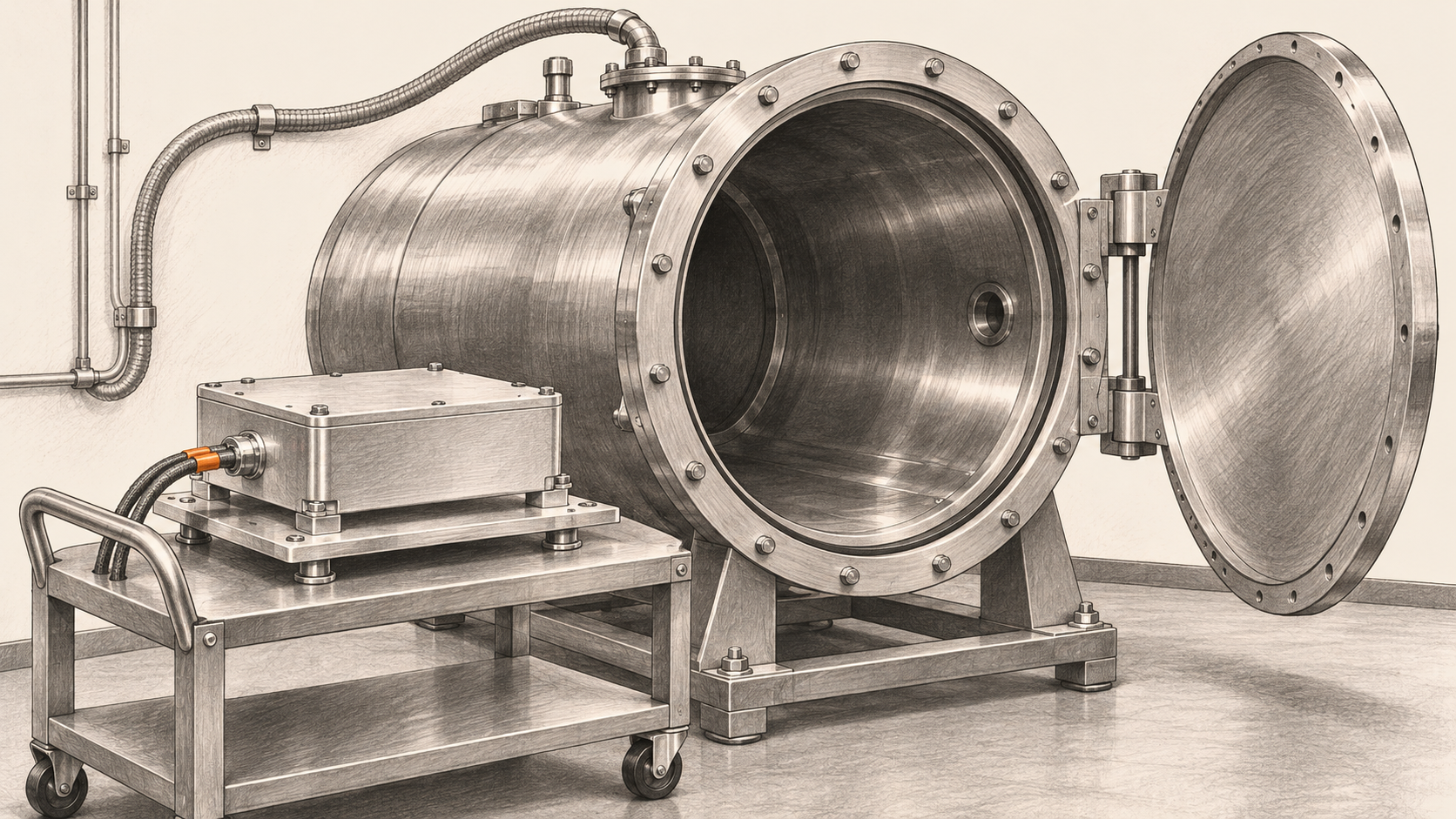
AI-generated conceptual illustration; not Starmind hardware, an actual SpaceX laboratory or a measured test.
On November 25, the FCC’s Space Bureau partly granted SpaceX’s Starmind orbital data-center application, with conditions and a deferred disposal-waiver request.
## The big change
- The conditional grant covers backup radio links for a proposed orbital computing network. It sets deployment deadlines and requires more debris information before higher-altitude launches.
- End-of-mission disposal is a separate obligation. The historical five-year re-entry rule measures time after a mission ends; it does not demonstrate that a particular satellite has actually been removed.
- Space has no air to carry heat away from equipment. Designers must move internally generated heat to surfaces that radiate it, so an orbiting computer still needs a deliberate cooling system.
## What the authorization permits
DA 26-1273 authorizes backup and emergency tracking-and-control radios for the proposed million-satellite system. SpaceX plans optical links with Starlink for primary communications. The radios must not cause harmful interference or claim protection. Federal coordination, earth-station authorizations and semiannual reports are required.
Debris-plan clearance applies below 600 km. Before deployment above 600 km, SpaceX must file a modification application with its final plan. SpaceX proposed disposal orbits around Earth or the Sun. Non-re-entry disposal remains deferred.
Deployment deadlines require one operating satellite by November 25, 2033, 10% by November 25, 2035, half by November 25, 2038, and completion by November 25, 2040. These are conditions for retaining authority, not company launch forecasts or evidence of delivered computing.
## Why the end of the mission matters
The FCC’s separate 2024 Federal Register notice explains the earlier disposal policy. For stations ending missions in, or passing through, low-Earth orbit below 2,000 km and planning uncontrolled atmospheric re-entry, it described disposal as soon as practicable and within five years after mission completion. That is a post-mission interval, rather than five years from launch.
The notice contrasts that limit with the older 25-year benchmark. Its rationale is to reduce the time that retired spacecraft remain in low-Earth orbit, where collisions can generate more debris.
The same document explains why regulators request debris plans before authorizing communications. Those disclosures let the agency and affected parties evaluate an operator’s proposed mitigation, rather than waiting until a failed spacecraft is already an abandoned object.
## Cooling in vacuum
NASA’s thermal review describes heat from sunlight, Earth and the equipment itself. Surfaces must emit enough heat, or the spacecraft stores it and its temperature changes. Components have operating and survival temperature limits.
In a vacuum, heat travels by conduction and radiation, without convection. Conductive paths move heat between internal components and structure; external surfaces exchange heat through radiation. Radiator area, its surface properties and what it faces affect that exchange.
NASA also identifies a practical constraint on small spacecraft: solar cells, radiators and instrument openings compete for limited external surface area. Closely packed electronics can lack a direct heat path to a radiator.
NASA’s thermal-vacuum guidance describes hot-cold cycles in a vacuum, with functional tests at temperature plateaus. These assess the hardware under those conditions, rather than an entire future fleet.
## A real example has a bounded workload
ESA’s July 2025 account of Φsat-2 provides an example of onboard AI with an identifiable task. After its August 2024 launch and commissioning, the small Earth-observation satellite began delivering science data. Its applications include selecting images with clear visibility and discarding cloud-obscured ones, as well as processing and compressing imagery.
That changes what can be transmitted: computation can turn observations into selected or smaller products before they reach the ground. It is a mission-level choice about the information needed, rather than evidence of a general-purpose orbital cloud service.
The mission’s data plan also evolved. ESA began supplying observation-data products to developers, rather than only the results of onboard processing. The agency still calls Φsat-2 a demonstrator designed to find technological limits and understand the resources needed to operate the mission. Its account establishes that bounded context, without validating the throughput, cost or reliability of a much larger system.
## Sources
- [FCC Starmind order](https://eu-assets.contentstack.com/v3/assets/blt23eb5bbc4124baa6/bltf4cdf2af47159e12/6b071c5f5506bb38bca5b0ec/FCC_report_and_order_on_SpaceX_Starmind_AI_constellation_11-25-2026.pdf) — Conditional grant and deferred request; PDF mirror.
- [FCC disposal-rule history](https://public-inspection.federalregister.gov/2024-17093.pdf) — Historical deadline and disclosure rationale.
- [NASA thermal-control review](https://www.nasa.gov/smallsat-institute/sst-soa/thermal-control/) — Physical heat paths and spacecraft constraints.
- [NASA thermal-vacuum guidance](https://s3vi.ndc.nasa.gov/ssri-kb/topics/59/) — Component tests under simulated conditions.
- [ESA Φsat-2 science phase](https://www.esa.int/articles/phsat-2-begins-science-phase-for-ai-earth-images) — Reported onboard processing and demonstrator scope.
The BIG CHANGE newsletter
The big picture. At your pace.
Recent stories on AI and robotics, the shifts worth watching and practical ideas to use. Choose a daily briefing, weekly digest or monthly perspective.
Next scheduled send (UTC): . Your first edition arrives at the next scheduled send after you confirm.
Your privacy, your choice.
Necessary storage supports site security and remembers your choices. Optional Google Analytics stays off until you allow it. You can read every story with necessary storage only. Privacy details