# Stuttgart funds two different robot-team approaches to construction
> University of Stuttgart researchers have funding for two distinct construction robotics projects beginning in November 2026. SCALAR plans crane-assisted timber assembly; COBRAS plans mobile robot teams for reusable space frames. Neither reports site productivity results.
By BIG CHANGE Editorial
Published: 2026-10-06T22:47:01.220Z
Updated: 2026-10-06T22:47:01.220Z
Canonical: https://bigchange.ai/blog/stuttgart-scalar-cobras-construction-robot-research
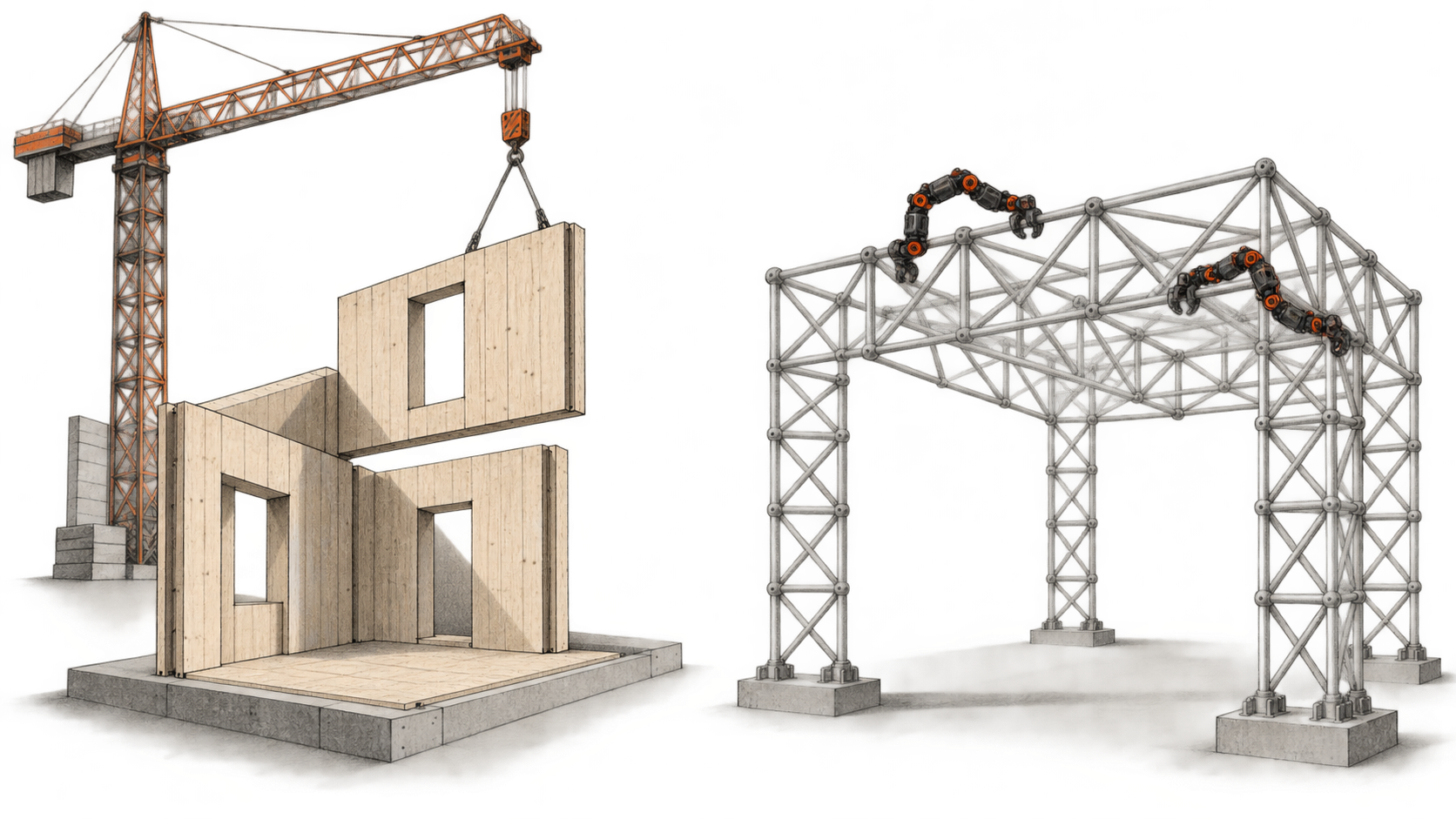
SCALAR's crane-assisted timber assembly and COBRAS's robot collective on a reusable space frame, illustrated from the projects' proposed concepts. AI-generated artwork by BIG CHANGE; not documentary imagery, a completed demonstration or deployed systems.
The University of Stuttgart has secured European research funding for two construction-robotics projects, [SCALAR and COBRAS](https://www.uni-stuttgart.de/en/university/news/all/Robot-teams-for-construction-sites/). Both are scheduled to start on November 1, 2026, and run through October 2029. Their plans describe different ways for machines to assemble buildings on site. Neither project has reported a construction-site deployment or a measured productivity gain.
## The big change
- **What changed:** Two funded research programs now put robot coordination and building-component design in the same plan. SCALAR proposes cranes and smaller robots working on timber modules; COBRAS proposes teams of mobile robots assembling reusable space frames. These are research objectives, not working site services.
- **Why it matters:** For builders, the distinction is practical: automation depends on the components and joints being designed for machine assembly, as well as on the robots. A crane-based timber system and a mobile swarm would face different handling and coordination problems.
- **What to watch:** Both grants call for technology-readiness-level 4 demonstrations. The useful evidence will be whether the teams can repeatedly assemble their specified structures under representative conditions, with safe coordination and dependable sensing. Site productivity and commercial readiness would require further evidence.
## SCALAR: cranes, mobile robots and timber modules
[SCALAR](https://www.icd.uni-stuttgart.de/research/research-projects/scalar/) proposes a timber building system designed alongside its robotic assembly process. Retrofitted cranes would move wall, floor and facade elements and put them roughly in place. Mobile robots and effectors would then align and position the pieces, with the mobile robots making screw connections. A shared digital control system is meant to coordinate the equipment under human supervision. The researchers also plan to simulate the assembly sequence before construction.
The project covers both new timber building sections and facade retrofits. Its [EU grant record](https://cordis.europa.eu/project/id/101306614) calls for a full-scale demonstration at technology readiness level 4, including a multistorey section and a retrofit scenario under representative construction conditions. That is a planned research demonstration, not a completed pilot on a customer's site.
## COBRAS: mobile robots and reusable space frames
[COBRAS](https://www.icd.uni-stuttgart.de/research/research-projects/cobras/) takes a different route. Its researchers aim to develop identical electrically powered mobile robots that coordinate without central control to assemble and disassemble lightweight space frames. The structure and robot system are to be designed together so that the prefabricated elements can be taken apart and reused. Stuttgart says the number of robots could be adjusted to the job and work could continue when one needs maintenance; those are intended properties of the proposed system.
The [COBRAS grant record](https://cordis.europa.eu/project/id/101306498) sets a technology-readiness-level 4 demonstration as its endpoint: a robot team assembling a space frame from prefabricated elements. Unlike SCALAR, its proposed assembly method does not center on retrofitted cranes. It has not yet shown the stated benefits in a live building project.
## Funding sets the research stage
Both projects are coordinated by Stuttgart's Institute for Computational Design and Construction under the European Innovation Council's Pathfinder Challenge. The university describes each award as about €4 million; the EU records list contributions of €3,997,296.25 for SCALAR and €3,999,913.67 for COBRAS. Their common grant dates are November 1, 2026, to October 31, 2029.
The grant descriptions specify what the teams intend to build and demonstrate. They do not supply results for construction speed, labor savings, reliability in dust and changing light, or performance at a working site. Those are the measurements needed to judge whether either research path can move beyond a controlled demonstration.
## Sources & further reading
- [University of Stuttgart announcement](https://www.uni-stuttgart.de/en/university/news/all/Robot-teams-for-construction-sites/), October 6, 2026: identifies the two projects, research start, partners and distinct plans. Its productivity and sustainability language describes aims.
- [SCALAR project page](https://www.icd.uni-stuttgart.de/research/research-projects/scalar/) and [EU grant record](https://cordis.europa.eu/project/id/101306614): detail the timber modules, division of robotic tasks, proposed demonstration, dates and EU contribution.
- [COBRAS project page](https://www.icd.uni-stuttgart.de/research/research-projects/cobras/) and [EU grant record](https://cordis.europa.eu/project/id/101306498): detail the mobile swarm, space-frame design, proposed demonstration, dates and EU contribution.
## Sources
- [University of Stuttgart: Robot teams for construction sites](https://www.uni-stuttgart.de/en/university/news/all/Robot-teams-for-construction-sites/) — Announcement, start period, funding approximation, partners and distinct proposed architectures; benefits are aims.
- [University of Stuttgart ICD: SCALAR](https://www.icd.uni-stuttgart.de/research/research-projects/scalar/) — Proposed timber assembly system, crane/mobile robot roles, digital coordination and planned TRL4 demonstration.
- [European Commission CORDIS: SCALAR grant 101306614](https://cordis.europa.eu/project/id/101306614) — Grant dates and EU contribution; project objective, not a completed trial. Source date is the displayed last-update date.
- [University of Stuttgart ICD: COBRAS](https://www.icd.uni-stuttgart.de/research/research-projects/cobras/) — Proposed mobile robot collective, reusable space frames and planned TRL4 demonstration.
- [European Commission CORDIS: COBRAS grant 101306498](https://cordis.europa.eu/project/id/101306498) — Grant dates and EU contribution; project objective, not a completed trial. Source date is the displayed last-update date.
The BIG CHANGE newsletter
The big picture. At your pace.
Recent stories on AI and robotics, the shifts worth watching and practical ideas to use. Choose a daily briefing, weekly digest or monthly perspective.
Sent at 09:00 Belgrade time: daily, Mondays or the first of the month. Your first edition arrives at the next scheduled send after you confirm.
Your privacy, your choice.
Necessary storage supports site security and remembers your choices. Optional Google Analytics stays off until you allow it. You can read every story with necessary storage only. Privacy details