# Taiyo Yuden demonstrates AI urine-odor sensor at CEATEC
> Taiyo Yuden demonstrated a urine-odor sensor and AI pattern analysis at CEATEC. The reviewed sources do not establish clinical performance for its proposed examination prompt.
By BIG CHANGE Editorial
Published: 2026-10-17T07:34:13.523Z
Updated: 2026-10-17T07:34:13.523Z
Canonical: https://bigchange.ai/blog/taiyo-yuden-ai-odor-sensor-ceatec-2026
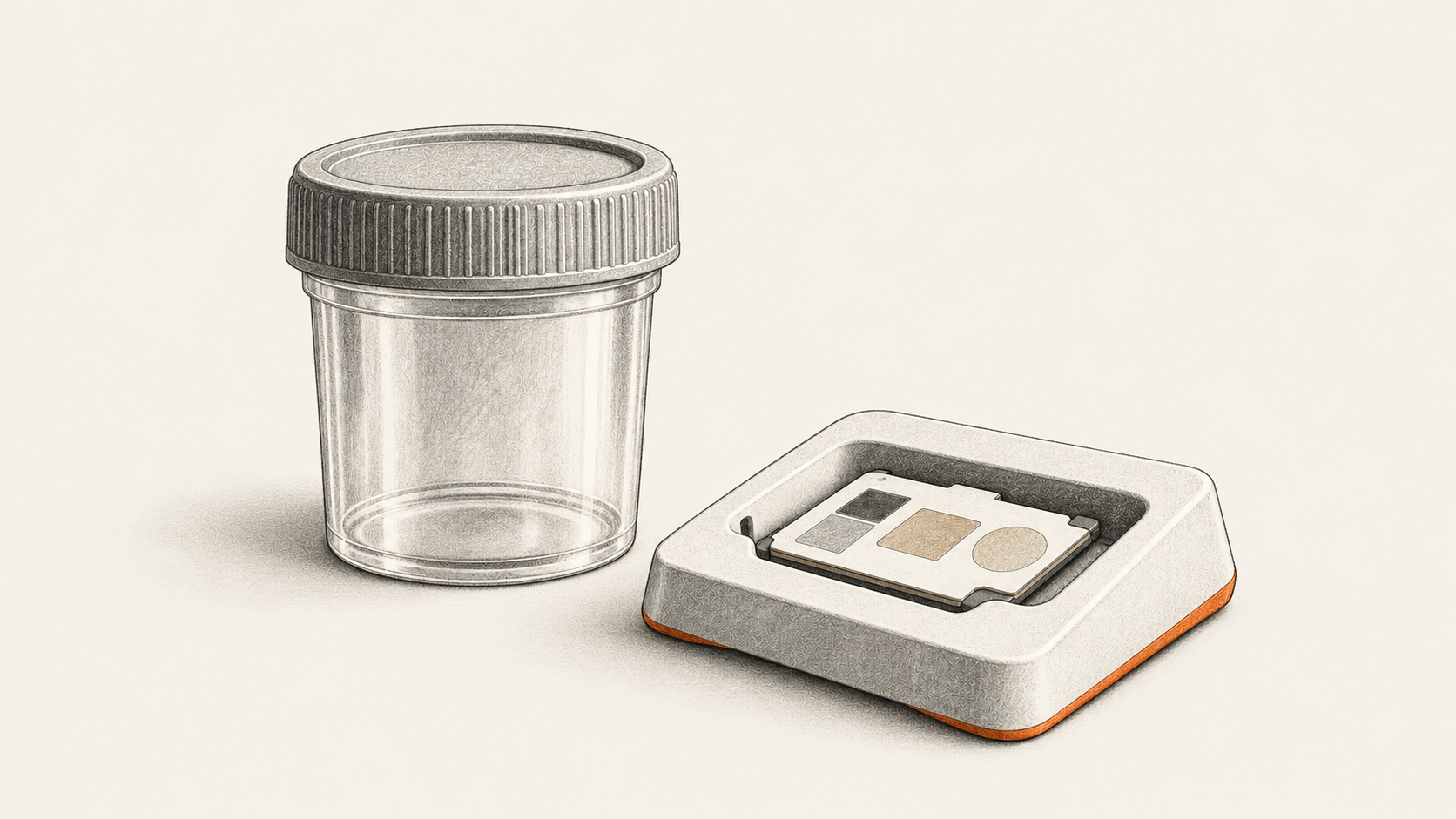
AI-generated conceptual illustration by BIG CHANGE; generic objects, not Taiyo Yuden's product or a validated medical test.
Taiyo Yuden showed a urine-odor sensor and AI analysis at CEATEC 2026, held October 13–16. The company proposes using the result to prompt further medical examination when a pattern remains unusual. Its demonstration establishes a sensing approach and an intended use, but the published material does not establish how reliably it identifies people with or without cancer.
The exhibit shows how a device measures an odor pattern. It leaves unanswered whether a medical decision based on that pattern would be reliable.
## The big change
- **What changed:** Taiyo Yuden presented a urine-odor monitoring concept at CEATEC. Its sensor records responses across 16 films, and AI compares the resulting pattern with learned examples.
- **Why it matters:** The proposed output is a prompt to consider further examination. That creates a possible route from a routine measurement to a clinical visit, if the system can be validated for that use.
- **What to watch:** A study reporting the population tested, comparison with established examinations, sensitivity, specificity and false results would show whether the proposed prompt is useful. The exhibition and award do not supply those measures.
## The sensor measures a pattern
Taiyo Yuden describes its device as a quartz crystal microbalance, or QCM, sensor. Odor molecules attach to films on a quartz substrate, changing their mass. Different substances interact differently with the films. The [company's technical account](https://www.yuden.co.jp/jp/poe_smellsensor01.html) says its current model combines 16 types of responsive film, then uses AI to compare the collected responses with learned odor patterns.
This method does not identify a tumor directly. The sensor measures a set of chemical responses; the analysis compares that set with patterns in its training data. At CEATEC, the company presented a concept in which changes in urine odor could signal a reason to seek an examination. Its [development account](https://www.yuden.co.jp/jp/poe_smellsensor02.html) explicitly describes this as a preliminary monitoring layer rather than a substitute for cancer testing.
The [CEATEC award entry](https://www.ceatec.com/ja/award2026/) confirms that the exhibit received an excellence award. It describes QCM sensing, responsive films and AI analysis, and presents the intended prompt for medical follow-up. The award recognizes the exhibited proposal; it is not a clinical validation result.
## A referral flag needs clinical evidence
[MONOist's October 16 report from the exhibition](https://monoist.itmedia.co.jp/mn/articles/2610/16/news031.html) quotes a company representative saying the current target is breast cancer and describing a roughly 80% judgment accuracy. The report does not give the study population, sample size, reference test, error breakdown or conditions behind that figure. It cannot be translated into a clinical detection rate from the information provided. The same representative described repeated unusual readings, rather than a single result, as the proposed reason to prompt a visit.
A usable referral system would need to show how often it flags someone who does not have the targeted disease, how often it misses someone who does, and whether repeated measurements improve the decision. Those questions matter because the consequence is a recommendation to seek further examination. None of the four published sources supplies a clinical cohort or independently verified sensitivity and specificity. They also do not establish medical approval, a sale date, price or deployment in routine care.
BIG CHANGE reviewed the company's descriptions, the organizer's award record and the exhibition report. We did not test the sensor or assess patients. These sources establish a development-stage demonstration and its proposed workflow; they provide no clinical validation of the referral flag.
## Sources & further reading
- [Taiyo Yuden: odor-sensor technology, part one](https://www.yuden.co.jp/jp/poe_smellsensor01.html). Company interview reflecting August 2026; checked October 17, 2026. Describes QCM mass-change sensing, 16 responsive films and comparison with learned patterns.
- [Taiyo Yuden: odor-sensor development and proposed health use, part two](https://www.yuden.co.jp/jp/poe_smellsensor02.html). Company interview reflecting August 2026 and its CEATEC 2026 demonstration; checked October 17, 2026. Describes preliminary monitoring and says it would not replace cancer examination.
- [CEATEC Award 2026 winners](https://www.ceatec.com/ja/award2026/). Organizer's record, checked October 17, 2026. Confirms the award, event dates and the exhibitor's stated concept; it does not report clinical test performance.
- [MONOist: Taiyo Yuden's CEATEC exhibit](https://monoist.itmedia.co.jp/mn/articles/2610/16/news031.html). Independent exhibition report, published October 16, 2026. Quotes a company representative on the intended use and a preliminary accuracy claim without a reported trial design or clinical error rates.
## Sources
- [Taiyo Yuden odor-sensor technology, part one](https://www.yuden.co.jp/jp/poe_smellsensor01.html) — Explains QCM sensing, 16 responsive films and AI comparison with learned patterns; company account, not a clinical study.
- [Taiyo Yuden odor-sensor development, part two](https://www.yuden.co.jp/jp/poe_smellsensor02.html) — Describes the CEATEC demo and preliminary monitoring concept, expressly separate from cancer testing.
- [CEATEC Award 2026 winners](https://www.ceatec.com/ja/award2026/) — Confirms October 13–16 event, award and stated QCM/AI concept; an award is not clinical validation.
- [MONOist October 16 CEATEC report](https://monoist.itmedia.co.jp/mn/articles/2610/16/news031.html) — Independent exhibit reporting and attributed company representative claims; no trial design or clinical error measures reported.
The BIG CHANGE newsletter
The big picture. At your pace.
Recent stories on AI and robotics, the shifts worth watching and practical ideas to use. Choose a daily briefing, weekly digest or monthly perspective.
Next scheduled send (UTC): . Your first edition arrives at the next scheduled send after you confirm.
Your privacy, your choice.
Necessary storage supports site security and remembers your choices. Optional Google Analytics stays off until you allow it. You can read every story with necessary storage only. Privacy details