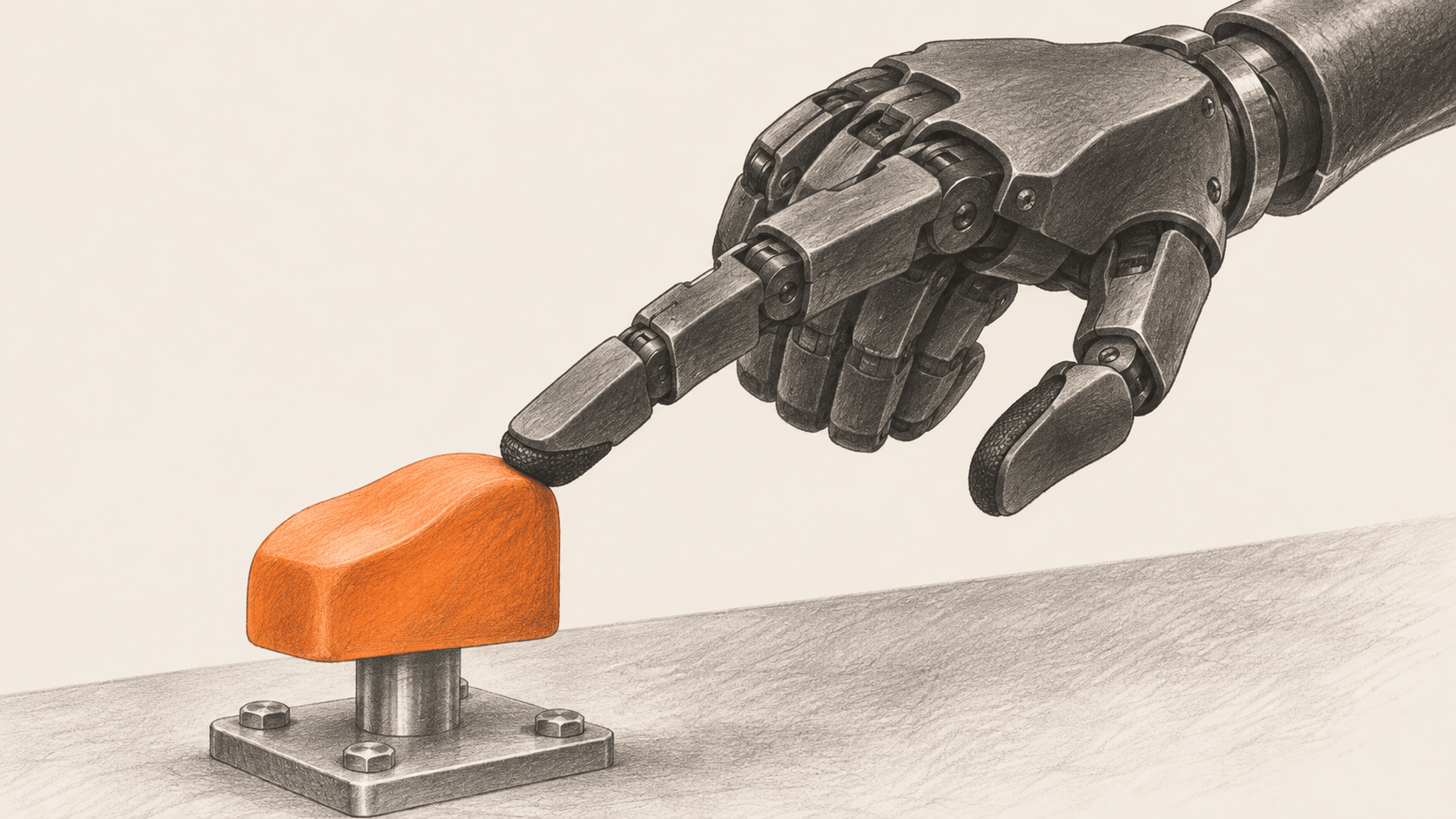
A November 18 preprint led by Yoobin Shin presents TapTacTouch, which reconstructs shapes from tactile contacts without a pretrained shape model.
The big change
- TapTacTouch turns scattered pressure contacts into a continuous surface, using geometric assumptions to fill gaps. The reconstructed shape therefore contains inferred regions, not just directly touched ones.
- A reconstruction’s F-score combines the closeness of its predicted points with coverage of the reference surface. The distance threshold defines what counts as a match, so a percentage needs that condition to be meaningful.
- Choosing the next touch is a separate problem from drawing a surface through existing observations. Earlier tactile research uses uncertainty to guide exploration; a complete-looking mesh alone does not establish an efficient sensing policy.
What touch does and does not reveal
The 2011 Gaussian Process Implicit Surface (GPIS) paper by Stanimir Dragiev, Marc Toussaint and Michael Gienger explains the representation. Instead of storing only a collection of surface points, it estimates a function throughout space: zero marks the surface, with opposite signs inside and outside the object. A contact constrains that function at a location; information about the local surface direction can constrain it further.
The Gaussian process combines those observations into a continuous estimate while representing uncertainty. This matters because a few known points do not uniquely specify every curve between them. The model’s assumptions help connect the observations, and the estimated surface remains conditional on those assumptions. A smooth or closed result should not be read as a record of physical contact at every point.
TapTacTouch scanned six small, fixed, 3D-printed objects with a multi-finger hand carrying 3×3 pressure arrays. Joint positions locate contacts; points inserted between them and inferred horizontal slices can fill gaps. Scans follow a rule-based sequence. Reconstruction does not calculate a surface-uncertainty map.
Read the score with its reference conditions
For comparisons, contacts were projected onto reference surfaces and perturbed with Gaussian noise of 0.5 mm standard deviation. Scores characterize ground-truth-assisted inputs, not raw end-to-end touch accuracy.
Beyond 5 mm from input contacts, the full method’s six-object mean F-score was 92.605%, versus 89.705% for multi-scale GPIS alone. Both used a 5 mm matching threshold; advantages varied by metric.
The Tanks and Temples benchmark’s original evaluation documentation explains why both directions of comparison matter. Precision asks how much of a reconstructed point set lies sufficiently close to the reference. Recall asks how much of the reference is covered by nearby reconstructed points. Their harmonic mean is the F-score: a result cannot earn a strong combined score by excelling at only one side.
For example, a small patch of very accurate points can have good precision while missing most of an object. Conversely, scattering points widely might cover the reference but introduce many incorrect points. This is a general interpretation of the metric, not an additional experiment. Thresholds and the reference geometry determine what the score rewards; they do not independently establish whether a robot can handle an object reliably.
Touch collection averaged 30 minutes. The 49.99-second mean reconstruction included loading, inference, meshing, closure and flat-bottom construction, excluding filling and metric evaluation. These are laboratory comparisons, not industrial or peer-reviewed validation.
A surface estimate is not yet a touch strategy
A separate 2020 study by Gabriela Zarzar Gandler and colleagues investigated sparse GP surface models using visual and tactile data. Its representation explicitly models uncertain regions, with experiments on synthetic data and observations from two robots. The work also describes how uncertainty can help prioritize where to acquire another tactile observation, while movement cost matters for exploration.
That distinction gives a robot developer two questions to assess. How well does a method represent the geometry already supported by observations? And how usefully does its next action reduce what remains unknown? These questions concern different parts of a perception system. A representation can support action selection, but that does not make every reconstruction procedure an adaptive exploration controller.
Touch can also complement a camera
Stanford’s Touch-GS offers a concrete, independently documented example of a different design choice. That IROS 2024 project combines optical tactile sensing with a color-and-depth camera and estimated image depth to train a 3D scene representation. Touch-derived geometry is fused with visual depth. The training objective weights depth information according to its uncertainty. The project shows examples involving reflective and transparent objects, where visual geometry is difficult.
The practical distinction is between replacing visual observations and combining sensors with different weaknesses. A developer assessing a tactile reconstruction method needs to identify which information the system receives, which surfaces are inferred, and what remains to be tested for its intended task. Sensor fusion is a documented alternative, rather than evidence that any single sensing approach works in every environment.