# TESS will retest an AI-assisted planet candidate
> TESS has an active target for TIC 4206066. New observations will test a researcher's preregistered transit predictions, while the planet interpretation remains unconfirmed.
By BIG CHANGE Editorial
Published: 2026-10-13T18:25:18.994Z
Updated: 2026-10-13T18:25:18.994Z
Canonical: https://bigchange.ai/blog/tess-ai-assisted-planet-candidate-sector-110
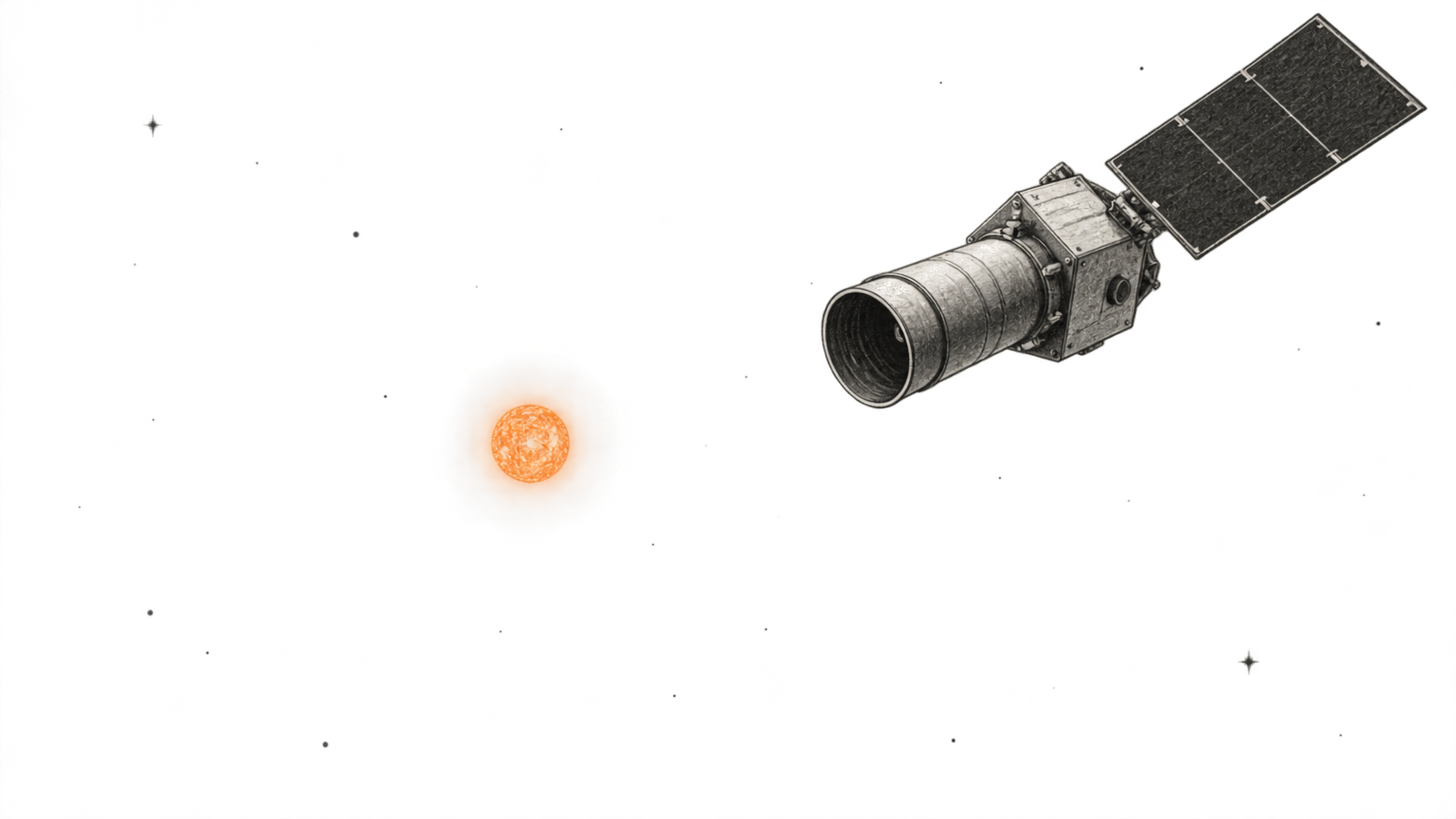
AI-generated conceptual illustration by BIG CHANGE; no actual TESS spacecraft or observation is depicted.
NASA's TESS telescope has put a star with two reported transit-like signals on its active list of special targets. The [mission's target list](https://tess.mit.edu/science/ddt/) names TIC 4206066 under Director's Discretionary Target program 100, with two-minute observations. [TESS's provisional schedule](https://tess.mit.edu/tess-year-9-observations/) places the relevant Sector 110 run from October 31 to November 26. The new data will test predictions that researcher Pavel Rabtsevich published before that run. Neither signal is a confirmed planet.
## The big change
- **What changed:** TESS lists a fresh two-minute observation of TIC 4206066, and Rabtsevich has deposited a protocol specifying when and how two proposed signals should reappear.
- **Why it matters:** The new measurements were not used to find or fit the signals. A stated test on independent data can expose an attractive result that fails outside the observations used to develop it.
- **What to watch:** Whether the predicted brightness dips recur, where they fall on TESS's pixels, and whether later imaging and radial-velocity work can distinguish a planet around TIC 4206066 from an unresolved companion-star explanation.
## What the earlier data show
Rabtsevich's [September 25 preprint](https://doi.org/10.5281/zenodo.22967456) reports small, repeated dips in TESS measurements of the nearby K dwarf TIC 4206066. He says the stronger signal, found in Sector 98 and traced back to Sectors 6 and 32, repeats about every 3.18 days. If it comes from a body crossing the named star, the estimated size is about 1.4 Earth radii. The paper reports a weaker 11.13-day signal with less archival support. Its estimated size, about 2.2 Earth radii, also depends on the signal originating at the target star.
Those conditional sizes are a useful description of the proposed signals, not measured planet properties. The preprint explicitly claims no statistical validation. Rabtsevich identifies a planet transiting an unresolved bound companion as a remaining alternative for the stronger signal. More periodic dimming alone cannot determine which star is being dimmed or establish that the object is a planet. The [supporting data and code deposit](https://doi.org/10.5281/zenodo.22967099) records the archival analyses; BIG CHANGE has reviewed the public records and protocol, but has not rerun the calculations or examined the raw light curves.
## The test is specified before new observations
TESS's [DDT page](https://tess.mit.edu/science/ddt/) lists Rabtsevich as principal investigator for one active target, TIC 4206066, at two-minute cadence. Its [Year 9 schedule](https://tess.mit.edu/tess-year-9-observations/) lists Sector 110 for October 31 through November 26 and says future pointing dates are provisional. The mission listing confirms the observation allocation. It does not endorse the preprint's interpretation of the dips.
In an [October 6 preregistration](https://doi.org/10.5281/zenodo.23175179), Rabtsevich fixed the predicted times and depths before Sector 110's data exist. His protocol expects nine opportunities for the stronger signal and three for the weaker one. It sets processing and pixel-location checks and four possible outcomes for each signal: recovered, inconsistent, excluded or insufficient data. The posted files include frozen code and checksums. Any analysis chosen after seeing the new light curve would have to be labelled separately from this registered test.
The protocol also states its limit. Recovering the dips would strengthen the case that the periodic signals persist in independent measurements. An eclipsing companion too close to resolve could also produce a recurring dip. High-resolution imaging and radial-velocity measurements would still be needed to address that alternative. An inconclusive result would likewise leave the cause unsettled.
## The AI role is a reported research workflow
In [his account of the work](https://www.reddit.com/r/ClaudeAI/comments/1wzw8zd/i_think_i_found_a_planet_nobody_knew_existed_i/), Rabtsevich says he used Claude Code to download and parse TESS data, write and rerun analysis code, fit transits and check possible false positives. He says he chose the questions and pass criteria, while Codex and separate agent sessions supplied additional reviews. The preregistration credits Claude with code and text drafting and Codex with editing and verification; it calls those internal AI reviews, not human peer review.
The disclosed AI work was part of a researcher-led analysis and has not been independently reproduced here. Rabtsevich is responsible for the scientific claims. After Sector 110, the posted predictions and outcome rules provide a specific basis for checking his interpretation.
## Sources & further reading
- [TESS Director's Discretionary Targets](https://tess.mit.edu/science/ddt/), accessed October 13, 2026. The mission lists DDT 100, Rabtsevich, TIC 4206066 and two-minute cadence as active. It does not validate a planet.
- [TESS Year 9 observations](https://tess.mit.edu/tess-year-9-observations/), accessed October 13, 2026. The provisional mission schedule lists Sector 110 for October 31–November 26, 2026.
- [Rabtsevich, “Two Transit-like Signals in TESS Photometry of the Nearby K Dwarf TIC 4206066”](https://doi.org/10.5281/zenodo.22967456), preprint dated September 25, 2026, modified October 6. This is the researcher's analysis and interpretation, without statistical validation.
- [Supporting data and code](https://doi.org/10.5281/zenodo.22967099), September 25, 2026. This deposit documents the research materials; BIG CHANGE did not reproduce its computations.
- [Preregistered Sector 110 test](https://doi.org/10.5281/zenodo.23175179), October 6, 2026. Its posted protocol, README and checksums specify predictions, outcome rules and limitations before the new observations.
- [Rabtsevich's account of the AI-assisted workflow](https://www.reddit.com/r/ClaudeAI/comments/1wzw8zd/i_think_i_found_a_planet_nobody_knew_existed_i/), October 2026. His account describes tool use and human decisions; it is not independent validation.
## Sources
- [Rabtsevich preprint, Two Transit-like Signals in TESS Photometry of the Nearby K Dwarf TIC 4206066](https://doi.org/10.5281/zenodo.22967456) — First-party author preprint record and abstract; modified October 6. Explicitly no statistical validation. PDF not inspected.
- [Supporting data and code for TIC 4206066 preprint](https://doi.org/10.5281/zenodo.22967099) — Author's deposited record and description. Code and TESS measurements were not run or independently checked.
- [A Pre-registered TESS Sector 110 Test of Two Transit-like Signals in TIC 4206066](https://doi.org/10.5281/zenodo.23175179) — Record metadata and README describe predictions, outcomes, frozen code and stated limits; protocol PDF not inspected.
- [TESS Director's Discretionary Targets](https://tess.mit.edu/science/ddt/) — Mission table shows active DDT 100, Rabtsevich, TIC 4206066 and two-minute cadence.
- [TESS Year 9 observations](https://tess.mit.edu/tess-year-9-observations/) — Mission's provisional Sector 110 calendar lists October 31 to November 26, 2026.
- [Rabtsevich's account of Claude Code in the analysis](https://www.reddit.com/r/ClaudeAI/comments/1wzw8zd/i_think_i_found_a_planet_nobody_knew_existed_i/) — Original researcher's self-report of AI workflow and human decisions; not independent validation.
The BIG CHANGE newsletter
The big picture. At your pace.
Recent stories on AI and robotics, the shifts worth watching and practical ideas to use. Choose a daily briefing, weekly digest or monthly perspective.
Next scheduled send (UTC): . Your first edition arrives at the next scheduled send after you confirm.
Your privacy, your choice.
Necessary storage supports site security and remembers your choices. Optional Google Analytics stays off until you allow it. You can read every story with necessary storage only. Privacy details