# Unlearning study shows how tests can miss known deletions
> Seeing a deletion and proving that a method removes data are different evaluation questions.
By BIGCHANGE.AI Editorial
Published: 2026-11-24T12:51:38.081Z
Updated: 2026-11-24T12:51:38.081Z
Canonical: https://bigchange.ai/blog/unlearning-coverage-tests-known-deletions
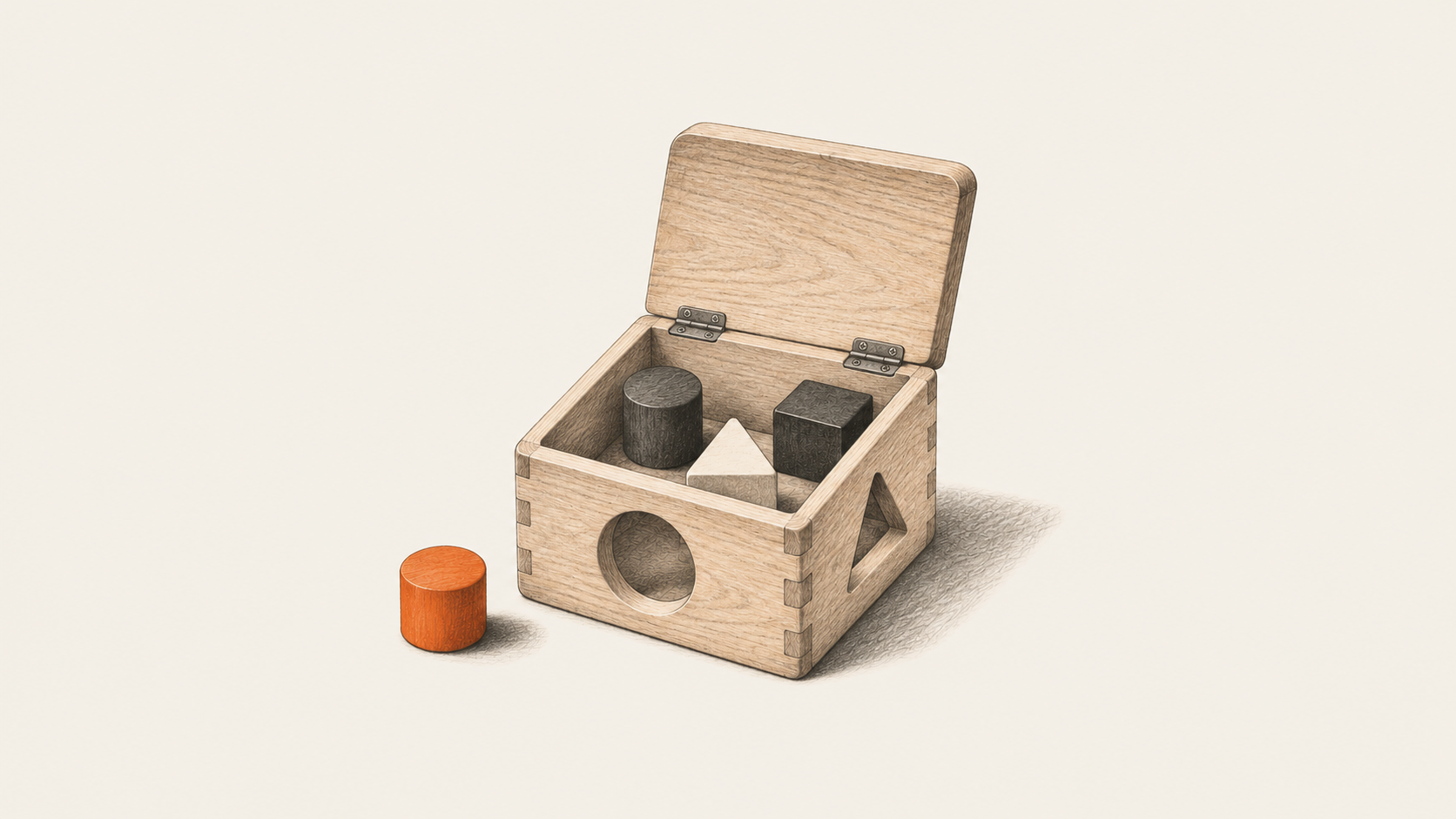
AI-generated conceptual illustration for BIG CHANGE; not the study's equipment, dataset or a verified deletion result.
In a preprint submitted on November 20, Ziluowen Luo and colleagues examine why a test can miss a known training-data deletion.
## The big change
- Known deletions went undetected when an evaluator discarded color–shape pairings. Preserving that information changed the result without further retraining.
- Unlearning concerns what a model learned from training data. Deleting the original file does not automatically undo the model updates that depended on it.
- Formal removal guarantees compare learning processes under stated assumptions. Numerical similarity between two trained models is a weaker claim than that guarantee.
## A deletion and its detection are different events
Observability concerns what the available measurements can reveal. Here, synthetic records pair colors with shapes; separate counts lose which went together. The coverage score counts targets meeting both detection and false-alarm limits. In the color–shape experiment, models were retrained with one pair omitted, so the exclusion was known before evaluation.
At 256 pairs, four separate-count tests covered none, while joint counts covered all, using identical 1,020 output draws per trial. A target needed at least 90% detection and at most 5% false alarms under every other deletion, which retained the queried pair; results average three training seeds. These are empirical point-estimate gates, not proof that private records were removed from a deployed model.
## Why deletion is a learning problem
Bourtoule and colleagues' original SISA research explains the underlying difficulty. Training changes a model's parameters—its learned numerical settings—through a succession of updates. An example can affect later updates as well as the step in which it appeared. Removing a stored training record leaves that learned state in place, which is why unlearning needs a reference for what the model would have become without it.
SISA—short for sharded, isolated, sliced and aggregated training—addresses the computational cost by organizing training in advance. It divides data into separate groups, trains component models independently and combines their predictions. Saved intermediate states let an affected component restart before the deleted example was used, rather than rebuilding every component. This is a training arrangement with a defined deletion path, not a setting that can simply be attached to any existing model.
The original research also examines an accuracy tradeoff: dividing data among smaller learners can reduce predictive quality.
## What a certificate would establish
Guo and colleagues' ICML 2020 paper defines certified removal through the probability distributions produced by learning procedures. One procedure trains a model and then removes an example's influence; the reference trains without that example from the outset. Their guarantee bounds how distinguishable those resulting model distributions can be.
This is a comparison over the possible models produced by randomized training, rather than a requirement that two saved weight files be identical. The paper shows why merely placing model parameters close together can leave information about a training example.
The mechanism addresses linear classifiers—models that score weighted input features—under specified mathematical conditions. The discussion of deeper networks uses a fixed feature extractor and applies removal to the linear model above it. Those assumptions matter: a guarantee for that specified learning procedure does not establish removal throughout an arbitrary neural network.
## Why a combined score needs unpacking
The organizers' original evaluation document for the NeurIPS 2023 unlearning competition provides another useful distinction. Its forgetting-quality measure averages scores for individual examples. The final competition score also incorporates accuracy on retained data and a held-out test set, with an execution-time cutoff.
That design makes several priorities visible: removing influence, preserving useful behavior and limiting computation. The organizers explicitly warn that compressing them into one number loses information about the individual components. They also say the competition's particular dataset, architecture and deletion set do not establish fitness in other settings.
For a team reading an unlearning result, the component measures explain what the overall score rewards and what it can hide. A strong combined score can coexist with a weaker result on one objective. The organizers also identify limited reference-model samples as a source of measurement uncertainty; observing a score requires judging the evidence used to estimate it.
BIG CHANGE reviewed the papers and original evaluation documents. It did not train or edit a model, inspect anyone's private data or reproduce the experiments.
## Sources
- [Coverage preprint, exact v1](https://arxiv.org/html/2611.27543v1) — Known deletions and Table 1B.
- [Original SISA research](https://arxiv.org/html/1912.03817v3) — Training structure and utility.
- [Certified Data Removal](https://proceedings.mlr.press/v119/guo20c.html) — Definition and classifier scope.
- [Original NeurIPS evaluation document](https://unlearning-challenge.github.io/assets/data/Machine_Unlearning_Metric.pdf) — Combined metrics and limits.
The BIG CHANGE newsletter
The big picture. At your pace.
Recent stories on AI and robotics, the shifts worth watching and practical ideas to use. Choose a daily briefing, weekly digest or monthly perspective.
Next scheduled send (UTC): . Your first edition arrives at the next scheduled send after you confirm.
Your privacy, your choice.
Necessary storage supports site security and remembers your choices. Optional Google Analytics stays off until you allow it. You can read every story with necessary storage only. Privacy details