WorldBridge links video prediction to robot actions, researchers report in an October 29 preprint.
The big change
- Task video improved simulated performance without new-task action labels.
- Physical tests used task-specific fine-tuning.
- Results depend on the tested tasks and conditions.
From visual prediction to movement
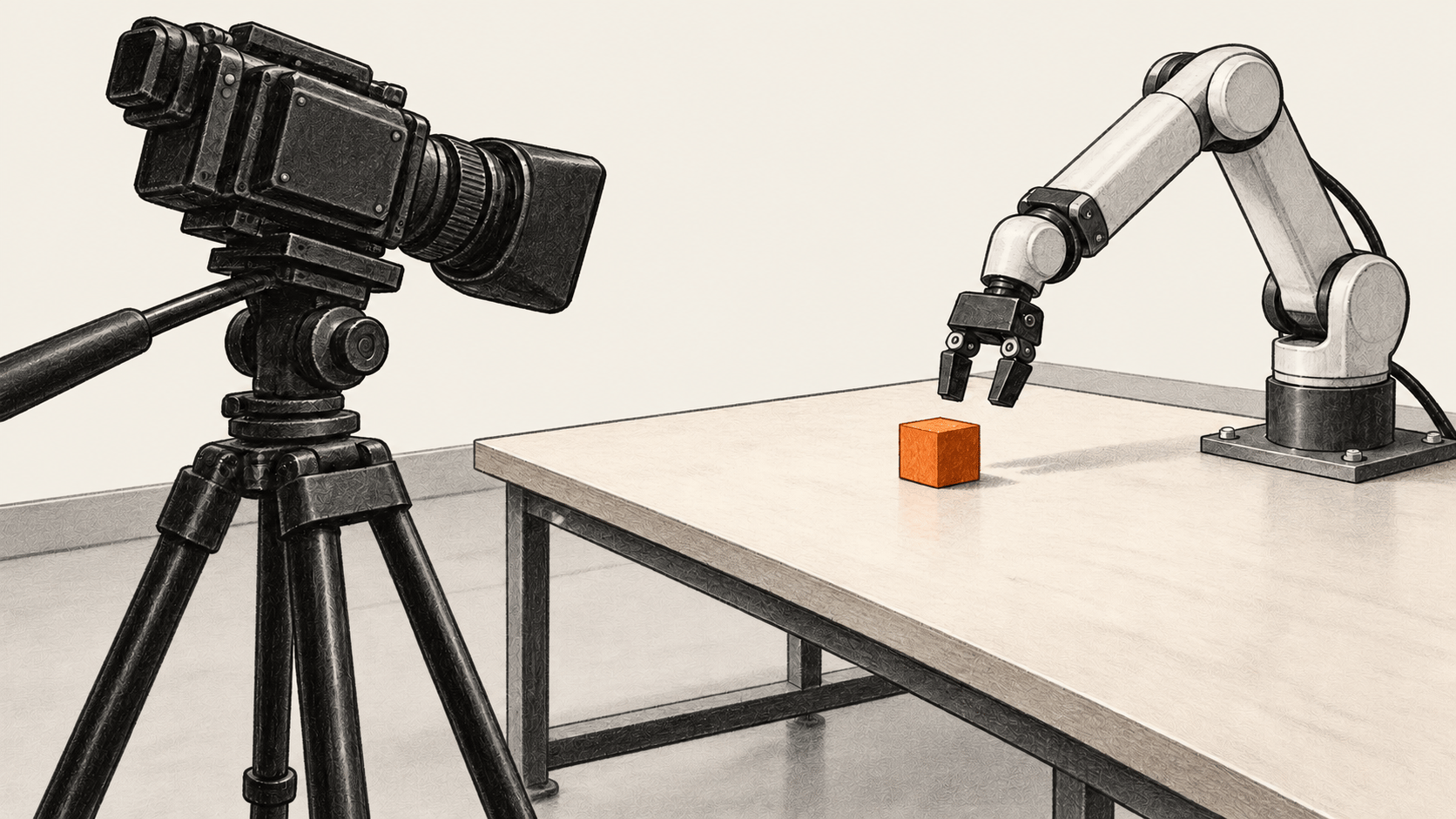
WorldBridge connects separate video and action experts: predicted visual changes help condition the actions a robot should take.
A visual prediction and an executable movement are different things. An earlier Video Prediction Policy paper also studied how predicted visual representations could guide robot action learning.
What was tested
In RoboTwin simulation, initial-task video-action data yielded 25.07% success on held-out tasks, the authors report. Adding video of those tasks, without corresponding action labels, raised success to 55.90%.
RoboTwin 2.0’s creators describe a simulation benchmark for two-arm manipulation with varied lighting, clutter and backgrounds.
Separately, physical tests covered six tasks on two platforms. Each method was fine-tuned on the same task demonstrations, then tested over 20 trials per task with varied starting positions or orientations. WorldBridge averaged 72.5% success versus 57.5% for π0.5, the authors report. This is not independent replication or proof of general-purpose deployment.
BIG CHANGE previously covered Runway’s separate Praxis-1 research.
Sources & further reading
- WorldBridge preprint — Model and experiments.
- RoboTwin 2.0 paper — Simulation context.
- Video Prediction Policy paper — Prior research.