# Xiaomi reports apartment trial of its robot model
> A reported multiroom run adds a practical setting to earlier research, while leaving reliability and operating conditions open.
By BIGCHANGE.AI Editorial
Published: 2026-11-03T14:08:38.375Z
Updated: 2026-11-03T14:08:38.375Z
Canonical: https://bigchange.ai/blog/xiaomi-robot-model-apartment-trial
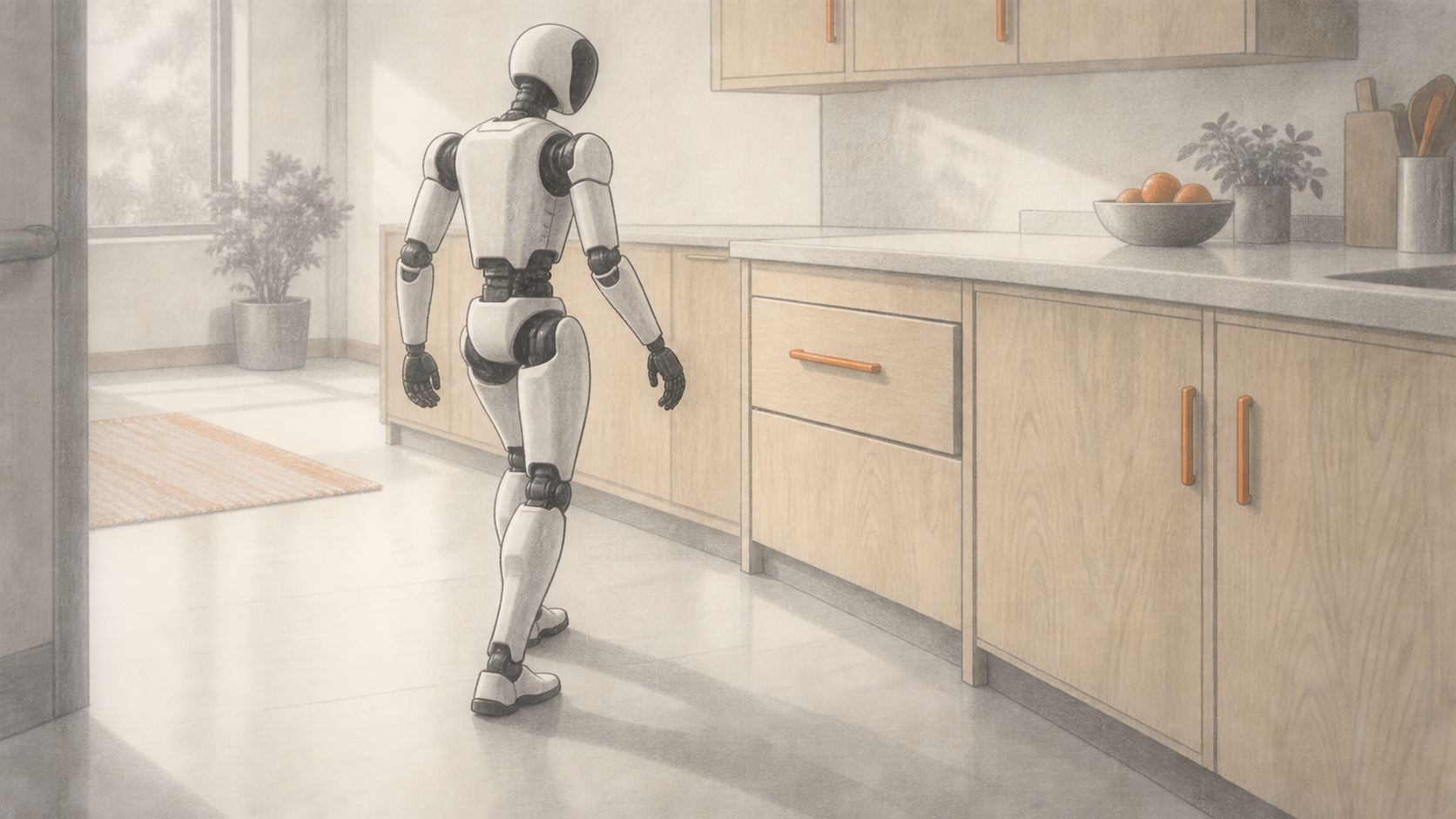
AI-generated conceptual illustration by BIG CHANGE.
IT Home reports a Xiaomi robot trial in a company apartment.
## The big change
- The reported run spans multiple rooms and household tasks.
- Earlier research trained the model on manipulation data and aligned actions with different robot bodies and instructions.
- The trial report does not establish repeat success or intervention rates.
## From a reported run to household work
On November 3, IT Home reported Xiaomi’s video describing a system based on Xiaomi-Robotics-1 in trial operation at a company youth apartment. The publication relayed a run of more than 30 minutes across three rooms and over 50 tasks, including tidying surfaces and collecting rubbish.
The report describes a loop joining data collection, model inference and task execution. It does not provide the number of attempts, interventions or a repeated-run success rate. BIG CHANGE could not independently access the underlying video.
## How the model was trained and tested
Xiaomi’s separate July paper describes a vision-language-action model trained on real-world manipulation recordings. Post-training aligns its learned actions with different robot bodies and language instructions.
In one earlier evaluation, researchers tested four familiar task types with unseen objects and environments, without task-specific or environment-specific fine-tuning. For its five-billion-parameter comparison, Xiaomi reported 75% overall success after action pre-training on 20,000 hours of recordings, versus 26% without action pre-training. Both used identical post-training. Four familiar task types were tested with unseen objects and environments. That supports a pre-training benefit under those test conditions.
A separate evaluation used four tasks held out from the in-house robot data, then fine-tuned on those tasks and tested each model ten times per task.
## A separate household research system
Stanford and Caltech’s HomeBody uses persistent spatial memory and a library of reusable skills to organize longer household tasks. A vision-language model calls skills such as navigation and grasping and receives feedback on their execution. BIG CHANGE previously covered [that separate project](https://bigchange.ai/blog/homebody-humanoid-spatial-memory-robot-skills).
## Sources
- [IT Home: Xiaomi apartment trial](https://www.ithome.com/1/021/602.htm) — IT Home reports Xiaomi's November 3 video and trial claims; the video was not independently accessed.
- [Xiaomi Robotics-1 research paper](https://arxiv.org/html/2607.15330v2) — Xiaomi's July paper explains model training and bounded experiments.
- [Stanford and Caltech: HomeBody](https://tml.stanford.edu/homebody/) — Stanford and Caltech describe their household robot research system.
The BIG CHANGE newsletter
The big picture. At your pace.
Recent stories on AI and robotics, the shifts worth watching and practical ideas to use. Choose a daily briefing, weekly digest or monthly perspective.
Next scheduled send (UTC): . Your first edition arrives at the next scheduled send after you confirm.
Your privacy, your choice.
Necessary storage supports site security and remembers your choices. Optional Google Analytics stays off until you allow it. You can read every story with necessary storage only. Privacy details