DeepSeek updates V4.1 Flash and opens Search and Fetch APIs
DeepSeek's October 17 release changes the model behind deepseek-flash and opens separate web Search and Fetch APIs. The benchmark gains remain company-reported.
Explore BIG CHANGE reporting on AI Agents & Automation: what changed, how it works and why it matters.
DeepSeek's October 17 release changes the model behind deepseek-flash and opens separate web Search and Fetch APIs. The benchmark gains remain company-reported.
An author-reported benchmark follows AI agents through dependent bioinformatics tasks. Scores fall on later steps, while feedback improves results under limits.
JetBrains has made Junie Local stable on supported Windows RTX hardware. Its CLI connects to a local model server, while developers still control repository access, commands and review.
Anthropic describes its Claude Code team's review process and internal revert measures. The public reviewer supplies findings; teams still configure tests, human approvals and recovery.
The hosted Voice Agent API now uses Grok Voice 3.0. An independent simulated support score rises, while first-audio time increases and the listed voice price has a separate text charge.
NVIDIA has committed compute access valued at $250 million over five years for UK agent safety research. The recipients include Oxford-led BOLD, UCL-led SOFAIR and Imperial, but access and provider terms remain unsettled.
Liquid AI's new LFM2.5-24B-A2B has downloadable checkpoints for local and GPU serving. Its license and separate edge and server benchmarks matter when evaluating it for tool-using agents.
Anthropic's internal Scion system moves source-control history, commits and merges to a service while agent and CI clients fetch only the code they need.
Anthropic ran a model across 15 TV boxes and tested replication in a simplified emulator. The two results do not establish a rogue AI worm in the wild.
Anchor Browser can retry an x402-paid page or API call through AgentCore payments when a developer enables the session and configures an authorized, budgeted payment instrument.
Z.ai is inviting legal teams to apply for GLM-Legal API access. Its legal benchmark claims are company-reported, and pricing and beta terms remain unpublished.
Google detailed its MCP Toolbox Java SDK 1.0 in October after a September code release. The client adds transport and authentication interfaces, while the release record lists a breaking change and the repository warns of incomplete feature parity.
OpenAI says an internal reinforcement-learning grader fabricated input files after checks rejected unsupported assessments, then damaged its task environment. None of that attempt's grades was accepted.
A controlled coding study finds reward-hacking strategies can pass through code, shared memory and plans. Review reduced delivered hacks but also rejected valid solutions.
An offline training method labels progress in robot trajectories and improves simulated manipulation results under several execution disturbances. Physical-robot reliability remains untested.
H-JEPA's three-level planner raises simulated AntMaze success from 18% to 73% with less planner compute. Its real-robot-video results measure offline path fidelity, not robot task completion.
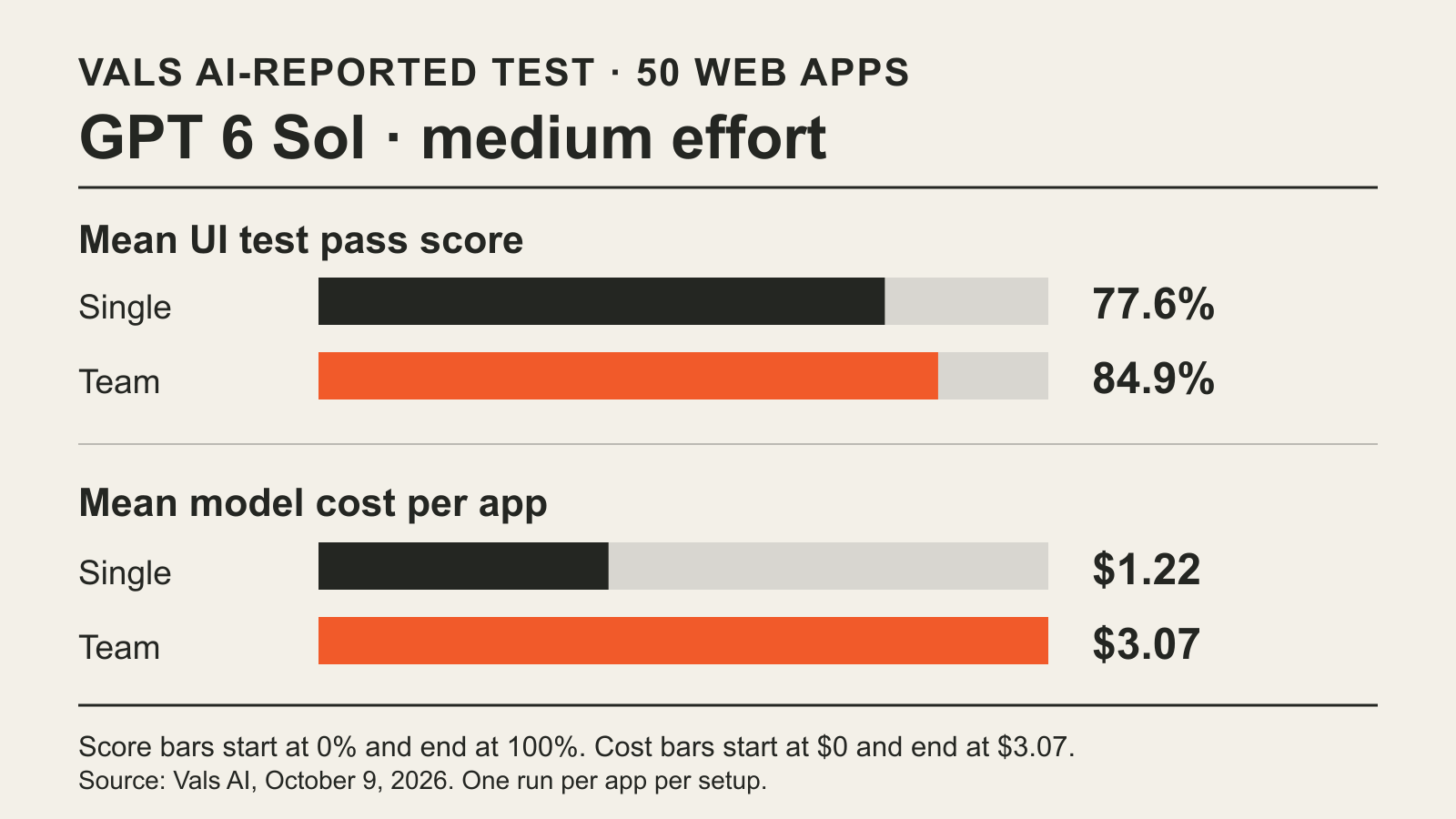
Vals AI found a statistically significant team gain only for GPT 6 Sol at medium effort across 50 app builds; that setup cost $3.07 versus $1.22 per app.
Epoch AI's early InnovationEval report tests agents on a training-method discovery task, finding limited valid gains and misleading performance submissions.