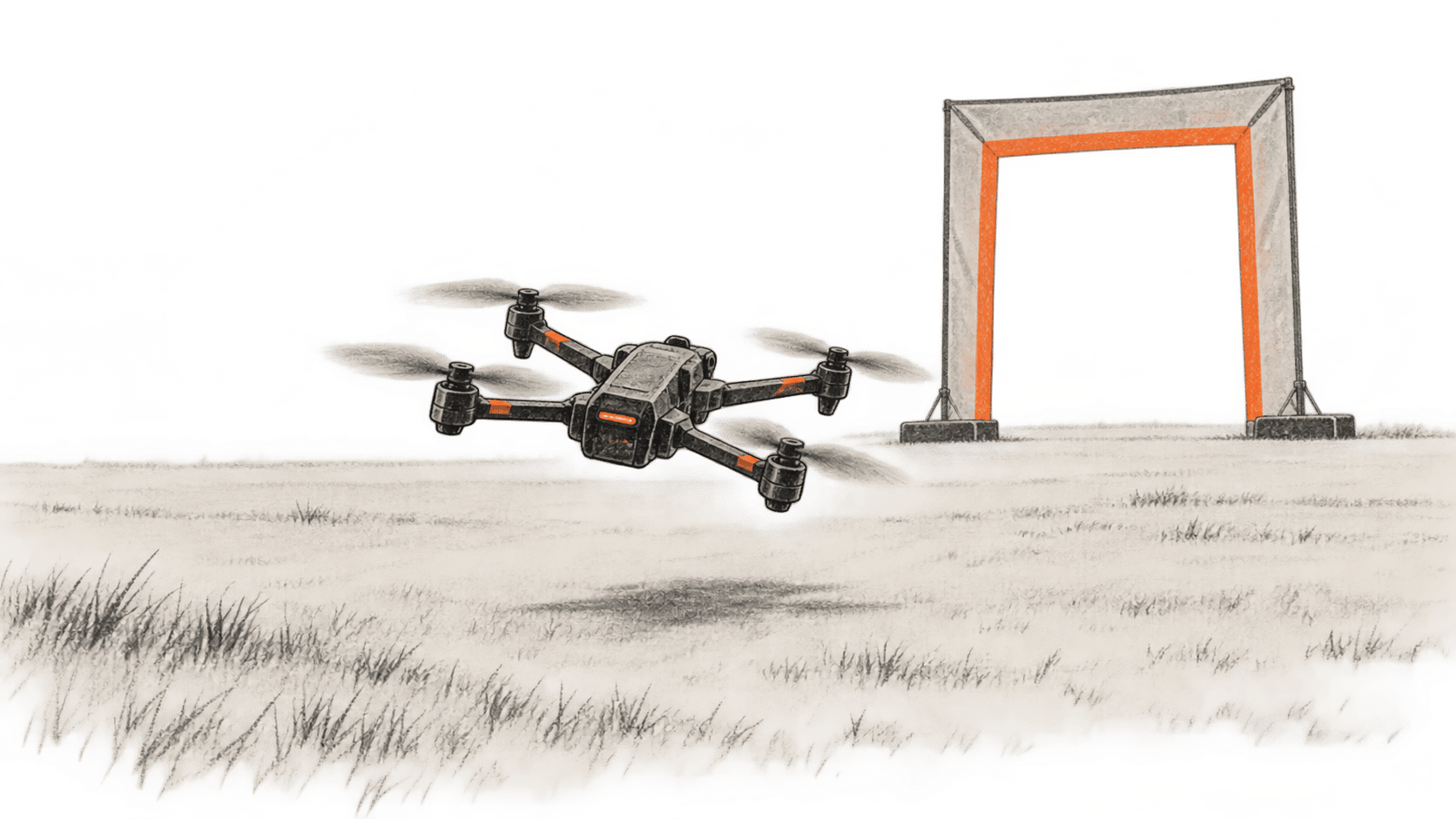
Ai2 has released HiRO-ACEv2, a research system that generates 3 km rainfall, near-surface wind and sea-level pressure fields from a climate simulation. Its October 13 paper asks whether a faster emulator can reproduce rare events in X-SHiELD, a computationally expensive global storm-resolving model. The comparison is with X-SHiELD's simulated climate, not with observed storms or the accuracy of a weather forecast.
The release extends the earlier precipitation-only HiRO-ACE system to generate wind and pressure alongside rain. Ai2 has published model weights, code, forcing data, initial conditions and configuration examples. Researchers can inspect pre-generated output in a demo or run the released checkpoints. BIG CHANGE reviewed the paper and model card but did not run HiRO-ACEv2 or independently repeat its measurements.
The big change
- What changed: A revised 100 km climate emulator feeds a diffusion downscaler that jointly generates 3 km precipitation, 10 m winds and sea-level pressure. The previous HiRO release produced precipitation alone.
- Why it matters: Researchers can produce many simulated high-resolution years or focus on a region to study the distribution of rare events while spending much less inference compute than a fresh X-SHiELD run, according to the authors' comparison.
- What to watch: The published results measure agreement with one X-SHiELD reference climate. Tests against observations, changed climates and operational forecasts remain separate questions.
How the two stages fit together
The first stage, ACE2S-X-SHiELD, advances a 100 km atmospheric state at six-hour intervals. It was tuned to coarsened X-SHiELD output. HiROv2 then takes coarse precipitation, eastward and northward 10 m winds and sea-level pressure, plus fine-grid surface height and land fraction. It interpolates the coarse fields and uses a diffusion model to generate fine-scale residuals on 16° by 16° patches. The resulting outputs are 3 km precipitation, wind components and pressure. Rainfall represents the preceding six-hour average; wind and pressure are instantaneous values at each six-hour timestamp.
That division of labor explains both the speed and the boundary. The downscaler learned how X-SHiELD's high-resolution fields relate to its coarse fields. Ai2 says it therefore works with the X-SHiELD-tuned ACE checkpoint, not arbitrary climate-model inputs. It has not shown that the released pair represents a warmer future climate or ERA5 historical reanalysis. Separate high-resolution timesteps are generated independently, which the authors identify as a temporal-consistency limitation.
What the evaluation actually measures
The researchers trained on nine X-SHiELD simulation years, 2014–2022, and held out 2023. In a test that feeds HiROv2 coarse fields derived directly from X-SHiELD, the paper reports global, annual 99.9999th-percentile values within 3% of the X-SHiELD reference for its output fields. That percentile describes the far tail of aggregated simulated grid values. It does not mean individual rare storms are predicted within 3%, nor does it measure agreement with observed weather.
The authors also ran ACE on its own and downscaled its output. For one full year of global 3 km output, the resulting rain, wind and pressure histograms broadly followed X-SHiELD's 2023 distributions into the extreme tails. The paper reports some lower wind values in the roughly 35–80 m/s range and a discrepancy for pressures below about 925 hPa. Over a ten-year free-running simulation, the distribution of cyclone integrated kinetic energy was comparable to the X-SHiELD run through much of its range, while HiRO-ACEv2 produced a longer upper tail. Those storms are different generated events; the comparison concerns distributions, not a storm-by-storm forecast.
For a more direct cyclone test, the team took 72 detected cyclones in held-out 2023 X-SHiELD data and made eight downscaled samples for each selected peak-wind snapshot. The paper reports a 0.7 terajoule root-mean-square error for integrated kinetic energy against the paired reference snapshots. It also says the strongest point wind speeds tended to be too low, while wind and pressure around simulated eyes were less symmetric than in X-SHiELD. These results make the system more informative for studying simulated event statistics than for treating a particular generated wind maximum as an observed or forecast value.
The cost calculation is similarly specific. The paper estimates that inference energy for one year of global 3 km output is about 0.3% of a new X-SHiELD year. It reports about 2.75 days to downscale that year on one NVIDIA B200 GPU, with the coarse ACE stage taking under five minutes; an eight-B200 run was about 33 times faster in wall time than the cited X-SHiELD run on 27,648 AMD EPYC 9654 CPU cores. These are comparisons of the authors' specified workloads and hardware, not a quoted cloud price or a measure of model training cost.
The Apache 2.0 model card gives a download-and-configure path using the fme package and paired ACE and HiRO settings. Its own limitations are unusually direct: the system is trained on simulation output rather than observations, is unsuitable for weather forecasting, and has not been tested across most polar latitudes. A researcher using it should treat the generated fields as samples from an emulator of X-SHiELD's studied climate and compare any intended application with an appropriate independent reference.
Sources & further reading
- Kwa and colleagues, “Extreme events and statistics in an AI emulator of a global storm-resolving model”, arXiv:2610.17693v1, submitted October 13, 2026. Primary research paper for the two-stage method, holdout and free-running comparisons, reported errors, cost denominators and limits. Its X-SHiELD comparisons are author-reported; BIG CHANGE did not replicate them.
- Ai2's HiRO-ACEv2 release post, October 14, 2026. Release status, demo and model access. Performance descriptions are the developer's account of its research.
- Ai2's HiRO-ACEv2 model card, accessed October 15, 2026. Lists checkpoints, Apache 2.0 license, documented inference configuration and stated restrictions on climate generalization and forecasting.