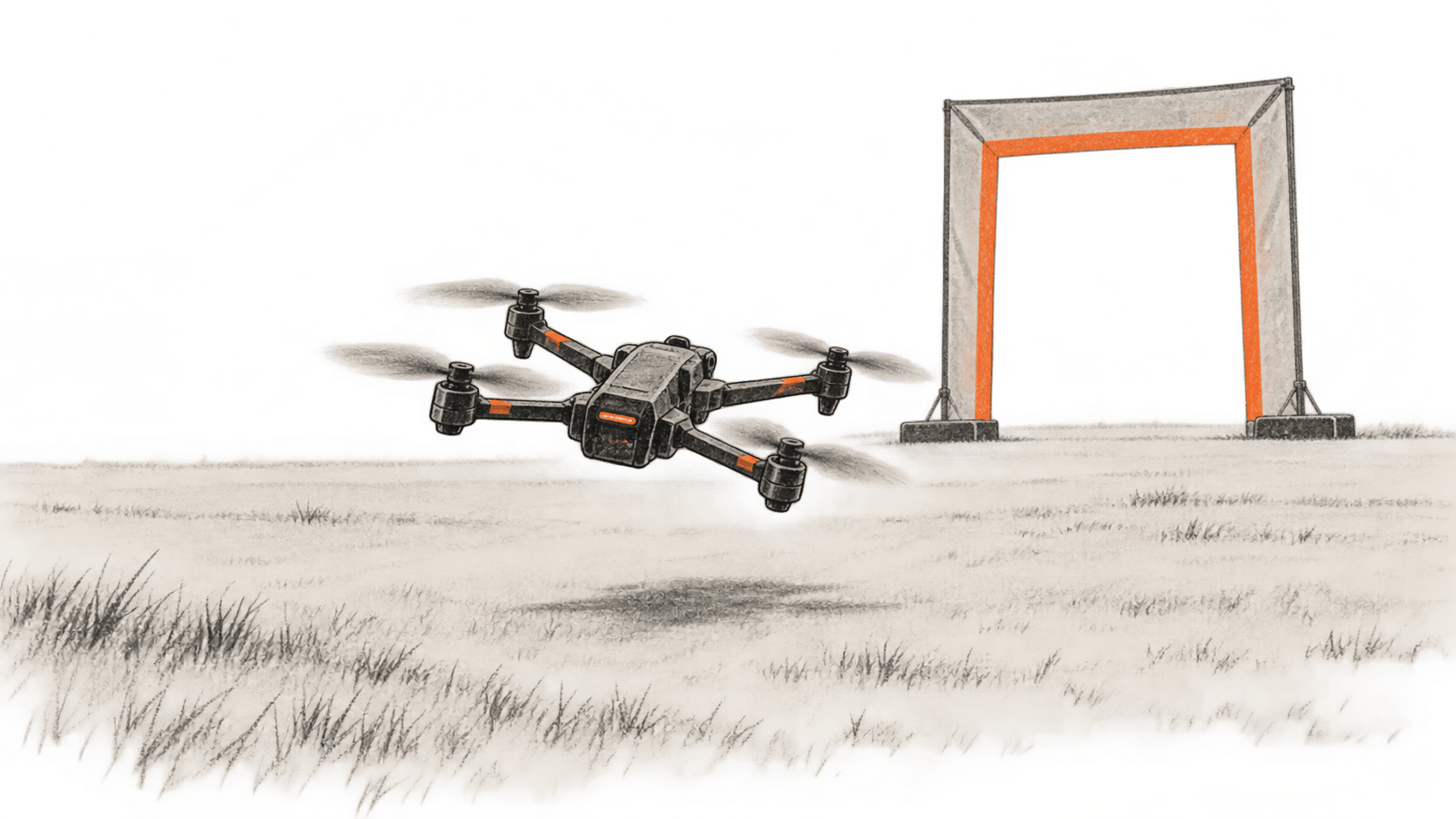
TU Delft researchers have published the method behind MonoRace in Science Robotics on October 14, 2026. The result it explains is older: the drone won at the Abu Dhabi Autonomous Drone Racing Competition in April 2025. The paper details how a single forward-facing camera, an inertial measurement unit (IMU) and a small onboard control network worked together at racing speed.
The authors' accessible preprint, submitted January 21, 2026, reports wins over the other autonomous teams and three human world champions in a knockout event. It says MonoRace reached up to 100 km/h on the competition track without external motion tracking. TU Delft's campus publication reported the win in April 2025. BIG CHANGE has not tested the system.
The big change
- What changed: The October 2026 paper explains how the team retuned MonoRace's camera alignment after impacts or repairs using onboard flight images and known gate shapes, without external motion tracking.
- Why it matters: Drone-racing teams evaluating multiple aircraft need to assess collision avoidance separately. MonoRace placed third in the multi-drone event because it lacked that capability, despite its solo and human-race wins.
- What to watch: The marked-course results do not establish reliability away from a track, general-purpose navigation, deployment safety, commercial availability or transfer to other robots.
From gate image to motor command
The competition drone used one visual camera alongside an IMU that measured motion. Its rolling-shutter camera supplied images to an onboard computer, where a neural network marked the racing gates. The software then found gate corners, checked them against the expected view and combined the visual position estimate with IMU readings in a state estimator. A drone dynamics model helped the estimator when hard maneuvers pushed the accelerometer beyond its measurement range, according to the paper's method.
The researchers also used flight recordings to improve calibration between runs. They compared where gates of known shape and size should appear in the camera image with where the segmentation system found them. That offline adjustment was particularly useful for refining the camera's position and angle relative to the drone after a repair or impact. The adjustment used knowledge of the racing gates and required no external motion tracking.
The estimated state then went to a small neural guidance-and-control network on the flight controller. Trained in simulation, it sent commands directly to the motors at 500 updates per second, bypassing a separate inner control loop. The camera images were processed on an onboard NVIDIA Jetson Orin NX; the 500 Hz network ran on the flight controller. The image processor and 500 Hz motor controller ran on separate onboard hardware.
What the race establishes
MonoRace won the individual Grand Challenge and the AI-versus-human knockout competition in 2025, the researchers report. Their paper also records a third-place finish in the multi-drone race, where it lacked collision-avoidance capability. The demonstrated result is fast flight around a known gate course under competition conditions, with all perception and control onboard and no external motion tracking. The paper does not establish general-purpose navigation, a deployment safety record, commercial availability or transfer to other kinds of robots.
An earlier system, Swift, beat champion human pilots on an indoor course using onboard sensing during its races. Its research used stereo visual-inertial sensing and motion-capture data during development. MonoRace's reported advance is a competition result with a single visual camera and onboard IMU, paired with its gate-based estimator and direct motor controller. The studies used different tracks and events, so their times are not a head-to-head measure of which system is faster.
Sources & further reading
- MonoRace author preprint, submitted January 21, 2026. The accessible methods and results account used for this article; the later journal article is linked separately.
- Science Robotics journal record, published October 14, 2026. Publication information is supported by the journal DOI and TU Delft release bibliography; the publisher's full page was inaccessible during this review, so technical details above are attributed to the preprint.
- TU Delft Delta's April 16, 2025 race report documents contemporary reporting of the Abu Dhabi win.
- Swift research paper provides the limited earlier-system comparison.