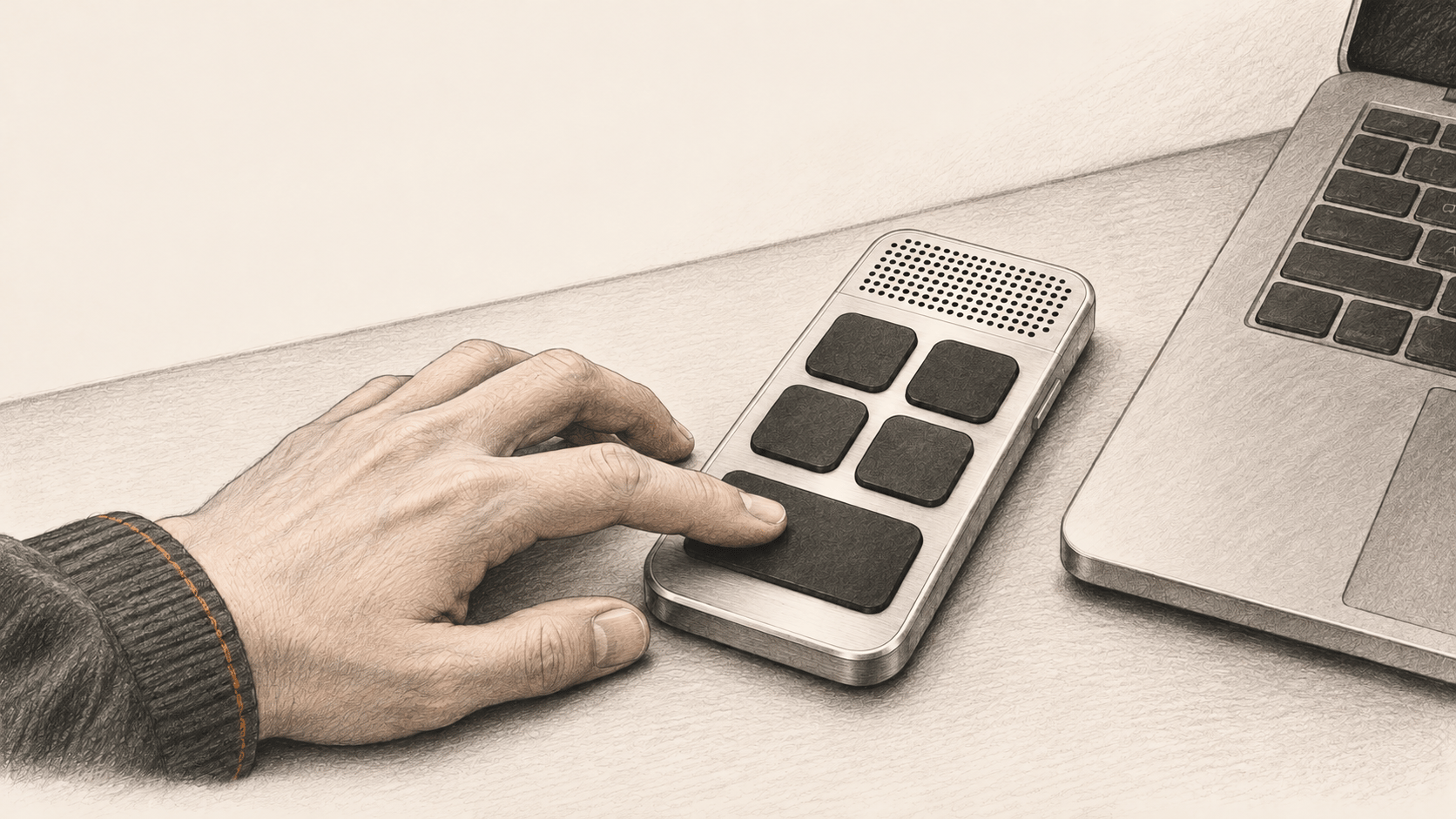
By November 26, Genspark’s shop was listing SecondBrain VoicePad as live on Kickstarter. The five-key controller depends on companion software for speech and AI functions.
The big change
- VoicePad adds dedicated buttons and off-computer recording. Genspark’s current shop promotes editable keys, but an October FAQ describes a fixed push-to-talk key, so the public control descriptions need careful reading.
- Speakly’s existing manual places recognition and speech cleanup in the cloud. Capturing sound and turning it into usable text are separate steps; a recording capability does not make transcription an offline task.
- Crowdfunding supports a product’s development rather than establishing that it is ready to ship. The FTC advises checking production status and refund arrangements, because completion and delivery are not guaranteed by a campaign.
Hardware controls
The shop describes remapping keys in the Genspark Super App. Its October 14 FAQ names Speakly and restricts remapping to keys one through four; the wide key stays push-to-talk. It lists Mac and Windows support over Bluetooth or USB-C.
The shop says VoicePad records without a computer; the FAQ adds playback through its speaker. These are creator descriptions, not our test. The older FAQ targeted January 2027 shipping. Current reward pricing and delivery terms were not verified in this report, so that dated target is not presented as a current pledge guarantee.
Where the software does the work
Speakly is already a separate voice-input app. Its manual describes holding a key, speaking and having text inserted at the cursor in another application. Recognition and cleanup run online. The default AI-polish mode removes filler words, fixes misspeaks and adds punctuation; Normal mode keeps the spoken wording without cleanup.
One documented example involves an email with several paragraphs and a buried request. The user selects it and asks for the request to move to the first line. The useful distinction is that speech can supply an editing instruction as well as the text being edited. This is the provider’s example, not a BIG CHANGE test.
Agent Mode is another step: a request opens in the browser as a Genspark Super Agent task. It should not be confused with simply inserting dictated words into a message.
A shortcut does not fix the processing bill
Genspark’s separate credits guide explains that credits meter computational effort. The amount varies with model tier, context length, output size and task complexity. A request involving research, writing and media can require different work from a short answer.
The guide also says longer conversations can become more expensive as their context grows. Its usage log may lag by a few hours even when the balance already reflects a task. These are account-level service mechanics, not a measurement of this hardware’s efficiency.
An allocation of credits therefore cannot be converted into a fixed number of finished projects from the unit count alone. For recurring work, the meaningful comparison is the actual service used and its consumption, rather than the number of times someone presses a button.
Permission remains a separate decision
Apple’s microphone guidance provides a useful platform boundary. On a Mac, users decide which apps can capture microphone audio, and a recording indicator shows current or recent use. Apple also says third-party collection is governed by those parties’ terms and privacy practices.
Microphone permission answers whether an app can capture sound. It is not a certification of that app’s handling of the recording. A familiar physical control should not substitute for understanding the software’s data practices.
Backing is not a delivery result
The FTC’s general crowdfunding guidance distinguishes funding production from buying an already finished product. It notes that a rendered product picture does not establish completion and recommends establishing whether an actual prototype exists and what stage production has reached. That is general guidance, not a finding against Genspark.
For prospective backers, a production schedule, reward description and refund arrangement answer different questions. A delivery target describes an intended future event; it does not show that the device has been manufactured and dispatched.