MountAIn announced €7.3 million in seed funding on November 17 to commercialize MountainCore, its software for running vision applications on microcontrollers, the small processors used inside embedded devices. Announcement
The big change
- The financing backs software that adapts a vision model and its surrounding application to constrained hardware. The company's target chip price does not describe the cost of a finished camera.
- Roboflow's IBEX example describes local image analysis and satellite alerts. Its pilot and early frame-rate figures are partner reports, rather than independent performance verification.
- A usable deployment must fit in memory and meet accuracy, response-time and energy requirements. Reducing a model's size alone does not establish those results.
Fitting the application around the model
MountainCore addresses more than the trained model. MountAIn describes a path covering sensor input, preparation of the images, model execution, interpretation of outputs and data movement within the target's memory, computing and power limits. Technology
The funding announcement names 360 Capital, Supernova Invest and C2AD as backers, with Bpifrance support. It plans commercial expansion and engineering growth. Its sub-$10 figure applies to microcontrollers: it is not a price for the complete IBEX camera, solar equipment or installation. The announcement supplies no finished-device bill of materials. Funding scope
What the partner camera example shows
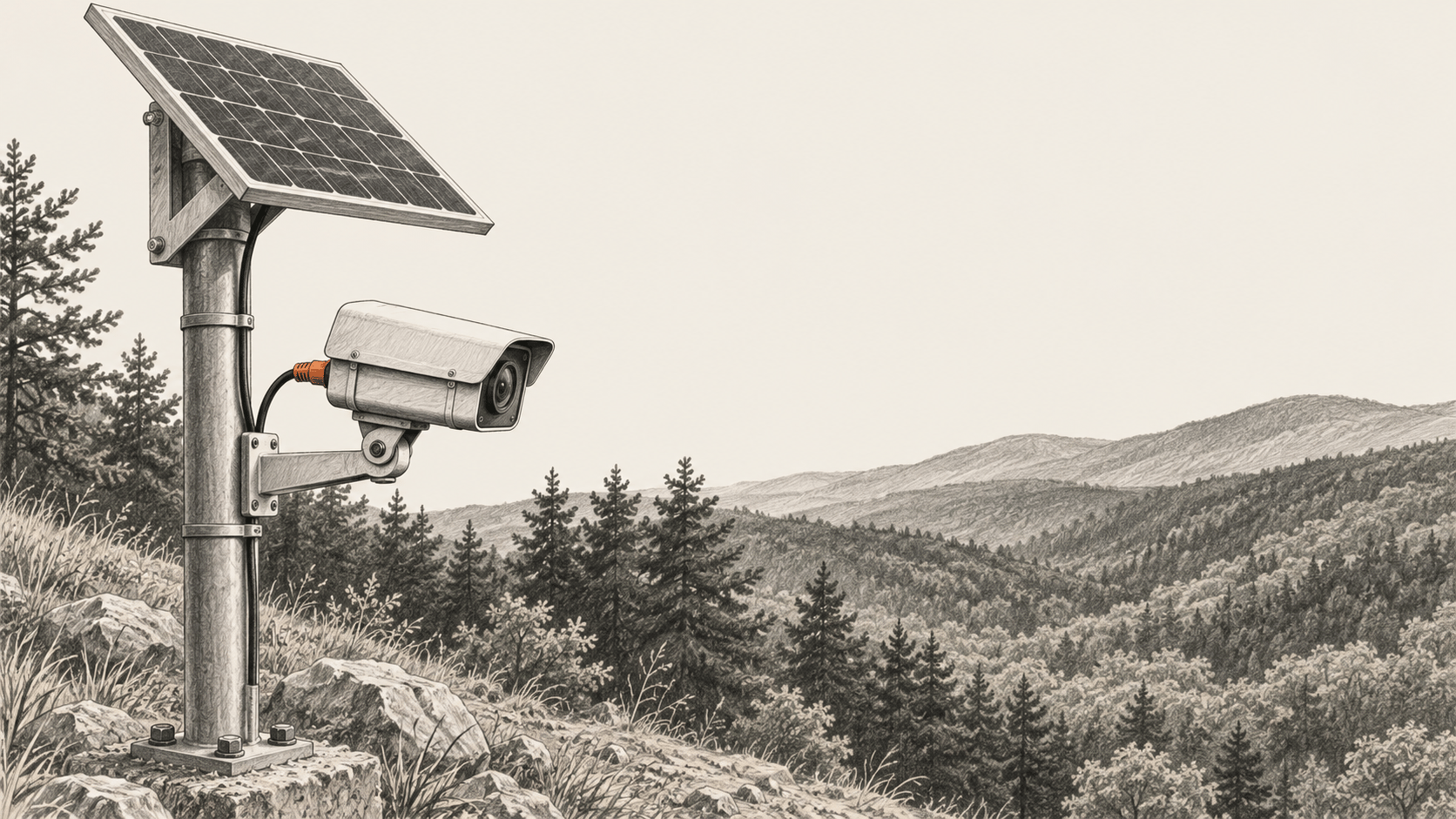
Roboflow's October 21 report says an IBEX smoke-detection pilot has operated in southern France since July 2024. It describes a solar panel and battery powering local image analysis, with a short satellite alert when the camera detects its target event. Partner report
Its workflow starts with images from the camera environment. Users label and train through Roboflow, then send the weights to MountAIn Studio for compilation to the camera's neural processor and deployment over USB. The pipeline includes hosted training, even though inference happens locally.
Roboflow also reports up to 22 frames per second for a YOLO nano model in MountAIn's early tests. It does not establish continuous field operation at that rate, or the speed and accuracy of every custom model.
A small model still needs working memory
Independent TensorFlow Lite Micro documentation illustrates the memory problem. That runtime uses a shared working buffer, called a tensor arena, for intermediate calculations, short-lived scratch space and persistent allocations. Its memory planner tries to reuse buffers across the model's computation, reducing the space needed when data need not remain available simultaneously. Memory management
A smaller stored model is consequently only one part of the fit. Working allocations also have to stay within the device's available memory. The documentation provides allocation logging to help examine that use. This is a general embedded-runtime example, not evidence that MountainCore uses TensorFlow Lite Micro or inherits its results.
What an operator would need to measure
MLCommons' MLPerf Tiny framework separates model quality, inference time and energy under specified workloads. Its Visual Wake Words example asks whether a 96-by-96-pixel image contains a person, with an 80% accuracy target. That defined presence test does not validate smoke detection. Benchmark framework
MLCommons also explains why the measurement boundary matters: including peripherals and input/output activity can change energy figures compared with measuring inference alone. A camera operator needs to know which parts of the system a power claim includes.
For a proposed smoke-monitoring trial, record misses, false alerts and alert delay on representative scenes, alongside memory use and whole-system energy. These are suggested evaluation requirements, not results from IBEX. The aim is a useful alert delivered within the installation's power and communication constraints.
BIG CHANGE read the public documentation; it has not benchmarked MountainCore or independently validated the pilot logs.