Nebuly announced November 12 that it raised $21 million in a Series A led by Planven, with Exor Ventures, Tenacity Capital and other investors participating.
The big change
- Nebuly analyzes conversations with employee and customer-facing agents to identify business-value signals. The funding supports expansion, not independent proof that customers have saved money.
- Its calculation guide values estimated time saved using an adjustable rate. Changing assumptions can change the amount without changing the conversation, so a dollar figure needs an explanation.
- Conversation analysis also requires decisions about sensitive data. Nebuly's own redaction experiment missed identifiers, and its terms distinguish retention of customer data from retention of analytical outputs.
From a task to a dollar estimate
Nebuly's methodology page says tasks count when they meet customer-defined success criteria. A proprietary model estimates manual completion time; the formula multiplies estimated time saved by what it calls net hourly cost.
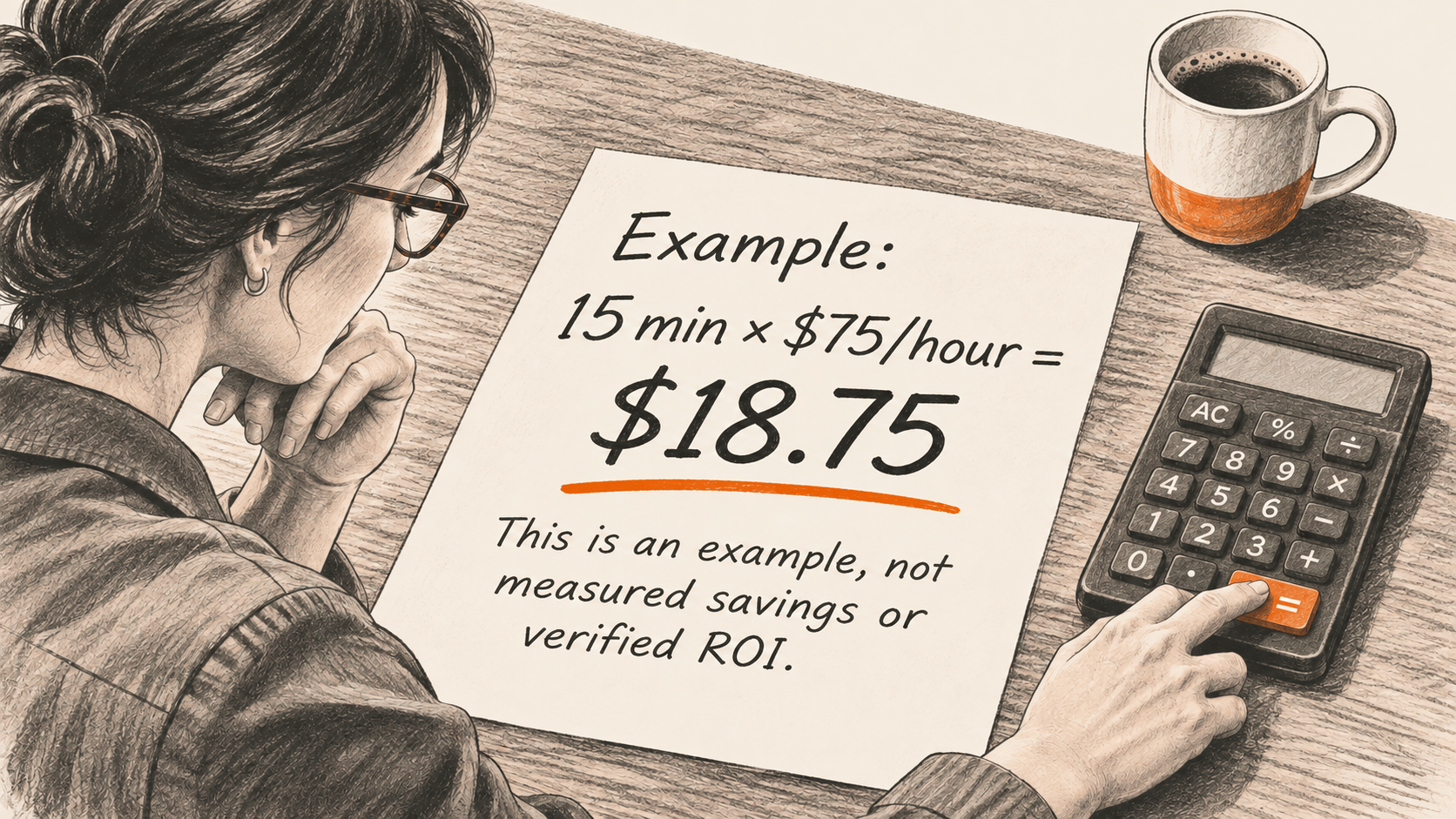
Before workspace calibration, its adjustable defaults are 15 minutes per action and $75 per hour. Those assumptions produce $18.75 per counted action. This is an estimated monetary value, not an observed payroll saving or a percentage return.
The guide distinguishes internal time savings from customer-facing revenue signals such as retention and expansion. Buyers should establish what the net rate includes before comparing the reported value with total AI spending.
What a comparison needs
NIST's measurement discussion asks how to select relevant human or non-AI baselines, report uncertainty and measure downstream effects. It distinguishes the concept a test claims to measure from what its procedure actually measures.
For a budget decision, compare the same work with and without assistance, including checking and correction. Recovered time might enable other work rather than reduce payroll. Ask whether the benefit being measured is faster completion, additional capacity or money actually released from a budget; those are different claims.
A conversation can end satisfactorily while work continues elsewhere. Checking a sample against completed work helps test whether a conversational signal represents the outcome that matters. This is an evaluation approach, not a finding about any customer's results.
What happens to the conversations
Nebuly's product overview describes self-hosted deployment and an anonymization module. These are vendor capabilities, not a guarantee that every sensitive value is removed.
Its August experiment reports 80 missed personal-information values out of 3,027 unique values in 1,396 synthetic documents across ten languages. Values, rather than every repeated occurrence in the text, are the counting unit. The developer-built test does not establish the error rate for customer conversations.
Its November 3 terms normally limit customer data held for ordinary processing to a rolling 12 months from receipt, but retain outputs for the service term, subject to agreement or law. Self-hosted retention and deletion are customer-configured.
The terms also restrict individual worker monitoring and employment decisions unless specifically agreed in writing. These contractual restrictions apply regardless of whether the AI Act applies to the use. A general productivity dashboard should not be assumed authorized for individual personnel decisions.
Before connecting logs, review the actual agreement, who receives data and outputs, and their deletion schedules. A retention limit for one category does not automatically cover the other.
What the funding changes
The company says it will develop the platform and expand commercial teams in the US and Europe, also reported by The Next Web. That supplies a business-expansion plan; the measurement and data-handling questions remain for prospective buyers.