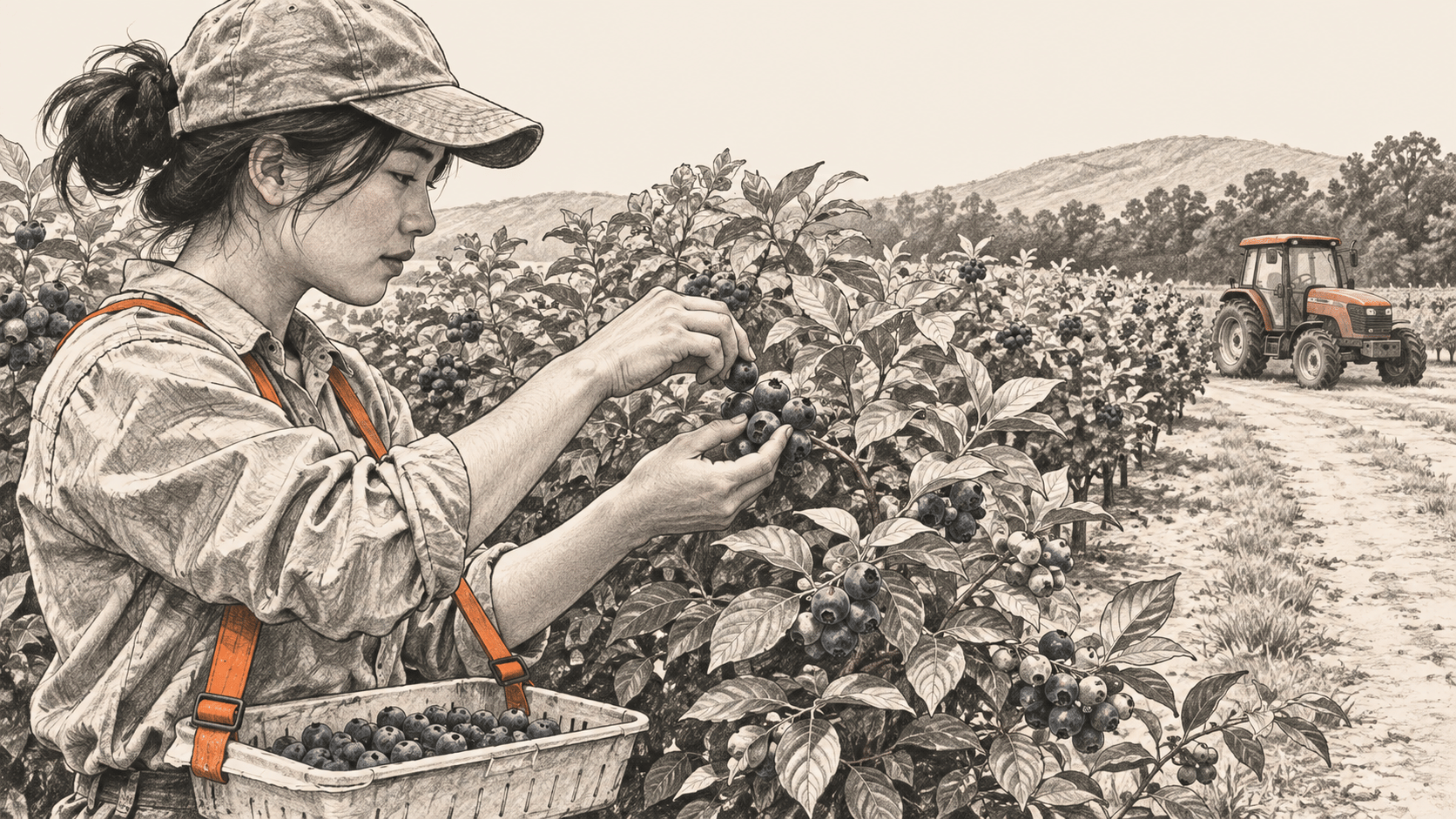
ABC reported on November 14 that Western Berry is expanding its Western Australian blueberry operation using autonomous tractors and mechanical harvesting.
The big change
- Its tractors navigate themselves, but the latest harvester is remotely controlled. Collecting fruit and navigating without a driver are different capabilities; one does not establish the other.
- The grower proposes AI-guided harvesting and pruning, not an operating pruning robot. A plan for a machine to make decisions still needs evidence that it can make the right ones.
- Hand pickers remain important, with at most half the crop destined for machines, the grower says. The practical question is which tasks change, rather than whether a farm becomes entirely worker-free.
What is operating now
ABC describes tractors spraying, controlling weeds and hauling fruit. The newer harvester collects berries and stacks trays. The report does not identify an AI model controlling the tractors. ABC reports over 200 pickers; manager Marek Kwiecien-Fisher says expansion creates jobs faster than technology replaces them.
Treating these systems separately matters. A vehicle can follow a route while another mechanism handles fruit. Improving either capability does not automatically solve the other, and a future operating mode should not be described as a demonstrated result.
Picking cost is only part of the decision
ABC reports roughly US$0.34/kg (A$0.50) for machines versus US$4.08/kg (A$6) by hand, with no complete cost breakdown. Conversions use the RBA’s November 13 rate of US$0.6804 per Australian dollar. These are reported estimates, not an independent audit.
A purchasing decision needs comparable accounting: what equipment, maintenance, training and follow-on work are included, and over what period? A low unit figure cannot answer those questions by itself. It also cannot show whether a particular farm will recover its investment.
The separate 2024 New South Wales Department of Primary Industries case study explains the physical trade-off. Rotating, vibrating rods detach berries. Weak settings leave ripe fruit behind; poor calibration can remove leaves and green fruit. Suitable bush size, variety, trained operators and grading equipment matter. Some blocks still need hand picking early in the season.
That study concerns another farm and machine, not Western Berry's results. It explains why counting fruit collected is insufficient: the harvest must still be suitable for sorting and sale. Moving a bottleneck from picking to grading would change where work is required, rather than remove it.
Decisions still needing evidence
Future automation should be assessed task by task. For a proposed system, ask what people must still do, what happens when it fails, and which outcomes have actually been measured. BIG CHANGE has not visited the farm or tested its equipment.