Researchers at Sweden's Defence Research Agency have published a Wi-Fi sensing study that identifies people carrying a concealed, deactivated handgun in recordings from two small indoor spaces. The work, posted on 13 October, pairs radio measurements with video during training and runs its detector on radio data alone at inference. Its measured results establish a research baseline under the team's collection conditions. They do not establish performance at a public entrance or across unfamiliar rooms.
The big change
- What changed: The researchers released a dataset and a detector that map Wi-Fi channel measurements into image-shaped features, then locate people and classify their associated carried-object labels. A camera supplies training labels and a visual teacher; the evaluated model uses Wi-Fi measurements for its predictions.
- Why it matters: Engineers and public bodies examining concealed-object sensing now have a reported four-class experiment to scrutinize, including comparisons with a plastic replica, a metal bottle and a phone. The handgun result is an object-detection score from controlled rooms, so it cannot tell an operator how often a real screening system would flag the wrong person.
- What to watch: A consequential follow-up would test complete sessions, people and rooms kept out of training, and report per-person alerts and false alarms at a stated operating threshold. Those measurements would address decisions the current sample-level evaluation cannot settle.
How the detector was trained
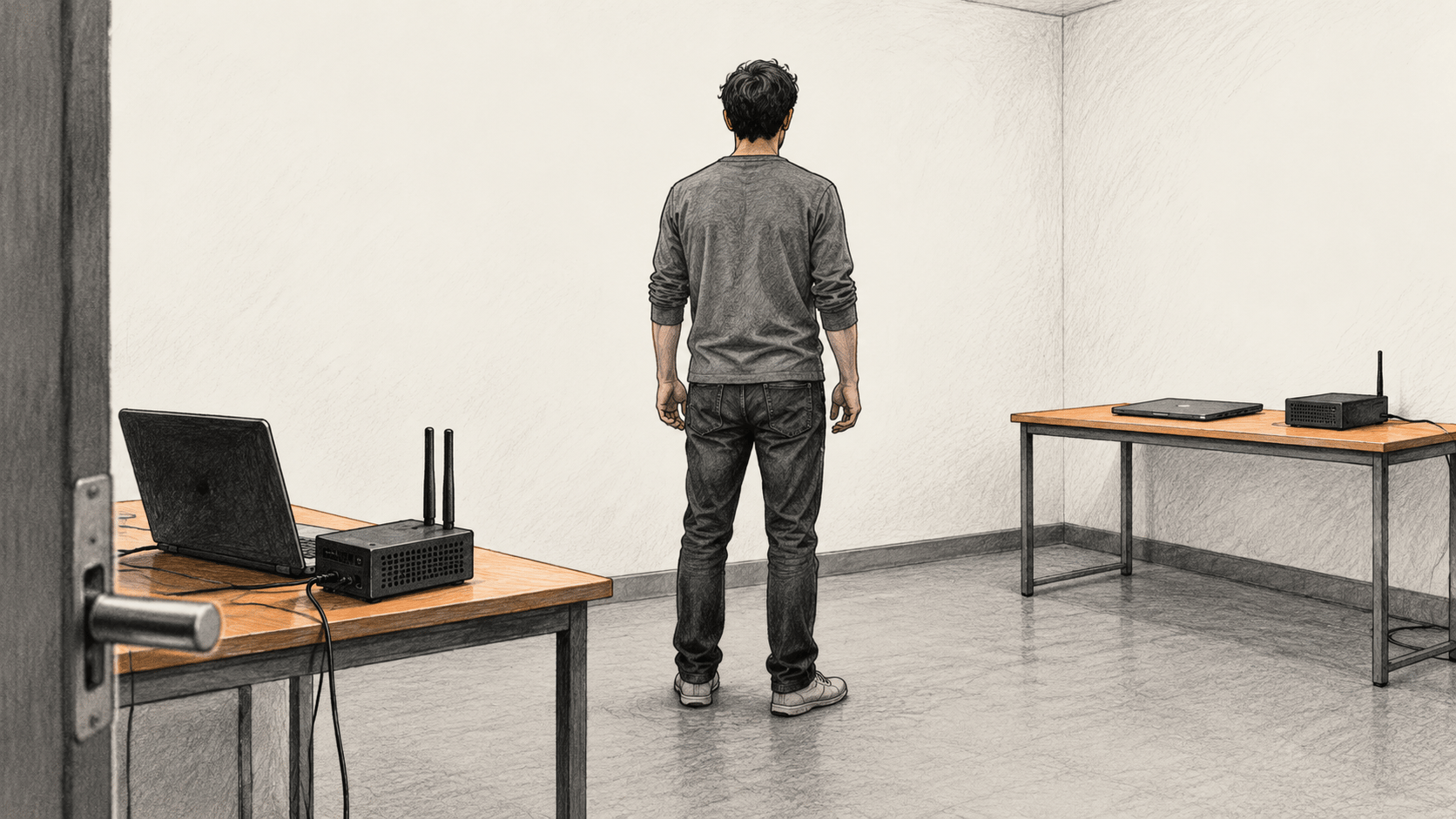
Wi-Fi channel state information, or CSI, describes how a transmitted radio signal changes as it reaches a receiver. The team collected CSI alongside RGB video in an 8-square-metre room with zero to two people and a 12-square-metre area with zero to four. At most one participant carried the deactivated metal handgun. The four labeled classes were that handgun, a plastic handgun, a metal water bottle and a mobile phone. The paper's dataset section says the camera footage supplied annotations: a pose model located people, while shirt colors associated with the objects helped assign classes. This is a controlled labeling design, not a test of unsuspecting people with arbitrary clothing and belongings.
Collection used a modified open-source IEEE 802.11a implementation at 5.68 GHz and 20 MHz, with laptops connected to transmitters and receivers. The authors compared a regular configuration, with four pilot subcarriers and interpolation for the others, against a modified 48-pilot configuration they call WiFi-plus. The experiment therefore depended on its particular radio and collection setup; the paper does not show a standard access point running the detector as installed.
WiFireNet separates the CSI signal into phase and amplitude. A convolutional translation network turns those inputs into a two-dimensional representation aligned with the camera image. A feature pyramid, region proposal network and detection head then produce bounding boxes for people and scores for their associated carried-object classes. During training, a separate model learned from the camera images, and an additional loss encouraged the Wi-Fi model's features to resemble the visual model's. According to the architecture and methods, only CSI samples feed WiFireNet at inference. The phrase “image-shaped” describes an internal representation; it is not a reconstructed photograph of a person or an object.
What the scores measure
The often-cited 72.5% is average precision for the handgun class in the WiFi-regular large-room experiment at a 25% intersection-over-union threshold. For a box prediction to meet that threshold, the area shared by the predicted and annotated boxes must be at least 25% of their combined area, counting the shared region once. At the stricter 50% threshold, the same handgun-class average precision was 53.8%. These are precision-recall summary scores for one class, not the percentage of people correctly screened.
The paper's Tables 1 and 2 also report 47.1% mean average precision across the evaluated classes at 50% overlap for WiFi-regular in the large room, and 89.5% recall at that overlap threshold. The recall is the paper's aggregate baseline measure, not a handgun-only catch rate. WiFi-plus scored 37.2% mean average precision at 50% overlap in the large room, below the regular configuration's 47.1%. The authors discuss dataset variation and room conditions as possible explanations; their measurements do not establish that adding pilot subcarriers generally harms detection.
The authors split data at the level of individual CSI samples: half for testing, half for training, with a fifth of the training portion used for validation. The paper does not report a separate held-out-room or field deployment test. Because nearby samples can come from the same recording conditions, a sample-level result leaves open how the detector would perform with new spaces, participants, objects and radio arrangements. The study also does not report the false-alert burden or response workflow needed to evaluate a live screening decision.
The code and model repository and WiFire dataset are public, giving other researchers material to examine and extend. The repository lists Apache 2.0 for its code; the dataset card lists CC BY-NC 4.0 for the data. The meaningful next measure is generalization under a clearly separated evaluation and an operating threshold, not a claim of checkpoint readiness from these scores.
Sources & further reading
- Persson, Gustafsson and Wilkinson, “Concealed Handgun Detection using WiFi Signals,” arXiv v1, 13 October 2026. Primary source for the collection setup, architecture, split and Tables 1–2. The reported experiment uses controlled indoor recordings and sample-level evaluation.
- WiFireNet code and model repository. Author-maintained implementation and project description. Its README summarizes scores; the paper tables govern the metric wording above.
- WiFire dataset card. Author-maintained description of the data and classes, with a CC BY-NC 4.0 license notice. It is a release for further research, not evidence of independent validation.