THE WORLD IS NOT STANDING STILL.RSS
BIG CHANGE.
BIG CHANGE, one tap away

Make room for the big picture.

Add BIG CHANGE to your home screen or desktop. It opens in its own window, with the latest stories when you’re online.

iPhone & iPad
Open bigchange.ai in Safari. Tap Share, then Add to Home Screen. Turn on Open as Web App if shown, then tap Add.
Android
Open bigchange.ai in Chrome. In the browser menu, choose Install app or Add to Home screen.
Desktop
In Chrome or Edge, use the install icon in the address bar or the browser’s app menu. In Safari on Mac, choose File → Add to Dock.
All briefings

Follow the change ·

The day,
in perspective.

What happened in AI and robotics — and the change behind it. A reading path through 24 stories from BIG CHANGE.

Ordered using RADAR attention, story opens and likes. Excerpts from our published reporting; open a story for the full context and sources. Dates in UTC.

Original story: news

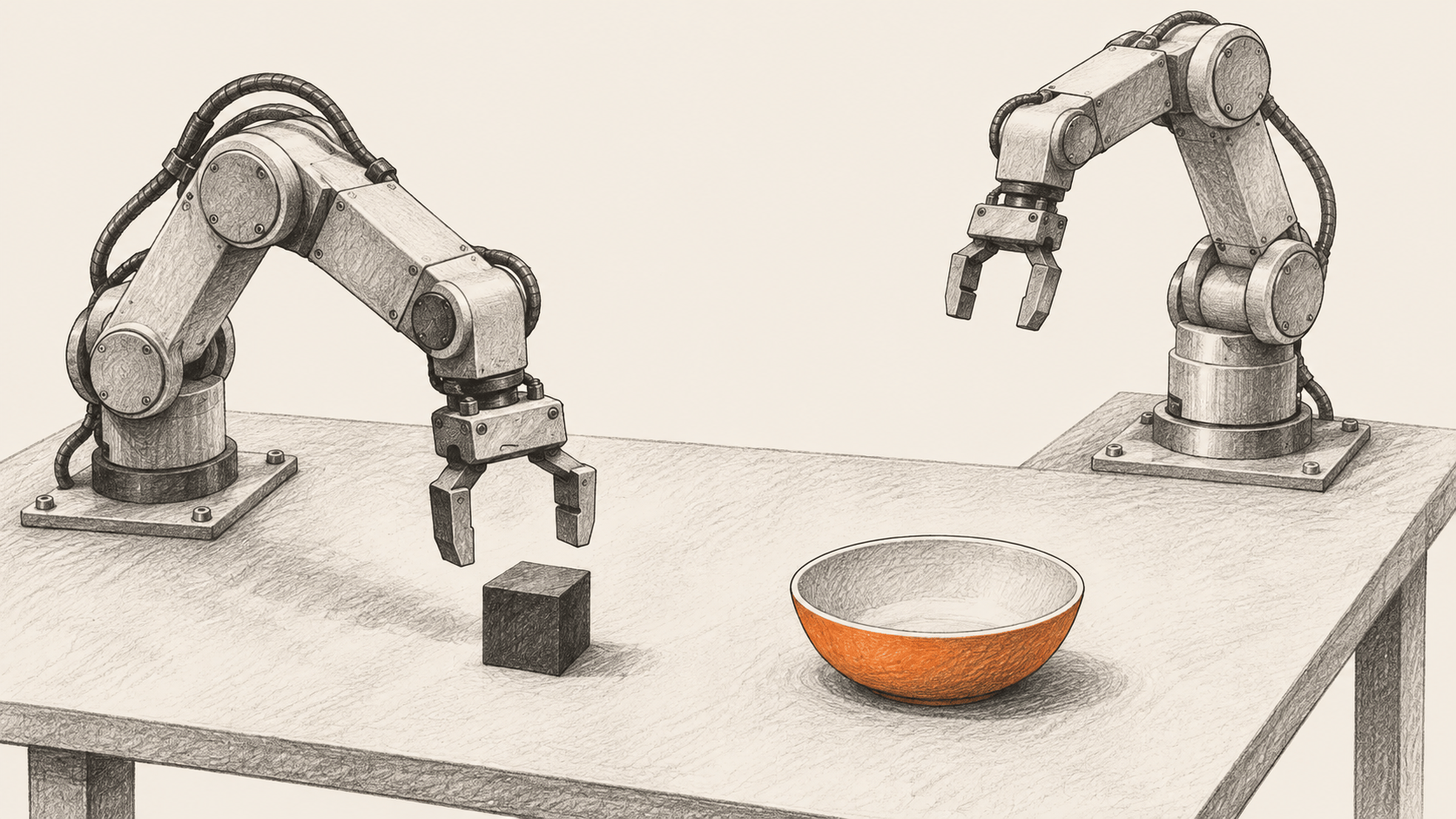
LoRN steers frozen robot policies

A fixed robot policy can produce different movements from different starting noise. Adapting that input requires its own learning process, experience and evaluation.

The big change

LoRN trains a steering actor with reinforcement learning while leaving the base policy's weights frozen.

Noise steering still requires learning from experience and a reward signal. Earlier DSRL research explains how that learning can happen outside the original robot policy.

A world-action model predicts future images alongside motor commands. Those imagined frames help determine an action, but the robot still needs observations of what actually happened.

Read the full story
—
Back to the briefing
Follow-up story: news

Anthropic closes its IPO as second-session trading retreats

Completed issuance and market returns measure different money flows.

The big change

The full option adds company-issued shares to the completed sale. It turns an optional source of funding in the prospectus into part of the announced closing.

A public offering’s total includes any shares sold by existing holders. Those holders receive their own proceeds, so the headline transaction size is not the company’s net funding.

ANT’s Friday price remained above the IPO price but below Thursday’s close. The price change therefore depends on which starting price is used, rather than a single description of an IPO gain.

Read the full story
—
Back to the briefing
Original story: news

Google rolls out free Gemini Tasks in six countries

The announcement expands free access, with new text and email channels starting in the US. Google’s grocery example leaves checkout to the user.

The big change

The rollout expands eligibility; it does not establish that every account already has access. Some advanced additions, including text and email channels, start in the US.

Task mode is meant to carry out a goal across apps and websites. Its work panel separates completed, current and planned steps, so progress remains visible.

Purchase settings can provide advance authorization instead of a new approval at checkout. Texting has its own account, phone and carrier requirements, rather than universal SMS availability.

Read the full story
—
Back to the briefing
Original story: news

Sumitomo Life’s ChatGPT case reports estimated returns

Employee-reported time savings leave a separate question about completed work. Controlled research shows why a faster task and a better result need distinct measurements.

The big change

The estimated return on investment (ROI) was 203% overall. The 524% figure applies only to employees using ChatGPT at least 101 times a month.

The insurer’s separate workplace policy combines a working-time reduction goal with changes to business processes and working-time management.

Controlled studies can compare workers offered AI with a control group and assess output quality separately from time spent.

Read the full story
—
Back to the briefing
Original story: news

NVIDIA details Daviator for materials AI calculations

A well-converged electronic calculation and a reliable learned force field require different checks. VASP’s guidance calls for consistent reference data as well as testing predictions.

The big change

A calculation reaching its electronic stopping threshold has satisfied a numerical condition. VASP’s documentation still calls for consistent, converged reference data when training a force field.

OMat24 pairs atomic structures with calculated energies, forces and stresses. Those target values let a model learn from simulations rather than repeat every calculation.

Matbench Discovery tests whether predictions help identify stable crystal candidates. Small average energy errors can still produce wrong choices near a stability boundary.

Read the full story
—
Back to the briefing
Original story: news

NVIDIA examines the remaining costs of sparse attention

GPU memory traffic can limit attention performance. FlashAttention’s original research shows why the arrangement of calculations matters alongside their arithmetic count.

The big change

DeepSeek’s indexer learns which earlier tokens to select. That selection is part of the trained model, rather than a universally interchangeable shortcut.

FlashAttention shows why reducing GPU memory transfers can matter even without discarding attention calculations. Fewer arithmetic operations alone do not describe runtime.

Request-level evaluation distinguishes the wait for the first token from the pace of later tokens. It also needs a defined workload and quality requirement.

Read the full story
—
Back to the briefing
Original story: news

EvoSkill-S1 tests reusable procedures

An agent can retain natural-language lessons and retrieve relevant prior experience on later tasks. That guidance changes its input context without requiring an update to the solver’s parameters.

The big change

EvoSkill keeps the answer-producing solver fixed while training a separate model to revise skills. Retaining a revision in the bank is distinct from training that model.

Written memory changes what an agent can read on a later task. Earlier ExpeL research showed how insights and successful examples could be retrieved without changing the underlying model's parameters.

A coding test can give partial credit for passing some cases. That result answers a different question from whether a program passes every test, including difficult boundary cases.

Read the full story
—
Back to the briefing
Original story: news

Inkling 2 Mini brings looped AI weights to local computers

A local model’s file size is only the start of its memory requirement.

The big change

The model reuses some layers rather than storing new ones for every pass. Its active-parameter figure therefore describes only part of the computation needed to produce each token.

A model file is only one part of runtime memory. Cached information from earlier tokens also needs space, so a longer conversation can change how much memory generation needs.

ModelFit’s local test records short-prompt speed on one Mac. It measures token generation with a particular conversion and software build; the recorded workload does not establish successful completion of a useful application.

Read the full story
—
Back to the briefing