Applied Optoelectronics said November 24 it signed a multiyear optics supply agreement with an unnamed existing hyperscale data-center customer.
The big change
- The customer’s minimum purchases cover about $1.5 billion in 800G transceivers during 2027 and $0.7 billion in laser diodes across 2028–29. These are separate products and delivery windows.
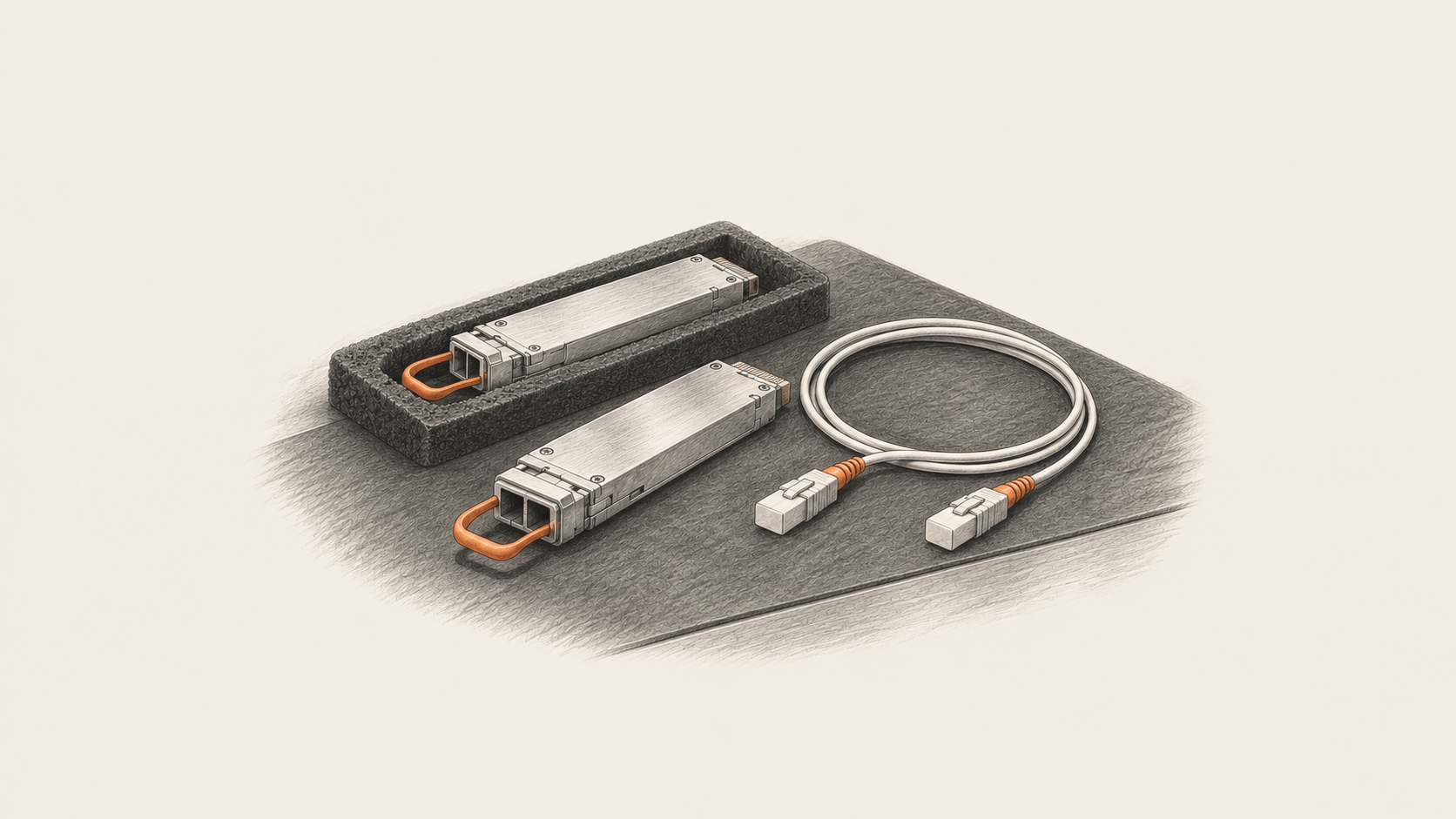
- A transceiver sends and receives data over fiber. A laser supplies the light; it does not by itself perform all the functions of a complete network link.
- AOI generally recognizes product revenue when contractual obligations are satisfied, most often at shipment or delivery. A purchasing promise and an earned sale describe different stages of the supply chain.
From electrical signals to fiber
An optical transceiver bridges electrical network equipment and fiber cabling. Cisco’s silicon-photonics explanation traces light from a laser into an optical chip, where it is modulated—altered to carry information—and coupled into a fiber. At the receiving end, photodetectors turn light back into an electrical signal for electronics to interpret.
The laser provides the light, rather than the complete send-and-receive system. Silicon photonics integrates optical functions on a silicon substrate, paired with electronics for electrical processing. Cisco also describes moving optics closer to the switch chip to shorten long electrical paths to front-panel modules. That is the idea behind co-packaged optics: placing optical engines close to the processing electronics. Power, cooling and the complete system design still affect the result.
Supply and delivery windows
The agreement runs from December 2026 through December 2030, including U.S.-made volumes starting in the first quarter of 2027 and ramping that year. AOI will spend $2 million to accelerate customer qualification; the buyer made no capital commitment.
Management’s greater-than-$10 billion demand forecast is not guaranteed, an order, an additional binding commitment or revenue guidance. Extra business needs more capacity and new commitments. Actual sales remain exposed to qualification, product mix, pricing, component availability, delivery and contractual volume reductions.
AOI expects some lasers to feed co-packaged optics from 2028. It has not identified a specific deployed system.
Why a light source can be separate
OIF’s external-laser agreement provides a concrete design example. It defines a removable light-source module at a system’s front panel, supplying optical power to optical engines elsewhere inside. The engines can remain near the processing electronics while the lasers sit farther from that heat. Field replacement of the light source is another purpose of the arrangement.
The document calls this an External Laser Small Form-Factor Pluggable, or ELSFP. It specifies mechanical, thermal, electrical and optical interfaces, rather than treating any laser package as interchangeable with any host. Its application drawings show one possible arrangement, not a requirement that every co-packaged design use the same placement. For equipment buyers, a laser diode, a removable laser-source module and a complete transceiver are therefore different procurement items. Matching the component to its intended system remains part of qualification.
Qualification has a concrete object
A published AOI 800G OSFP DR8 datasheet illustrates how specific that question becomes. It lists a particular plug-in form factor, dual MPO-12 APC fiber connectors and a 500-metre single-mode-fiber link. Those are product-specific mechanical and optical conditions, rather than a distance promise attached to every 800G label.
For a hypothetical operator choosing such a link, the host port, fiber route and corresponding optics at both ends have to fit the design. The datasheet is an existing product example; the new agreement does not identify it as the selected part.
Revenue and installed equipment answer different questions
AOI’s 2025 annual report separates the existence of a sales contract from performance under it. Product revenue is generally recognized at a point in time, most often upon shipment or delivery. Cash received before obligations are fulfilled is recorded as unearned revenue. A prepayment and an earned sale are consequently different accounting events.
The report also distinguishes construction in progress from AOI’s own equipment in service. It collects installation and other direct costs while an asset is being built; transfer to the appropriate fixed-asset account and depreciation begin when the asset is substantially complete and placed in service. These distinctions give readers different milestones to check: promised purchases, fulfilled sales and equipment available for operation. A dollar value alone does not establish all three.