Danu Robotics is bringing its H.E.R.O. recycling sorter to market after six years of development, TechCrunch reported on October 9. Recycling-facility operators need to know whether the machine can reliably recover enough of the right material to justify its cost on a sorting line. Danu describes the machine's approach, but public figures do not yet answer that question.
The big change
- What changed: TechCrunch reports that Danu is taking H.E.R.O. to market. Its reported contracts and customer pipeline indicate commercial interest, without establishing the number of operating units or repeatable site results.
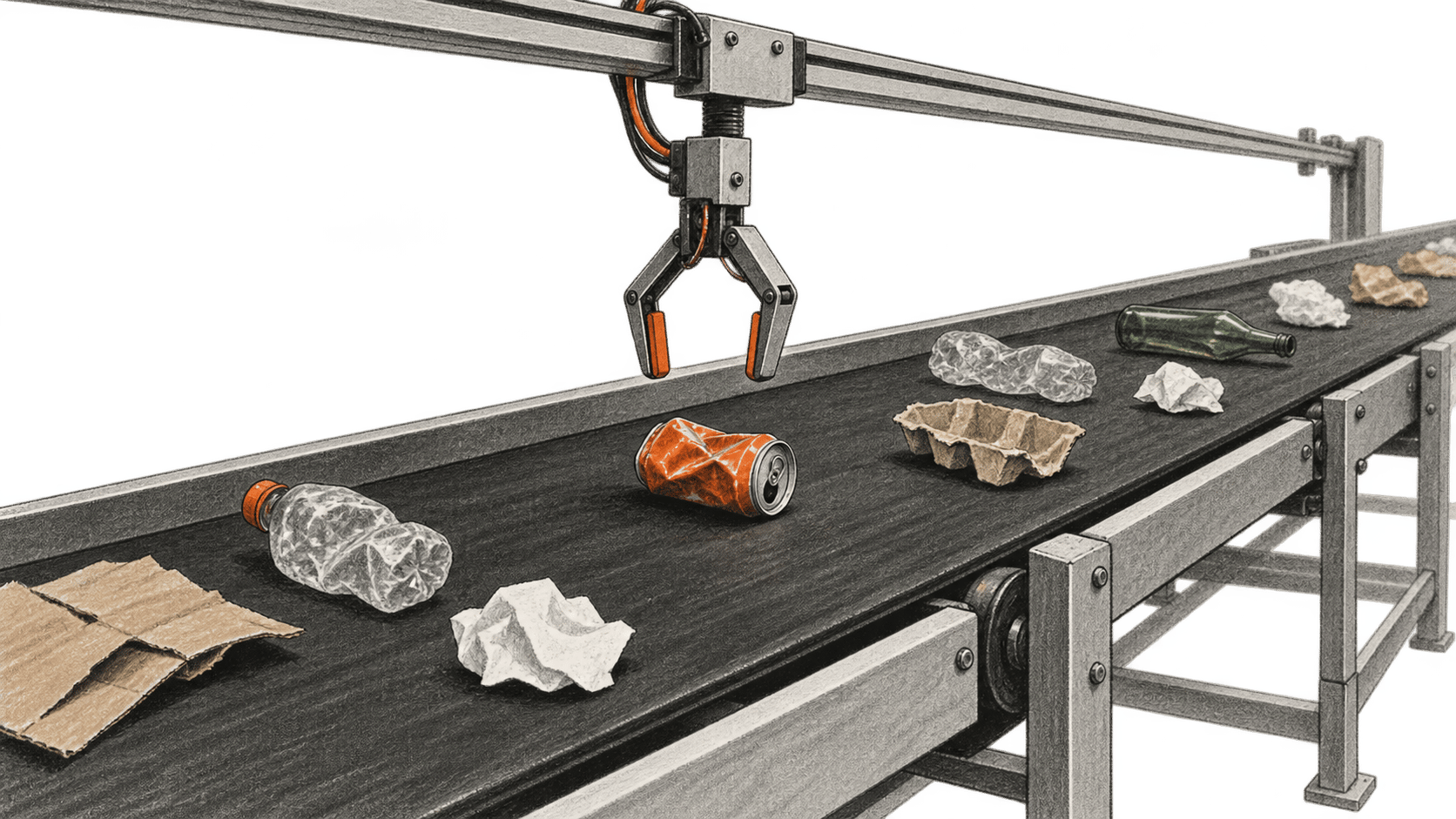
- How it works: Danu describes computer vision that identifies material in mixed waste, plus modular robotic pickers. TechCrunch reports that the picker uses a pincer claw rather than suction.
- Why it matters: A sorter that fits an existing conveyor and records items reaching the correct bin could give operators a more useful account of recovered material. Danu says its Series 2 needs less than one metre of conveyor space and measures successful picks at the bin; those are company descriptions, not independently measured outcomes.
- What remains open: Public sources give no comparable throughput, sorting-accuracy, uptime or site-economics results for H.E.R.O.
What the robot is designed to do
Danu's product page describes a system for picking valuable recyclables directly from mixed waste streams. It says AI-guided computer vision identifies material for a modular, multi-picker platform. TechCrunch's interview with founder Amy Ma adds a mechanical detail: H.E.R.O. uses a pincer claw, where some competing sorters use suction.
Perception and picking solve different parts of the task. The vision system has to identify a target among changing material on a conveyor; the picker then has to move that item to the intended stream. Danu says it logs every pick and counts success when an item reaches the bin rather than when the robot grabs it. That distinction matters to a buyer because an attempted pick and recovered material are different operational results. The company has not published the measurement protocol or independent data showing how often a logged pick reaches the right bin.
Danu also says the H.E.R.O. Series 2 needs less than one metre of conveyor space and is designed to retrofit into an existing facility. The product page describes software updates intended to improve performance over time. Neither statement supplies installation records, before-and-after results or a quantified improvement from updates. An operator would still need to assess how the system handles the site's material mix, line speed and maintenance requirements.
Interest is ahead of public performance data
TechCrunch reports that Danu has $500,000 in signed contracts, letters of interest from two large customers and more than 200 prospects in its sales pipeline. These figures come from the company's account in the profile. A signed contract is a stronger commercial signal than a letter or a prospect, but the report does not establish how many machines have been installed, how long they have run or what their customers have recovered.
Ma estimates that a working site would generate $485,000 in additional revenue with the robot, compared with a $160,000 initial investment and $24,000 in yearly maintenance, according to TechCrunch. These are her projected economics, not audited returns. The report does not provide the site's baseline, the material volumes or prices behind the estimate, the period covered by the revenue figure, or the other operating costs needed to assess payback. Treating that estimate as a result from a typical facility would overstate the evidence.
The next useful evidence would be site-level results with clear denominators: items presented and correctly recovered, misses and wrong sorts, conveyor speed, operating hours, maintenance and total cost. Those measures would show whether Danu's compact design and bin-based counting translate into dependable recovery at facilities with different waste streams. For now, H.E.R.O.'s mechanics and intended workflow are described more clearly than its performance in commercial use.
Sources & further reading
- Danu Robotics, H.E.R.O. product page. The company's description of mixed-waste picking, AI-guided vision, modular pickers, bin-based pick counting and Series 2 footprint. Checked October 9, 2026. Specifications and performance language are company claims; the page does not provide an independent trial or measured site results.
- Russell Brandom, “Danu Robotics' fight to build a better recycling robot,” TechCrunch, October 9, 2026. Original interview/profile reporting on the pincer design, market entry and founder's commercial figures. The contracts, pipeline and economic projection are attributed to Danu or Ma; the report does not independently test H.E.R.O. or establish payback.