NVIDIA has described an agent-assisted workflow for building a Microduck obstacle course, training a robot policy and checking it in simulation. In its October 23 account, an instruction becomes a plan and asset handoff; the assets become an Isaac Sim scene; Isaac Lab then adapts a walking policy to ramps and obstacles. The reported result is a simulation evaluation. The account does not establish that this obstacle policy works on a physical Microduck.
The big change
NVIDIA connected AI-assisted planning and 3D asset production to a robot learning experiment with a stated training setup. That makes the handoffs between tools visible. It also exposes the remaining work: matching the simulated robot to its hardware and testing the resulting policy on that hardware.
From a prompt to a scene
The NVIDIA walkthrough starts with a prompt describing the course and Microduck's task. On RTX Spark, Hermes and NVIDIA Nemotron 3.5 Bolt turn it into a project plan. A locally generated concept image becomes an inventory of reusable objects, each with an identifier, visible features and a cropped reference. The handoff to Astra includes the plan, robot research, concept, inventory and instructions. The post calls for recording obscured details rather than presenting an image crop as a complete specification.
Astra uses cloud image editing to clarify the cropped references, then directs local FreeCAD and Blender work to make editable models and USD assets. It compares the enhanced references with the original crops and records unknown dimensions or hidden surfaces as modeling assumptions. Those checks matter because a visually plausible object can still have the wrong size or collision geometry for a robot task. The post shows Astra assembling the resulting course in Isaac Sim. NVIDIA also points to its SimReady asset library as another source of OpenUSD objects.
The planning output is an asset inventory and instructions. The modeling output is editable geometry and USD. The simulation needs a robot model, course objects and sensor observations. Isaac Sim supplies rendering and sensor simulation, while Newton models the robot's physical interactions. The account describes links, joints and actuators as the elements that connect policy actions to simulated movement. It does not publish a pinned set of Hermes, Astra, FreeCAD, Blender, Isaac Sim and Newton versions or a complete reproducible integration recipe for this course.
Training is a separate compute step
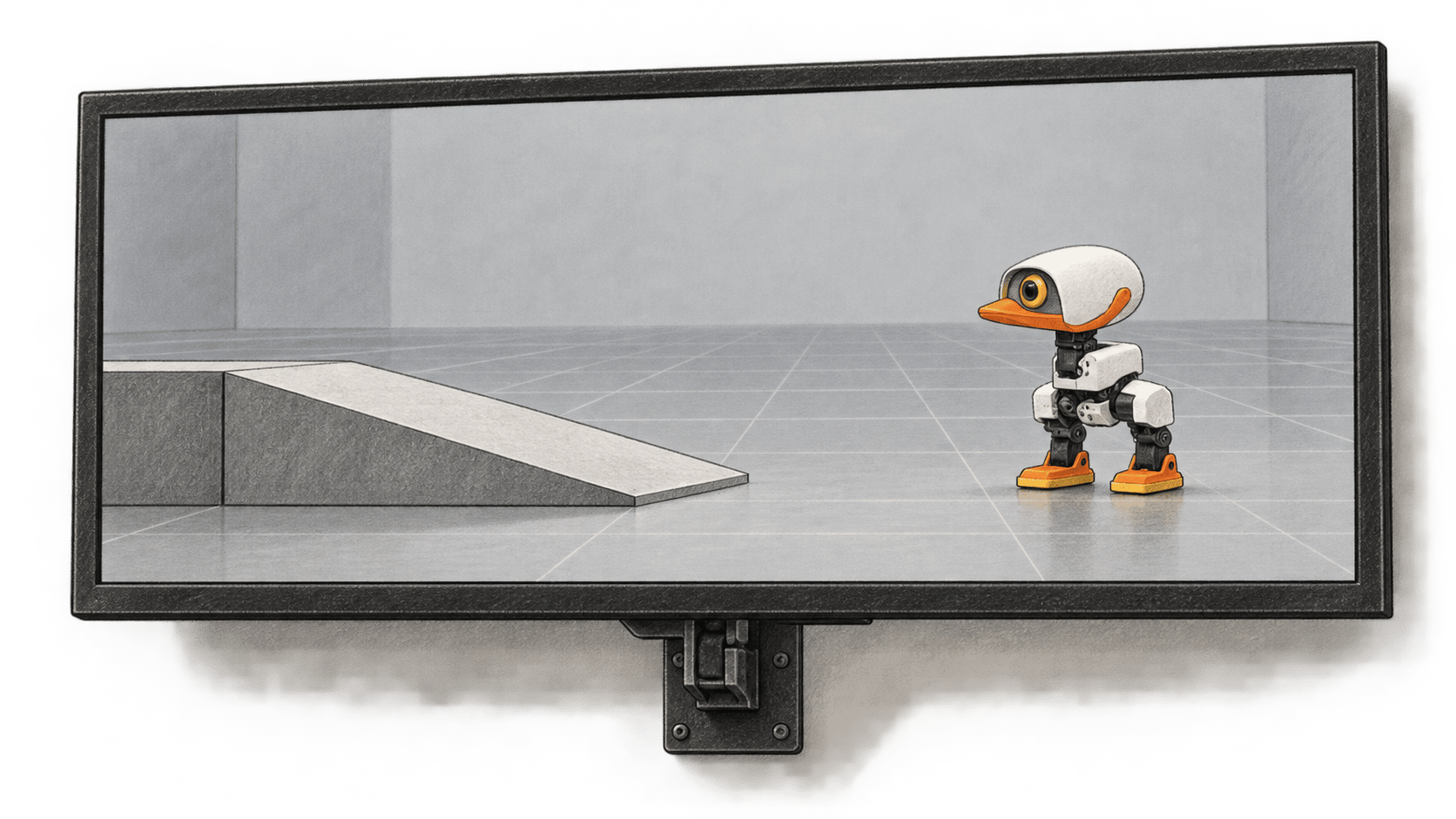
NVIDIA says it started from an Isaac Lab Microduck example and further trained a pretrained locomotion policy for ramps and obstacles. The adaptation used head-camera depth and robot-state observations, with 4,096 parallel environments on an RTX PRO 6000 Blackwell Workstation Edition GPU. Isaac Lab defines the observations, actions and rewards for the task; Newton calculates the simulated consequences of the actions. Repeated attempts give the reinforcement learning algorithm feedback on progress, balance, collisions and falls.
RTX Spark handles the local planning and later evaluation described in the post. The stated 4,096-environment adaptation run used a different GPU. The post supplies no duration or total compute bill for reproducing this course.
After training, NVIDIA describes bringing the selected policy back to Isaac Sim on RTX Spark. Simulated observations feed the policy, its actions move Microduck through the scene, and new observations close the loop. The proposed checks include course completion, falls, collisions and where progress stops. The article gives the evaluation procedure and images of the course, but no numerical completion rate or comparison against a baseline for this obstacle adaptation. BIG CHANGE did not run the workflow or inspect its policy artifacts.
The hardware handoff remains open
The same walkthrough recommends Better Actuator Models for delays, backlash and voltage effects, along with domain randomization for plausible variation in physical parameters and observations. These are preparations for transfer. Actual sensor readings, ground contact and control timing still need to be checked against the physical robot.
NVIDIA's Figure 10 shows a physical Microduck walking with a locomotion policy trained in Isaac Lab. A separate Microduck sim-to-real tutorial documents a walking-policy export and hardware loading path, including a 61-value observation and 14-action interface. Neither source demonstrates that the head-camera obstacle policy from this course uses that same deployment interface or has crossed to hardware. NVIDIA explicitly leaves detailed hardware deployment of the obstacle-course workflow outside its post.
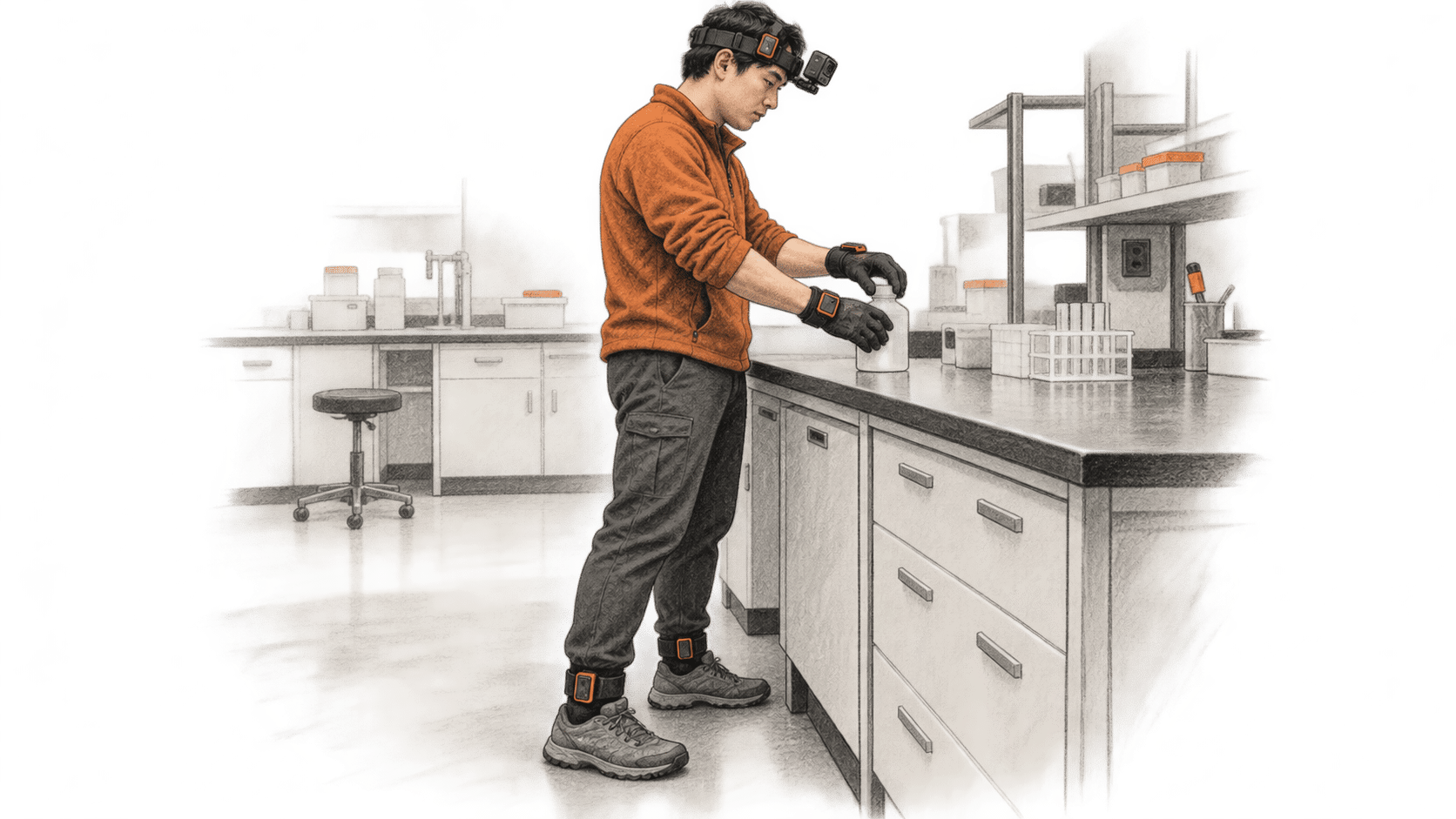
This is distinct from EgoExplorer's wearable human-motion dataset, which addresses data collection for robotics research. Here the useful evidence is the chain of artifacts and simulated checks, plus a clear limit on what the physical walking image can prove.
Sources & further reading
- NVIDIA's Microduck obstacle-course walkthrough (October 23, 2026): the source for the reported sequence, compute setup and simulation-only scope of the obstacle adaptation. This is a vendor account, not independent replication.
- NVIDIA's Microduck sim-to-real tutorial (October 21, 2026): a separate walking-policy path and its documented hardware interface. It does not verify hardware transfer of the obstacle policy above.
- Isaac Lab actuator documentation: technical background on simulated actuator behavior.