On November 26, WaterSense founder Filip Budny described €5.75 million in combined equity and grant financing to expand the Polish company’s water-monitoring business, including a proposed network along the Oder.
The big change
- The financing includes €2.25 million from investors and about €3.5 million in grants, Budny told MamStartup. Equity funds expansion; grants finance further research.
- WaterSense’s ASIR research project links measuring stations to cloud analysis and forecasts up to 72 hours ahead. A reading describes an observed condition; a forecast estimates a future one and needs its own validation.
- Poland’s environmental inspectorate already runs systematic water monitoring. Krapkowice’s November 20 notice begins siting proceedings for one WaterSense station. It confirms a proposal, not completion of the installation.
What the new money is meant to do
Budny names b2venture, Movens Capital and vastpoint as the equity investors. He describes a subscription business in which WaterSense maintains the measurement infrastructure and sells access to its data. The Oder ambition is to build a network whose readings can serve several customers. He does not disclose its station count, cost or timetable.
The ASIR record covers 2024–2027 and lists PLN 22.18 million in public research support for a university-led consortium. Older consortium support differs from company equity.
Measurements feed a model
The ASIR station design includes acidity, dissolved oxygen, temperature and nutrient measurements. Seven measurements are intended to use disposable sensors replaced automatically. This project description does not establish that all commercial installations measure the complete set.
Its cloud component is intended to detect anomalies and forecast parameter values. A forecast can miss a change even when its input measurement is correct. The project site provides no independent river-wide forecast evaluation or measured reduction in pollution losses.
Budny likewise rejects a single accuracy percentage in his interview, saying results depend on the water body, available history, network density and forecast horizon. He describes decision support, with operational decisions remaining with people.
One concrete step on the Oder
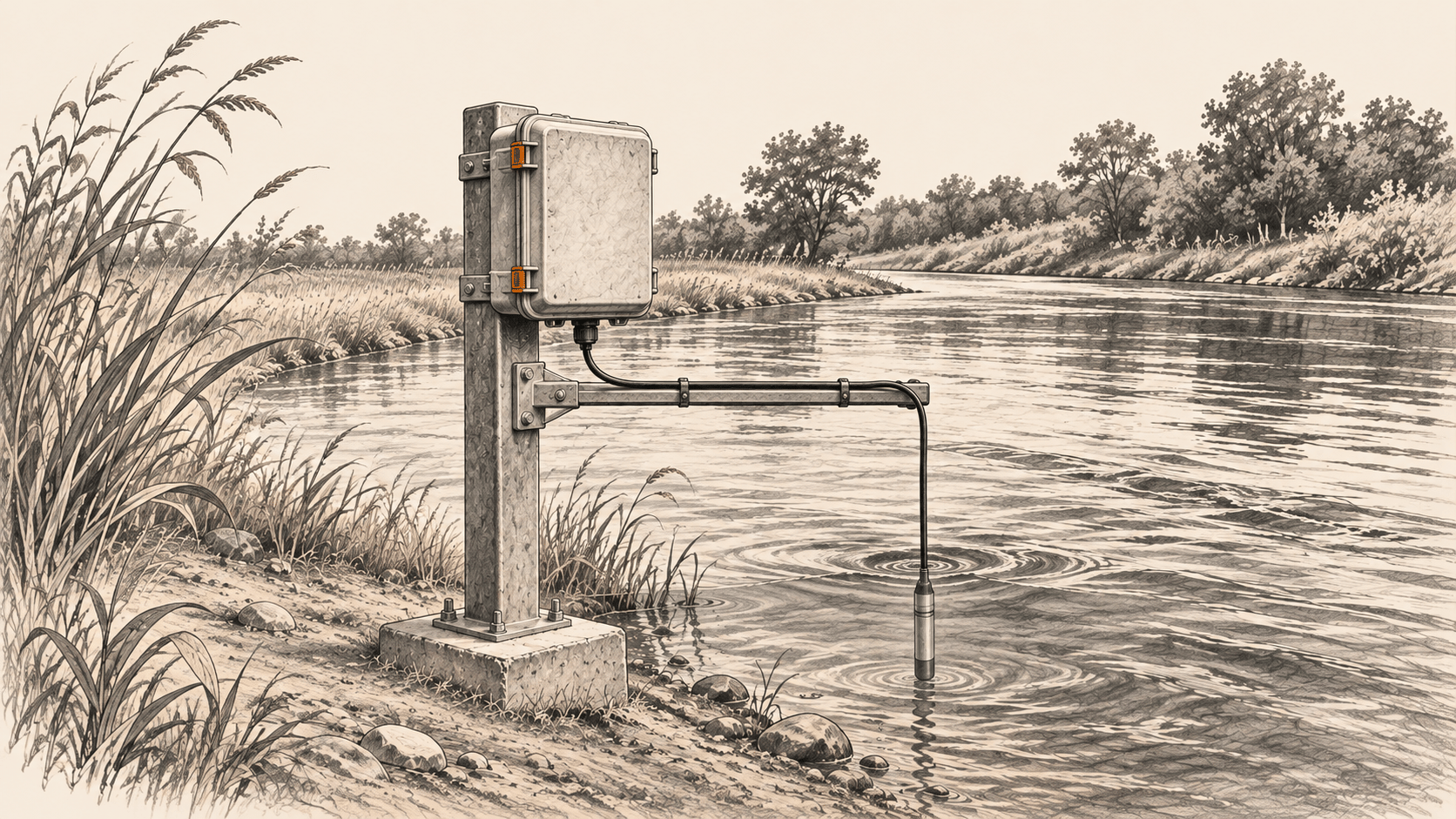
Krapkowice’s November 20 public notice says proceedings have begun, at MAGLY’s request, to determine the public-purpose siting of a WaterSense monitoring station on the Oder. It identifies a proposed location and installation. That is independent evidence of a local administrative step, not an installation certificate or proof that the river is now continuously covered.
A wider monitoring question
Poland’s Chief Inspectorate of Environmental Protection, GIOŚ, explains that its national programme uses fixed observation points, consistent time intervals and consistent methods. Its September account distinguishes ecological status—the functioning of a water ecosystem—from chemical status, concerning toxic substances.
For a river user, that makes the question more specific than whether a dashboard offers frequent updates. Measurements at comparable places and times help distinguish a sustained change from a short-lived local reading. GIOŚ also describes separate intervention monitoring of golden algae, introduced after the 2022 Oder crisis, with sample results and risk analysis published publicly.
The agency’s account establishes that an existing monitoring system is operating; it does not endorse WaterSense or evaluate its forecasts. For customers, the interview leaves forecast lead time separate from demonstrated benefits: Budny supplies no independently verified estimate of avoided losses.