THE WORLD IS NOT STANDING STILL.RSS
BIG CHANGE.
BIG CHANGE, one tap away

Make room for the big picture.

Add BIG CHANGE to your home screen or desktop. It opens in its own window, with the latest stories when you’re online.

iPhone & iPad
Open bigchange.ai in Safari. Tap Share, then Add to Home Screen. Turn on Open as Web App if shown, then tap Add.
Android
Open bigchange.ai in Chrome. In the browser menu, choose Install app or Add to Home screen.
Desktop
In Chrome or Edge, use the install icon in the address bar or the browser’s app menu. In Safari on Mac, choose File → Add to Dock.
All briefings

Follow the change ·

The day,
in perspective.

What happened in AI and robotics — and the change behind it. A reading path through 19 stories from BIG CHANGE.

Ordered using RADAR attention, story opens and likes. Excerpts from our published reporting; open a story for the full context and sources. Dates in UTC.

Follow-up story: news

Gemini 4 Argon reaches the paid API and Pro subscribers in the app

Google released Gemini 4 Argon through its paid API on October 13. AI Ultra subscribers can use it in Studio and Antigravity, while Pro and Ultra subscribers get app access; long-output settings and API costs have separate limits.

The big change

What changed: The model has moved from a restricted test to a stable, billed API release. Developers can now use a named endpoint and published limits to evaluate Argon in their own workflows; Google AI Pro subscribers get Argon in the Gemini app, but the Pro subscription does not include API or AI Studio access to this model.

Why it matters: The separate access paths affect both who can try Argon and what a test costs. A developer can budget tokens and choose an output limit, while an app subscriber can use the model without integrating an API. Google's robotics examples show possible uses but do not establish how reliably those systems work outside the reported demonstrations.

What to watch: Google's introductory API rates expire after November 30. Teams evaluating long outputs also need to decide whether background execution and its larger output budget fit their tasks; the default synchronous limit remains far below the shared million-token window.


Read the full story
—
Back to the briefing
Original story: analysis

Apple HomeView launch: dates, Siri AI access and costs

Apple announced HomeView, new home accessories, HomePod mini 2 and Apple TV 4K. Their sale dates, Siri AI access and device requirements differ.

The big change

What changed: Apple has put an AI-enabled, multiuser display at the center of a wider home hardware launch. HomeView can show camera feeds and control compatible accessories, while a paired Apple Intelligence-enabled iPhone or iPad adds Siri actions that use personal information.

Why it matters: Buying the display does not give every household member every Siri AI function. Device pairing, language, country, software version and, for some camera features, an iCloud+ plan determine what works.

What to watch: HomeView and the new Apple TV are due November 13, with Home Collection accessories starting in December. Apple's October 13 announcements describe intended behavior; BIG CHANGE has not tested the hardware or its privacy protections.

Read the full story
—
Back to the briefing
Original story: news

Naver Maps announces voice walking directions for AI glasses

Naver names Ray-Ban Meta and Oakley Meta as the first devices for voice walking navigation. Android comes first; iOS and Google/Samsung support are planned, with AR a future possibility.

The big change

Naver is extending its existing walking-navigation service to a wearable voice interface and adding spoken requests for local information. The useful change for Maps users is access to directions and route-related queries through glasses. The announced order puts Meta devices and Android first, while Google/Samsung hardware and iOS support remain later steps.

The evidence establishes the company's proposed interaction and compatibility sequence. It supplies no measurements of navigation accuracy, reduced phone use or safety outcomes, and does not describe camera-based obstacle recognition.

Naver also outlines a possible future experience for glasses with displays: augmented-reality routes, nearby store information and available Place coupons. It gives no delivery date for those visual features. They belong to its future plans, separate from the voice navigation announced on October 12.

Read the full story
—
Back to the briefing
Original story: news

New publishers join SPUR's AI content tracking coalition

Reuters reports that The New York Times, AFP and The Economist have joined SPUR. Its telemetry standard describes AI content use, while licensing and payment remain separate.

The big change

What changed: More publishers are participating in an effort to give AI content use a shared reporting format. SPUR's specification separates a page fetched by an agent from material that enters an answer's generation context, appears in a citation or reaches a user.

Why it matters: A publisher can see a request to its site, but that request alone cannot show whether its reporting shaped an AI answer. A participating agent's later events could give the publisher a more useful account for a licensing discussion, subject to what the operator records and agrees to share.

What to watch: SPUR says it is developing implementations and proofs of concept with industry partners. Their scope will show whether operators can produce useful reports beyond the published specification. The format leaves license terms and payments to separate agreements.

Read the full story
—
Back to the briefing
Original story: analysis

NVIDIA's OCP AI factory push spans MGX racks, DSX code and a facility spec

NVIDIA presented MGX 1.2 rack designs and four DSX software repositories at OCP. The cited facility specification predates the summit; partner designs and hardware support remain plans.

The big change

NVIDIA's OCP announcement brings together three different layers of an AI facility: an updated MGX rack architecture, public DSX software repositories, and an OCP facility design specification. The combination gives builders documents and code to assess against their own requirements. It does not establish that any particular Vera Rubin installation is running, or that the announced partner designs and future networking products are available to buy.

Read the full story
—
Back to the briefing
Original story: analysis

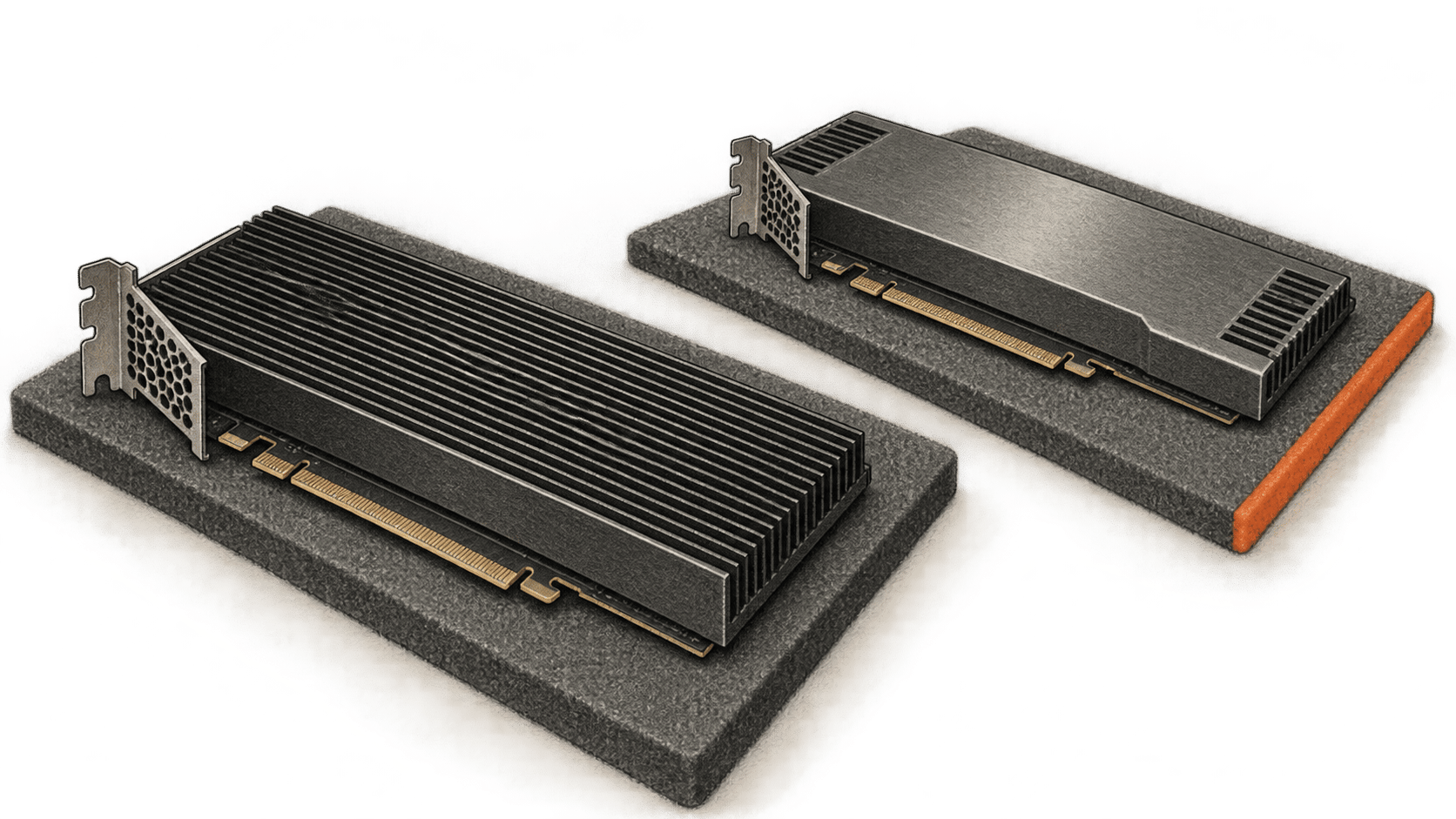
Intel D-series: 160 GB card, up to 480 GB partner designs

Intel says D-series customer sampling is underway. Its branded card has 160 GB of memory, while ODM designs can reach 480 GB; pricing and a general availability date remain undisclosed.

The big change

What changed: Intel disclosed D-series specifications and said customers are sampling the GPU. Its release distinguishes the 160 GB Intel-branded PCIe card from ODM-branded options that can reach 480 GB.

Why it matters: Memory capacity affects which models and inference workloads a system architect can evaluate on a card. Buyers need the exact vendor configuration before using Intel's upper-end capacity claim in a deployment plan.

What to watch: Intel has not supplied a general availability date or price in these sources. Product-level specifications, partner system details and independently measured results would make the sampling announcement more useful for procurement decisions.

Read the full story
—
Back to the briefing
Original story: analysis

EmbodiedCLBench finds no steady gain from extra examples

EmbodiedCLBench tests simulated household tasks. One example boosts advanced-task success in the authors' study, but additional examples bring no steady gain.

The big change

What changed: The researchers released a benchmark of 168 basic and 100 advanced household tasks designed to test whether agents can carry experience into unseen task combinations.

How it works: Agents first complete related basic tasks. They then choose actions from candidates in an offline state graph built from the TongSim household simulator. A task succeeds when the agent reaches its goal within a fixed step budget.

What the authors found: In the main comparison, access to two basic-task experiences improved advanced-task success across all eight tested harness and model pairings. In a narrower sample-count analysis, moving from zero to one experience helped substantially, while moving from one to six produced no consistent upward trend.

Read the full story
—
Back to the briefing
Follow-up story: analysis

Jev study: cheaper decisions, fewer mobile tasks completed

A 4,500-execution Jev study found cheaper agent decisions, but two mobile integrations completed fewer tasks and one spent more per success at the observed mean.

The big change

Jev’s reported decision savings survived at the task level most clearly where action selection dominated the work and completion stayed high. ReAct was cheaper and faster per delivered success. In the mobile integrations, other calls, environment time and lower completion narrowed or reversed parts of that benefit. For builders, the paper makes a concrete measurement case: compare completed tasks and resources across all attempts, then inspect recovery and stopping decisions. A per-call price or latency figure cannot answer whether a workflow delivered more useful work.

The study used text observations, bounded action choices, fixed task instances and three repetitions with a shared seed. Its cost figures use stated model prices and its own accounting rules. Visually grounded agents, longer workflows and new task distributions remain outside this evidence. The paper evaluates Jev in agent workflows; it does not test or validate SubQ Snap.

Read the full story
—
Back to the briefing